

This cheeseburger soup recipe started with a simple idea: some genius looked at a cheeseburger and thought, “What if this were a soup?” I don’t know who that person was, but I’d like to shake their hand. Because cheeseburger soup takes everything you love about a great burger — the savory beef, the melty cheese, the tangy pickles, the whole comfort-food package — and turns it into a thick, creamy, spoonable bowl of happiness. For safe ground beef handling, see the USDA Food Safety and Inspection Service.
If you’ve never had it, let me paint the picture: tender potatoes and deeply browned seasoned ground beef swimming in a rich, velvety cheddar broth, topped with all your favorite burger fixings — diced pickles, crispy bacon, extra cheese, fresh tomatoes. It tastes like a cheeseburger and fries had a delicious baby. Kids go absolutely feral for it. Adults pretend they’re making it “for the kids” and then quietly eat two bowls.
The best part? It’s a true one-pot weeknight dinner — 40 minutes start to finish, with ingredients you probably already have in your kitchen right now. No grill to heat, no patties to flip, no drive-thru line. Just
pure, unapologetic comfort in a bowl, with exactly one pot to wash when you’re done.
Why You’ll Love This Cheeseburger Soup Recipe
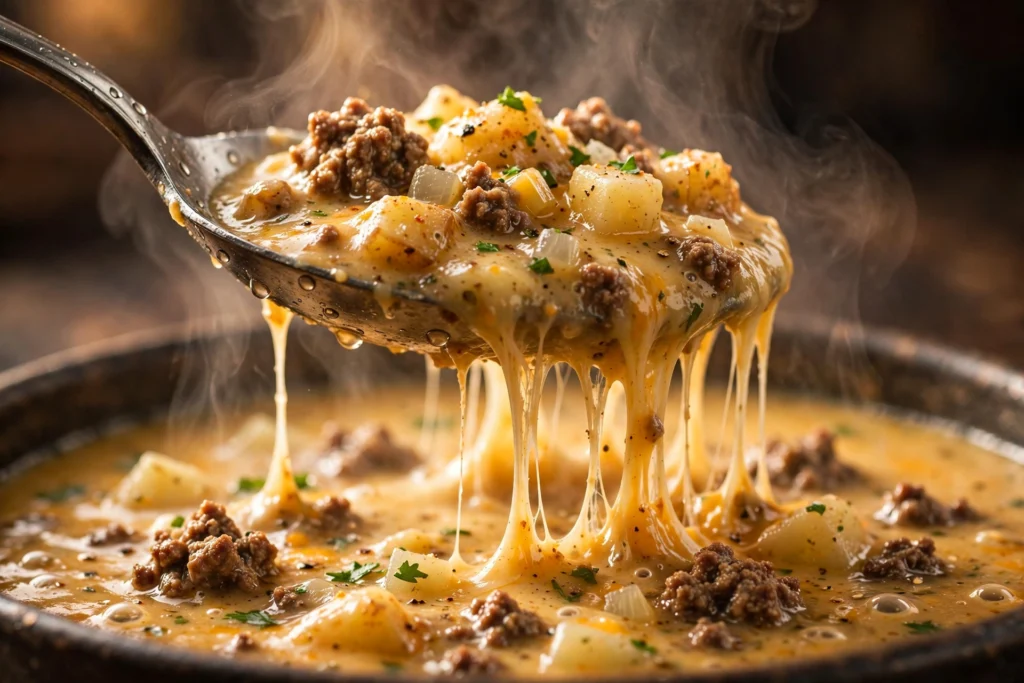
First, it tastes like a cheeseburger — but somehow better, because the format lets every flavor meld together. All the flavors you crave (beefy, cheesy, tangy pickles, savory onion) in a creamy, cozy, spoonable format. It’s familiar and surprising at the same time, which is exactly why it becomes an instant family favorite. The first spoonful gets a laugh; the second gets silence; the third gets “can you make this every week?”
Second, it’s a genuine one-pot wonder. Brown the beef, soften the veggies, build the broth, stir in the cheese — done. One pot to wash, one cutting board, one spoon. On a busy weeknight, when the sink is already full and everyone’s hungry, that matters almost as much as the taste. Minimal cleanup is a feature, not a footnote.
Third, it’s endlessly customizable. Bacon cheeseburger soup? Mushroom Swiss? Jalapeño popper style? Double cheeseburger with extra melt? The base recipe is a canvas — I’ll give you variations below that’ll keep this in your dinner rotation for months without anyone getting bored.
Finally, it’s a universal crowd-pleaser across all ages. Toddlers, teenagers, grandparents, picky eaters, adventurous eaters — I’ve never met anyone who didn’t love this soup. It’s the rare recipe that pleases the entire table without a single modification, which makes it invaluable for family dinners, potlucks, and feeding a mixed crowd.
The Secret to Great Cheeseburger Soup: Layering Burger Flavor
The difference between good cheeseburger soup and great cheeseburger soup comes down to one thing: building genuine burger flavor rather than just making cheese soup with beef in it. Anyone can melt cheese into broth. The trick is making it taste like a cheeseburger — and that requires layering.
Layer one is the beef. Deeply browned — not gray, not steamed, but properly caramelized with crispy edges. The Maillard reaction (the browning of proteins and sugars under heat) creates hundreds of flavor compounds that are the essence of “burger taste.” This is why we brown the beef first, undisturbed, before anything else goes in the pot.
Layer two is the tang. Real cheeseburgers have acidity — from pickles, mustard, sometimes ketchup. In the soup, Worcestershire sauce and yellow mustard provide that essential tangy backbone. Without them, you have rich cheese soup. With them, you have cheeseburger soup. It’s a small amount that makes an enormous difference.
Layer three is the toppings. A cheeseburger isn’t just the patty — it’s the whole assembly. Diced dill pickles for crunch and acid, crumbled bacon for smoke, fresh tomatoes for brightness, green onions for bite. These aren’t garnishes; they’re structural components of the burger experience. Don’t skip the toppings bar.

Ingredients for Cheeseburger Soup Recipe (And Why Each One Earns Its Place)
Ground beef (1 lb, 80/20) — Don’t go too lean here; the fat carries flavor and contributes richness to the broth. 80/20 is the classic burger blend for a reason — it’s the ratio that tastes like a real cheeseburger.
Brown it well and deeply — those crispy browned bits are concentrated flavor gold. If you use leaner beef, the soup will still work but taste less burger-like.
Russet potatoes (3 medium, diced in ½-inch cubes) — Russets are the right choice because their high starch content means they break down slightly during simmering, naturally thickening the soup while still keeping enough structure to bite. Cut them in uniform ½-inch dice so they all cook through in the same time. Uneven pieces mean some turn to mush while others are still crunchy.
Yellow onion (1 large, diced) + carrots (2, diced) + celery (2 stalks, diced) — The classic mirepoix, the aromatic foundation of countless soups. They build a savory vegetable base that makes this taste like more than just melted cheese — it gives the soup depth and complexity. Dice them all roughly the same size for even cooking.
Garlic (3 cloves, minced) — Added after the vegetables have softened, so it doesn’t burn and turn bitter. One minute is enough to take the raw edge off while keeping the flavor bright.
Chicken broth (4 cups, low-sodium) — The cooking liquid that becomes the soup’s body. Low-sodium is important because the cheese, Worcestershire, bacon toppings, and other ingredients all contribute salt — you want to control the final seasoning yourself. Regular broth can make the finished soup oversalted.
Whole milk (2 cups) — For creaminess and body. Whole milk gives the best rich texture; 2% works but the soup will be noticeably thinner. Don’t use skim — there’s not enough fat to create the creamy mouthfeel. The milk goes in after the simmering, off high heat, to prevent curdling.
All-purpose flour (⅓ cup) — The thickener. Cooked with the butter and vegetables, it creates a roux-like base that gives the soup body and — critically — keeps the cheese sauce smooth and emulsified instead of greasy and separated. This is what separates restaurant-quality cheese soup from the broken, oily kind.
Butter (3 tablespoons) — For sautéing the vegetables and building the roux with the flour. The butterfat also contributes to the rich mouthfeel. Unsalted is preferred so you control the salt level.
Sharp cheddar (2 cups, freshly shredded from a block) — THE cheese, and the shredding matters enormously. Sharp cheddar gives real, assertive cheese flavor; mild cheddar disappears into the background. And you must shred it yourself — pre-shredded bagged cheese is coated with cellulose and potato starch (anti-caking agents) that prevent smooth melting, giving you grainy soup. A box grater and three minutes is all it takes, and the difference is night and day.
Cream cheese (4 oz, softened to room temperature) — The secret weapon. It melts into the broth and makes it luxuriously smooth and velvety, while adding a subtle tangy depth. It also acts as an emulsifier, helping the cheddar incorporate smoothly. Trust me on this — it’s the ingredient that makes people ask “what makes this so creamy?”
Worcestershire sauce (1 tablespoon) + yellow mustard (1 tablespoon) — The burger flavor duo. They add that unmistakable tangy, savory cheeseburger character. Don’t skip either one — together they’re greater than the sum of their parts. The mustard should be classic yellow (not Dijon, not spicy brown) for authentic burger joint flavor.
Salt (1 teaspoon) + black pepper (½ teaspoon) + smoked paprika (½ teaspoon) — Seasoning that makes it taste like a great burger rather than just cheese soup. The smoked paprika adds a subtle smokiness that echoes grilled burger flavor. Start with these amounts and adjust at the end after tasting.
For the toppings bar: diced dill pickles, crumbled cooked bacon, extra shredded cheddar, diced fresh tomatoes, sliced green onions. Set these out in small bowls and let everyone customize. The toppings aren’t optional garnish — they’re essential to the cheeseburger experience.
Equipment You’ll Need
A large Dutch oven or heavy-bottomed soup pot (5–6 quart capacity) is ideal. The heavy base distributes heat evenly, preventing scorching on the bottom — critical when you’re working with dairy. A wooden spoon for stirring (it won’t scratch the pot and gives you good leverage for the roux). A box grater for the cheese (non-negotiable, as discussed). A ladle for serving. That’s the complete list — true one-pot cooking with no special equipment.
If you don’t have a Dutch oven, any heavy soup pot works. Thin-bottomed pots are the enemy here — they create hot spots that can scorch the flour roux or split the cheese sauce. If a thin pot is all you have, keep the heat lower and stir more frequently.
How to Make Cheeseburger Soup (Step by Step)
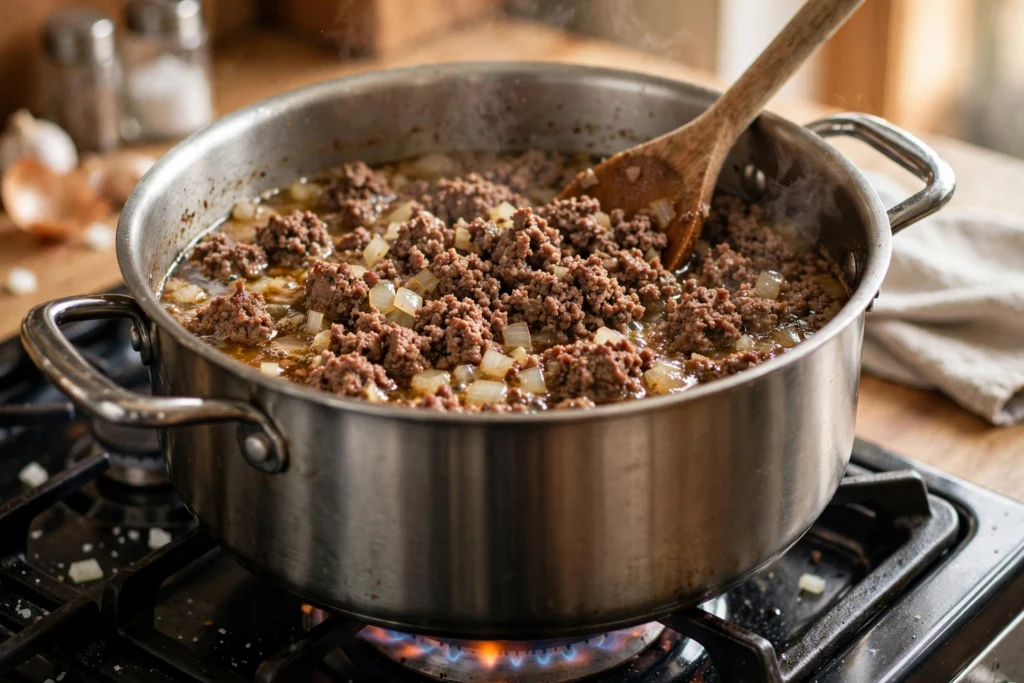


Step 1 — Brown the beef properly. Place your pot over medium-high heat. Add the ground beef, breaking it into large chunks. Now here’s the key: leave it alone for 3-4 minutes without touching it. Let it develop a deep brown crust on the bottom. Then break it into crumbles and continue cooking 3-4 more minutes until deeply browned all over — 6–8 minutes total. Don’t rush this; brown equals flavor, gray equals disappointment. Drain off the excess fat (leave about a tablespoon for flavor), and transfer the beef to a plate. Place your pot over medium-high heat. Add the ground beef, breaking it into large chunks. Now here’s the key: leave it alone for 3-4 minutes without touching it. Let it develop a deep brown crust on the bottom. Then break it into crumbles and continue cooking 3-4 more minutes until deeply browned all over — 6–8 minutes total. Don’t rush this; brown equals flavor, gray equals disappointment. Drain off the excess fat (leave about a tablespoon for flavor), and transfer the beef to a plate.
Step 2 — Soften the vegetables. Reduce heat to medium. In the same pot (don’t clean it — those browned bits are flavor), melt the butter. Add the diced onion, carrots, and celery. Cook, stirring occasionally, for 6–8 minutes until softened and the onion is translucent. Add the minced garlic and cook 1 minute more until fragrant. The vegetables should be tender but not browned.
Step 3 — Make the roux. Sprinkle the flour evenly over the vegetables. Stir constantly for 2 full minutes. The mixture will look pasty and thick — that’s exactly right. This step cooks out the raw flour taste and creates the thickening base. Don’t skip the full 2 minutes; raw flour makes the soup taste pasty. The mixture should smell slightly nutty when done.
Step 4 — Add liquids gradually. This step prevents lumps: pour in about a cup of the chicken broth while whisking constantly. The mixture will seize up and look terrible — keep whisking and it smooths out. Gradually add the remaining broth, whisking as you go. Then add the diced potatoes, Worcestershire sauce, mustard, salt, pepper, and smoked paprika. Stir well. Bring to a boil, then reduce to a steady simmer.
Step 5 — Simmer until the potatoes are tender. Simmer for 12–15 minutes, stirring occasionally to prevent sticking, until the potatoes are completely fork-tender. Test the largest piece — it should break apart easily when pressed. Return the browned beef to the pot and stir to combine. The soup should already look hearty and smell incredible.
Step 6 — Make it creamy (low heat is critical). Reduce the heat to LOW — this is the most important temperature instruction in the recipe. Once dairy goes in, the soup should never boil again; boiling causes cheese to separate into a greasy, curdled mess. Stir in the milk, then add the softened cream cheese in chunks, stirring until completely melted and smooth. Now add the shredded cheddar a handful at a time, stirring constantly and waiting until each handful is fully melted before adding the next. This gradual addition is what creates a silky, emulsified cheese sauce rather than a stringy one. Taste and adjust salt and pepper.
Step 7 — Top and serve immediately. Ladle into warm bowls (cold bowls cool the soup too fast). Set out the toppings bar and let everyone go wild: diced pickles, crumbled bacon, extra cheddar, diced tomatoes, sliced green onions. Serve immediately while it’s gloriously hot and melty. This soup waits for no one — the cheese is at its silkiest right now.
My Best Tips for the Best Cheeseburger Soup

Shred your own cheese — I’m saying it twice because it matters twice. Bagged pre-shredded cheese contains cellulose powder that prevents the shreds from clumping in the bag — and also prevents them from melting smoothly in your soup. The result is grainy, slightly gritty texture. A block of sharp cheddar and three minutes with a box grater changes everything. This is the single highest-impact tip in the recipe.
Low heat for dairy, no exceptions. Once the milk and cheese go in, the soup stays at a bare simmer — never a rolling boil. High heat causes the proteins in dairy to tighten and squeeze out fat, creating that broken, greasy, curdled appearance. If you see it starting to bubble vigorously, pull it off the heat immediately and stir. Patience here equals silky soup.
Brown the beef like you mean it. Gray, steamed beef tastes like nothing. The difference between crowded, steamed gray beef and properly browned beef is the difference between bland soup and burger-flavored soup. Give the beef space in the pot, don’t touch it for the first few minutes, and let the Maillard reaction work its magic. Those dark brown crispy bits are pure flavor.
Dice potatoes uniformly. This takes an extra two minutes and pays off enormously. Uneven potatoes mean some pieces turn to mush while others are still hard and crunchy. Aim for consistent ½-inch dice. Your spoon — and your eaters — will thank you.
Taste before adding more salt. Between the chicken broth, cheddar cheese, Worcestershire sauce, bacon toppings, and pickles, there’s a LOT of salt already in play. Always taste the finished soup before reaching for the salt shaker. You may find it needs nothing at all, or just a pinch of black pepper.
Expect it to thicken — plan for it. The soup thickens considerably as it sits, and leftovers will be very thick (almost stew-like). This is normal and not a flaw. When reheating, stir in a splash of chicken broth or milk to bring it back to soup consistency. Make a little extra broth available for this purpose.
Warm your bowls. Run them under hot water for a minute, then dry. Cheese soup served in a cold bowl drops temperature fast, and lukewarm cheese soup is a shadow of its hot self. It’s a small restaurant trick that makes a real difference.
Troubleshooting: Fixing Common Problems
Soup is grainy: Almost always caused by pre-shredded cheese (see above) or by boiling after the cheese was added. Unfortunately, you can’t fully fix grainy soup — but you can improve it by blending a portion with an immersion blender, which smooths the texture considerably.
Cheese sauce separated/broke: The heat was too high when the cheese went in. Remove from heat immediately, and whisk vigorously — sometimes it comes back together. Adding a splash of cold milk while whisking can help re-emulsify. Next time, keep it at the barest simmer.
Soup is too thin: It may just need more simmering time — let it bubble gently (before the dairy goes in) for 5-10 more minutes. Or mash some of the potato chunks against the side of the pot with your spoon; the released starch thickens naturally. As a last resort, stir in a cornstarch slurry (1 tablespoon cornstarch mixed with 2 tablespoons cold water).
Soup is bland: It almost certainly needs more of the burger tang — add another teaspoon each of Worcestershire and mustard. Also check salt level. And make sure you’re serving it with the toppings; the pickles and bacon contribute enormous flavor.
Potatoes are still hard: They were cut too large, or the simmer wasn’t vigorous enough. Keep simmering until tender — there’s no rescuing undercooked potatoes except more time. Next time, cut smaller and verify your simmer is actually bubbling gently.
Delicious Variations to Try (The Never-Ending Rotation)
Bacon cheeseburger deluxe: Cook 6 slices of bacon until crisp, crumble, and add half to the soup with the beef, reserving half for topping. The smoky crunch permeates the whole pot. This is the most popular variation by far.
Mushroom Swiss: Swap the cheddar for shredded Swiss cheese, and add 8 ounces of sliced mushrooms along with the other vegetables. Earthy, rich, and sophisticated — the grown-up version.
Jalapeño popper: Add 2 diced jalapeños (seeds removed for mild, kept for wild) with the vegetables, and swap half the cheddar for pepper jack cheese. Top with extra diced jalapeños, bacon crumbles, and a dollop of sour cream. Spicy, creamy, addictive.
Double cheeseburger (maximum melt): Stir in ½ cup of Velveeta-style processed cheese along with the cheddar. I know, I know — but processed cheese melts more smoothly than any natural cheese, and in this application, it’s genuinely better. No judgment here; it works.
Turkey cheeseburger (lighter): Substitute ground turkey for the beef, use 2% milk instead of whole, and skip the cream cheese. You’ll lose some richness but keep all the essential flavor. Still delicious, noticeably lighter — great for weeknights when you want comfort without heaviness.
Loaded baked potato crossover: Skip the burger toppings and go potato-style instead: sour cream, shredded cheddar, chives, and bacon bits. It eats like the love child of cheeseburger soup and loaded baked potato soup, and it’s magnificent.
Chili-cheeseburger mashup: Add a can of drained kidney beans and a tablespoon of chili powder with the broth. Top with the burger fixings plus a dollop of sour cream. Two comfort classics in one bowl.
Storing, Freezing & Reheating (Complete Guide)
Refrigerator: Keeps 4 days in an airtight container. It will thicken considerably in the fridge — this is normal. The flavors actually meld and improve overnight; many people think it’s better on day two.
Freezer: Up to 3 months, but with an important caveat: dairy-based soups can separate slightly when thawed. It will still taste great, but the texture may be slightly less silky. Pro tip: if you plan to freeze, make the soup through Step 5 (before adding dairy), freeze that base, then add fresh milk and cheese when reheating. The result is indistinguishable from fresh.
Reheating: Low and slow on the stovetop is best. Place in a pot over medium-low heat, stirring frequently, with a splash of chicken broth or milk to loosen it back to soup consistency. Avoid the microwave if possible — it heats unevenly and the hot spots can cause the cheese to split. If you must microwave, use 50% power in short intervals, stirring between each.
Make-ahead for parties: This soup is ideal party food. Make it completely (through Step 6) up to 2 days ahead, refrigerate, and reheat gently before guests arrive. Transfer to a slow cooker on WARM (not LOW, which can overcook the dairy) for serving. Set out the toppings bar and let people serve themselves.
What to Serve with Cheeseburger Soup
The obvious and perfect pairing: grilled cheese sandwiches for dipping. A buttery, crispy grilled cheese dunked in cheeseburger soup is one of life’s great combinations — it’s like a hug in meal form. Use sharp cheddar or American for maximum melt.
Other excellent companions: soft pretzel bites with cheese dip (double down on the cheese), a crusty baguette for sopping up every last drop, a simple green salad with vinaigrette to cut through the richness, or — my personal favorite and the most fun — a handful of crispy french fries scattered right on top of each bowl, completing the full burger-and-fries experience in soup form.
For drinks: a cold lager or pilsner is the classic burger pairing and works beautifully here. For kids (and the young at heart), chocolate milkshakes turn dinner into an event. Iced tea with lemon is a refreshing counterpoint to the richness.
Troubleshooting: Fixing Common Cheeseburger Soup Problems
Even straightforward recipes have failure points. Here’s how to diagnose and fix the most common cheeseburger soup issues, so your first batch tastes like your tenth.
Problem: The cheese turned grainy or gritty. This is the number one complaint, and it’s almost always one of two causes. First, pre-shredded bagged cheese — the cellulose and potato starch coating that keeps shreds from clumping also prevents smooth melting. The fix is prevention: always shred from a block. Second, heat too high when adding cheese. Dairy proteins tighten and squeeze out fat when boiled, creating that grainy, separated texture. The cheese must go in off the boil, over low heat, a handful at a time, stirring until each addition melts before adding the next. If it’s already grainy, try whisking in a splash of warm milk and a slice of American cheese (the emulsifying salts in processed cheese can rescue a broken sauce). It won’t be perfect, but it will be significantly better.
Problem: The soup is too thin. Several possibilities. The potatoes may have been cut too large (less surface area = less starch released), or the simmer time was too short. Fix it by simmering uncovered for 5-10 more minutes, mashing some potato chunks against the side of the pot with your spoon, or stirring in a cornstarch slurry (1 tablespoon cornstarch whisked into 2 tablespoons cold water, then stirred into the simmering soup). For future batches, make sure the flour roux cooks a full 2 minutes — raw flour doesn’t thicken properly — and don’t skip the russets, whose starch is doing quiet thickening work.
Problem: The soup is too thick — more like mashed potatoes than soup. This usually means too many potatoes or too long a simmer. Thin it with warm chicken broth, a half-cup at a time, until it reaches the consistency you want. Remember it thickens further as it cools and in the fridge, so aim for slightly thinner than your ideal serving consistency.
Problem: It tastes flat or one-dimensionally cheesy. You’re missing the burger layers. Add a teaspoon of yellow mustard, a splash of Worcestershire, or a tablespoon of pickle juice — that acidic tang is what separates cheeseburger soup from generic cheese soup. Taste after each addition. Also check your salt: dairy-rich soups need assertive seasoning, and under-salting is the most common reason a rich soup tastes boring rather than luxurious.
Problem: The milk curdled. The milk went into too-hot soup, or the soup boiled after dairy was added. Always reduce to LOW before adding milk, and never let it boil afterward. If it’s already curdled, the texture won’t fully recover, but blending a portion smooth with an immersion blender can even it out considerably.
Ingredient Substitutions & Dietary Adaptations
Real life means working with what’s in the fridge and who’s at the table. Here’s how to adapt without losing the soul of the dish.
Ground meat swaps: Ground turkey (93/7) works well for a lighter version — brown it just as aggressively for flavor, and add an extra tablespoon of butter since turkey is leaner. Ground chicken is fine too. For a richer, more indulgent version, use half ground beef and half ground pork, or even ground brisket if your butcher carries it. Plant-based ground “beef” crumbles work surprisingly well here because the cheese and seasonings carry the burger flavor; brown them hard for the best texture.
Dairy-free version: This is the hardest adaptation because cheese is structural, not just flavor. Use a high-quality melting vegan cheddar (the kind formulated for sauces, not slices), unsweetened oat milk or cashew milk for the liquid, vegan butter for the roux, and vegan cream cheese. The result won’t fool a cheese purist, but it’s genuinely good comfort food in its own right. Nutritional yeast (2-3 tablespoons) added with the vegan cheese deepens the cheesy flavor significantly.
Gluten-free: Replace the all-purpose flour roux with 3 tablespoons of cornstarch mixed into 1/4 cup of cold broth, stirred in during the last 5 minutes of simmering. Or use a gluten-free flour blend 1:1 for the roux — it behaves nearly identically. Double-check your Worcestershire sauce label (some brands contain gluten) and your broth.
Lower-carb / keto: Skip the potatoes entirely and replace with 3 cups of cauliflower florets (simmer until tender, about 10 minutes) or diced turnips. Use heavy cream instead of milk. The soup will be slightly less thick, but the cauliflower breaks down enough to give body. This version is rich, satisfying, and genuinely keto-friendly.
Vegetable upgrades: The base recipe is deliberately simple, but you can absolutely load it up. Diced bell peppers, mushrooms, corn, or green beans all work — add hardy vegetables with the mirepoix, quick-cooking ones in the last 10 minutes of simmering. Just don’t add so much that it stops being cheeseburger soup and becomes vegetable soup with cheese.
Meal Prep & Batch Cooking Strategy
Cheeseburger soup is a meal-prep champion, but dairy soups need a specific strategy to reheat well. Here’s the system.
The two-stage method (best quality): Make the soup base through Step 5 (beef browned, vegetables softened, broth and potatoes simmered, beef returned) — but stop before adding any dairy. Cool this base quickly, portion into containers, and refrigerate up to 4 days or freeze up to 3 months. When ready to serve, reheat the base to a bare simmer, then proceed with Step 6 (milk, cream cheese, cheddar) fresh. The cheese melts perfectly every time because it’s never been reheated, and the texture is indistinguishable from a fresh batch. This is how I do it for weekly meal prep, and it’s foolproof.
Portioning: This recipe makes about 8 hearty servings (roughly 1.5 cups each). For lunches, portion into individual containers so you can grab one and go. Leave the toppings separate — pack pickles, bacon, and extra cheese in small containers or bags so they stay crisp and fresh rather than getting soggy in the soup.
Freezer logistics: Freeze the dairy-free base in flat zip-top bags (they thaw faster and stack neatly) or rigid containers with headspace. Label with the date and “add dairy when reheating.” Thaw overnight in the fridge, never on the counter. A full batch frozen as base plus fresh dairy on serving day tastes like you made it that afternoon.
The Toppings Bar: Turning Dinner into an Event
Here’s what elevates cheeseburger soup from a good dinner to a memorable one: treat the toppings as the main event, not an afterthought. Set up a toppings bar and let everyone build their own bowl. It turns a weeknight meal into something fun, it accommodates picky eaters without extra cooking, and it makes the soup feel like a burger joint experience.
The essentials (don’t skip these): Diced dill pickles — the single most important topping, providing the acidic crunch that screams cheeseburger. Crumbled crispy bacon. Extra shredded sharp cheddar. These three are non-negotiable; they deliver the core burger experience.
The upgrades: Diced fresh tomatoes for brightness. Thinly sliced green onions or chives for bite. A drizzle of yellow mustard or burger sauce. Crispy fried onions (the canned kind) for crunch. Diced avocado for creaminess. Pickled jalapeños for heat. A handful of crushed potato chips or french fries on top for the full burger-and-fries experience in one bowl.
For a crowd: Put the soup in a slow cooker on WARM (not LOW — too hot for the dairy over hours), arrange toppings in small bowls with spoons, and put out a stack of bowls. Add a side of grilled cheese cut into dippers. This setup feeds 12-15 people from a doubled batch with almost no active hosting work — the soup holds beautifully for 2 hours on warm, and guests serve themselves.
Final Thoughts
Cheeseburger soup is one of those recipes that sounds like a novelty and eats like a staple. The first time I made it, I expected a fun one-time experiment; I didn’t expect it to become one of my most-requested dinners, the recipe friends ask for, the thing my kids mention to their friends. But here we are — it’s in the regular rotation, there’s never a drop left, and I’ve made it enough times to have strong opinions about cheese shredding.
That’s the thing about great comfort food: it doesn’t need to be fancy or innovative. It needs to be the thing you crave on a cold night, the thing that makes the whole house smell amazing, the thing that gets everyone to the table fast without being called twice. This soup is all of that, in one pot, in 40 minutes, with ingredients from a normal grocery run.
So grab your biggest spoon and shred that cheese by hand. Burger night just got a whole lot cozier. For more cozy dinner ideas, browse our full recipe collection — you’ll find plenty of hearty dinner recipes to add to your rotation, all here at Cookbook Bite.

Creamy Cheeseburger Soup
Ingredients
Equipment
Method
- Brown the beef properly. Place a large Dutch oven or heavy-bottomed soup pot over medium-high heat. Add the ground beef, breaking it into small crumbles with a wooden spoon. Cook, stirring occasionally, until deeply browned with crispy edges, 6–8 minutes. Do not rush this step — the browning is where the burger flavour comes from. Drain off excess fat, leaving about a tablespoon in the pot.
- Soften the vegetables. Reduce the heat to medium. In the same pot (do not clean it — those browned bits are flavour), melt the butter. Add the onion, carrots, and celery; cook, stirring often, until softened, 5–6 minutes. Stir in the garlic and cook 1 minute more, until fragrant.
- Make the roux. Sprinkle the flour evenly over the vegetables. Stir constantly for 2 full minutes. The mixture will look pasty and turn lightly golden — this cooks out the raw flour taste and gives the soup its body.
- Add the liquids gradually. Pour in about a cup of the chicken broth while whisking constantly to dissolve the roux smoothly. Once smooth, whisk in the remaining broth and the milk. Stir in the diced potatoes, Worcestershire sauce, mustard, salt, pepper, and smoked paprika.
- Simmer until the potatoes are tender. Bring to a gentle simmer (not a boil) and cook 12–15 minutes, stirring occasionally to prevent sticking, until the potatoes are completely tender when pierced with a fork.
- Make it creamy — low heat is critical. Reduce the heat to LOW. Stir in the softened cream cheese until melted and smooth, then add the shredded cheddar a handful at a time, stirring until each addition melts before adding the next. Taste and adjust the seasoning. Keep the soup at a bare simmer from here — never let it boil once the dairy is in.
- Top and serve immediately. Ladle into warm bowls. Set out the toppings bar — diced dill pickles, crumbled bacon, extra cheddar, diced tomatoes, sliced green onions — and let everyone build their own burger bowl. Serve right away.
What is cheeseburger soup?
Cheeseburger soup is a creamy, one-pot soup that captures all the flavours of a classic cheeseburger: deeply browned ground beef, tender potatoes, and a velvety sharp-cheddar broth with burger-style tang from Worcestershire sauce and yellow mustard, finished with a toppings bar of pickles, bacon, and extra cheese.
Can I make cheeseburger soup ahead of time?
Yes — it is ideal party food. Make it completely through adding the cheese (Step 6) up to 2 days ahead, refrigerate in an airtight container, and reheat gently on the stovetop. Set out fresh toppings just before serving.
How do I store leftover cheeseburger soup?
Refrigerate leftovers in an airtight container for up to 4 days. The soup thickens considerably as it sits — this is normal. Reheat low and slow on the stovetop, thinning with a splash of warm chicken broth.
Can I freeze cheeseburger soup?
You can freeze it for up to 3 months, but dairy-based soups can separate slightly when thawed. For the best texture, freeze the soup base before adding the milk and cheese, then finish with fresh dairy when reheating.
Why is my cheeseburger soup grainy?
Graininess is almost always caused by pre-shredded bagged cheese (the anti-caking starch prevents smooth melting) or by boiling the soup after the cheese was added. Always shred cheese from a block and keep the heat at a bare simmer once dairy goes in.
Why did my cheese sauce separate or break?
The heat was too high when the cheese went in. Remove the pot from the heat immediately and whisk vigorously — it will often come back together. To prevent it, reduce to LOW before adding any dairy and never let the soup boil.
What is the best cheese for cheeseburger soup?
Sharp cheddar, freshly shredded from a block. Sharp cheddar gives real, assertive cheese flavour that stands up to the beef and potatoes. Avoid pre-shredded cheese, which contains starches that make the soup grainy.
Can I make cheeseburger soup in a slow cooker?
This recipe is designed for the stovetop, where you can brown the beef properly and control the heat for the dairy. For serving a crowd, transfer the finished soup to a slow cooker set to WARM (not LOW — too hot for the dairy over hours) and arrange the toppings alongside.
Can I use ground turkey instead of ground beef?
Yes. Ground turkey (93/7) works well for a lighter version — brown it just as aggressively for flavour. You can also use 2% milk instead of whole and skip the cream cheese.
Is cheeseburger soup gluten-free?
As written, no, because of the flour roux. To make it gluten-free, replace the all-purpose flour with 3 tablespoons of cornstarch mixed into 1/4 cup of cold broth, and add it with the liquids in Step 4.
How do I thicken (or thin) cheeseburger soup?
If the soup is too thin, let it simmer a little longer before the dairy goes in. If it is too thick, thin it with warm chicken broth, a half-cup at a time, until it reaches the consistency you like. Note the soup thickens considerably as it stands.
What should I serve with cheeseburger soup?
The classic pairing is grilled cheese sandwiches for dipping. Soft pretzel bites, crusty bread, or a simple green salad also work well. For drinks, a cold lager or pilsner complements the burger flavours.

Hi, I’m Angela. I cook the way busy people actually cook — simple, tasty food with ingredients you already have. On CookBookBite I share easy recipes, honest kitchen tips, and dishes my family asks for again and again.