
Chicken noodle soup is one of the most cooked dishes in the world, and for good reason. It is warming, gentle, and filling without being heavy. It uses inexpensive ingredients, comes together in about an hour, and suits almost every occasion, from a weeknight supper to a meal for someone feeling unwell. Yet for all its simplicity, chicken noodle soup is easy to get slightly wrong. Noodles turn mushy, chicken dries out, and the broth tastes thin rather than rich. This chicken noodle soup guide explains how to avoid each of those problems, with a clear method, a full explanation of the ingredients, and a complete recipe card at the end.
Why Chicken Noodle Soup Works
The appeal of chicken noodle soup rests on a balance of four elements. The broth provides warmth and savoriness. The chicken provides protein and substance. The noodles provide comfort and body. The vegetables provide sweetness, color, and texture. When any one element is missing or poorly handled, the soup feels incomplete. A broth without depth tastes like hot water. Chicken cooked too long becomes stringy. Noodles cooked too long dissolve into starch. Vegetables cooked to mush add nothing. Getting all four right at the same time is the whole craft of the dish, and it is entirely achievable with attention to timing.
The soup’s reputation as a comfort food is not accidental. Warm broth, gentle flavors, and soft textures are easy to eat and easy to digest, which is why the soup is traditionally served to people who are ill or tired. The steam from a hot bowl clears the senses, the salt in the broth replaces what the body loses, and the combination of protein and carbohydrates provides steady energy. None of this requires exotic ingredients or complicated technique. It requires good stock, properly cooked chicken, noodles added at the right moment, and seasoning adjusted at the end.
Also Read: Puff Pastry Recipe: How to Make Flaky, Buttery, Homemade Puff Pastry from Scratch
The Broth: The Foundation of the Soup
Broth is the most important part of chicken noodle soup, and it deserves the most attention. A good broth is clear or lightly golden, savory, and full-flavored without being greasy. It can be made from scratch by simmering a whole chicken or bone-in pieces with vegetables, or it can be built from good-quality store-bought stock with a few additions. Both approaches work, and the method in this guide uses bone-in chicken thighs simmered directly in the soup pot, which produces a fresh broth and tender chicken in a single step.
Starting with cold water matters. When chicken is added to cold water and brought slowly to a simmer, the proteins release gradually and the broth stays clearer. Adding chicken to already boiling water shocks the proteins and produces more scum and a cloudier broth. The water should be brought to a gentle simmer, not a rolling boil, and kept there. A vigorous boil emulsifies fat into the broth and makes it greasy and cloudy. A gentle simmer, with only occasional bubbles breaking the surface, extracts flavor while keeping the broth clean.
Skimming is worth doing in the first twenty minutes. As the chicken heats, foam and impurities rise to the surface. Skimming them off with a spoon or a fine-mesh skimmer keeps the broth clear and prevents off flavors. After the first twenty minutes, skimming is rarely needed. The vegetables added at the start also contribute to the broth. Onion, carrot, and celery, the classic mirepoix, release sweetness and savory depth as they simmer. They should be added in large pieces at the beginning so they can cook for the full time without disintegrating, and they can be replaced with fresh vegetables later if a more distinct vegetable texture is wanted in the finished soup.
Seasoning the broth should happen in stages. Salt added at the beginning helps draw flavor from the chicken and vegetables, but the final seasoning must be adjusted at the end, after the noodles and chicken are in, because noodles absorb salt and the broth concentrates slightly as it simmers. Tasting the broth before serving and adjusting salt, and sometimes a squeeze of lemon juice, is the final step that separates a good soup from a great one. A small amount of acid brightens the broth without making it taste sour, and it is one of the most useful finishing touches in soup-making. Also Read: Sourdough Pizza Crust Recipe

Ingredients Explained
Chicken thighs are the best choice for this soup. Bone-in, skin-on thighs stay moist during simmering, and the bones and skin add body and richness to the broth. Boneless, skinless chicken breasts are leaner and cook faster, but they dry out more easily and contribute less to the broth. If breasts are preferred, they should be added later in the cooking time and removed as soon as they are cooked through. A whole chicken is the traditional choice and produces the richest broth, but it requires more handling to break down after cooking. For a weeknight soup, bone-in thighs offer the best balance of flavor, convenience, and reliability.
Egg noodles are the classic noodle for chicken noodle soup. They are made with egg, which gives them a rich color and a tender, slightly chewy texture that holds up in broth better than plain pasta. Wide egg noodles are traditional, but medium or narrow noodles also work. The key is to cook the noodles in the soup for only as long as the package directs, and to serve the soup promptly, because noodles continue to absorb broth after cooking. For soup that will be stored or reheated, the noodles should be cooked separately and added to each bowl at serving time, which prevents them from swelling and turning the soup starchy.
Carrots, celery, and onion form the aromatic base. Carrots add sweetness and color. Celery adds a fresh, slightly peppery note. Onion adds savory depth. They should be cut into even pieces so they cook at the same rate. Slicing carrots into coins and celery into half-moons gives a classic appearance and a pleasant bite. Dicing the vegetables smaller makes them blend into the soup more, which suits a smoother style. Either cut works, as long as the pieces are uniform.

Garlic adds warmth and depth. It should be added after the onion has softened, because garlic burns faster than onion and turns bitter when overcooked. Fresh herbs make a significant difference. Thyme, bay leaves, and parsley are the classic trio for chicken soup. Thyme adds an earthy, slightly floral note. Bay leaves add a subtle background depth. Parsley, added at the end, adds freshness and color. Dried thyme and bay leaves are fine for the simmering stage, but fresh parsley at the end is worth using, because dried parsley contributes little flavor.
Fat and seasoning complete the picture. A tablespoon of butter or olive oil for sweating the vegetables adds richness and helps carry flavor. Salt is essential and should be adjusted at the end. Black pepper adds gentle warmth. A pinch of turmeric is sometimes added for color, giving the broth a golden hue, though it changes the flavor slightly and is optional. Lemon juice, added at the end, brightens the whole soup. It should be added sparingly, a teaspoon or two at a time, tasting after each addition, because too much acid overwhelms the gentle flavors. Also Read: Soft Whole Wheat Bread Recipe
Step-by-Step Method
Begin by preparing the ingredients. Dice one large onion, slice three carrots into coins about a quarter inch thick, and slice three celery stalks into half-moons. Mince three cloves of garlic. If using fresh thyme, tie a few sprigs together with kitchen string so they can be removed easily later. Measure out eight cups of water or low-sodium chicken stock, and have two bay leaves ready. Pat one and three quarter pounds of bone-in, skin-on chicken thighs dry with paper towels and season them lightly with salt and pepper.
Heat one tablespoon of butter or olive oil in a large, heavy-bottomed pot over medium heat. Add the onion, carrots, and celery with a pinch of salt, and cook, stirring occasionally, for six to eight minutes, until the onion is translucent and the vegetables have softened slightly. This sweating step builds the flavor base of the soup. The vegetables should soften without browning; if they start to color, reduce the heat. Add the garlic and cook for thirty seconds, just until fragrant.
Add the chicken thighs to the pot in a single layer, skin side down if possible, and pour in the water or stock. The liquid should cover the chicken by about an inch; add a little more water if needed. Add the bay leaves and the thyme. Increase the heat to medium-high and bring the liquid to a gentle simmer. As soon as it simmers, reduce the heat to low, partially cover the pot, and skim any foam from the surface with a spoon during the first twenty minutes.
Simmer gently for twenty-five to thirty minutes, until the chicken is cooked through and tender. The meat should reach an internal temperature of 165 degrees Fahrenheit and should yield easily when prodded with a fork. Do not let the pot boil vigorously at any point. A gentle simmer produces a clear broth and tender chicken; a hard boil produces a cloudy broth and tough meat.
Remove the chicken thighs from the pot with tongs and place them on a plate to cool slightly. Remove and discard the bay leaves and the thyme bundle. If the broth looks greasy, the fat can be skimmed from the surface with a spoon, or the broth can be cooled briefly and the fat lifted off, though a small amount of fat adds richness and should be left in. Taste the broth and add salt as needed. The broth should taste well seasoned on its own, slightly more so than the finished soup, because the noodles will absorb some salt.
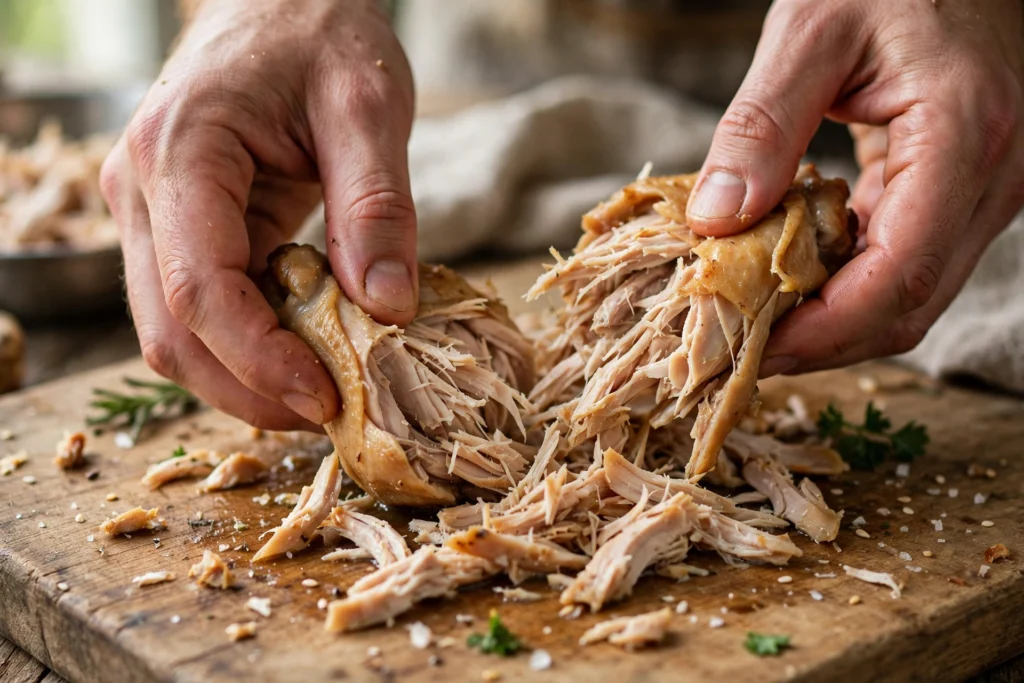
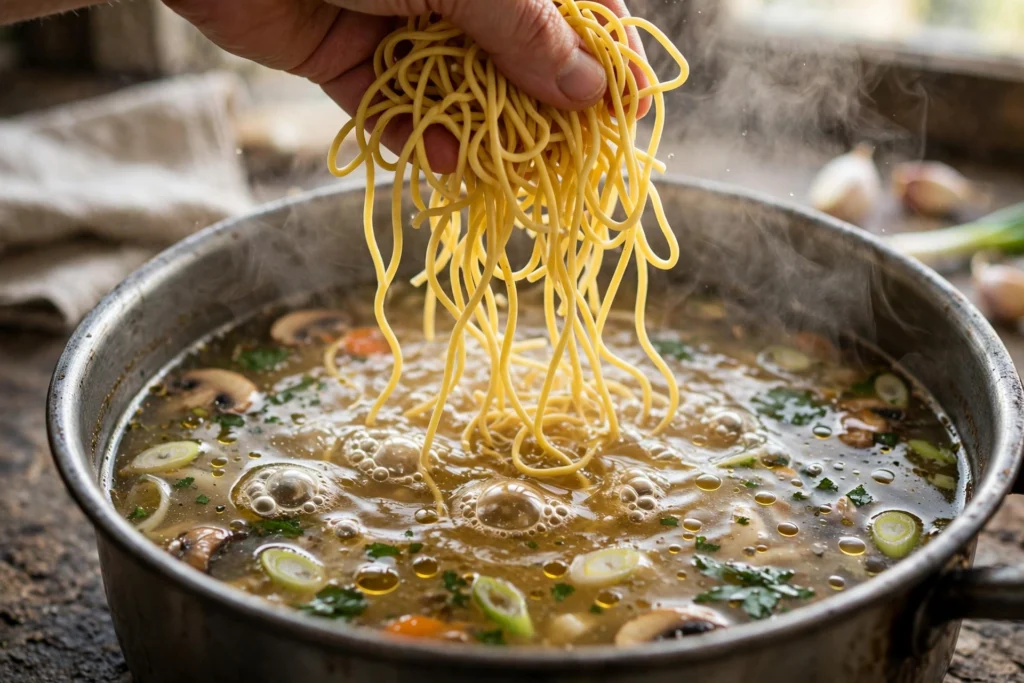
While the chicken cools, bring the broth back to a steady simmer and add eight ounces of egg noodles. Cook according to the package directions, usually six to eight minutes, stirring occasionally to prevent sticking. The noodles should be tender but still have a slight bite, because they will continue to soften in the hot broth after cooking. While the noodles cook, remove the skin from the chicken thighs and discard it, pull the meat from the bones, and shred or dice it into bite-sized pieces. Discard the bones.
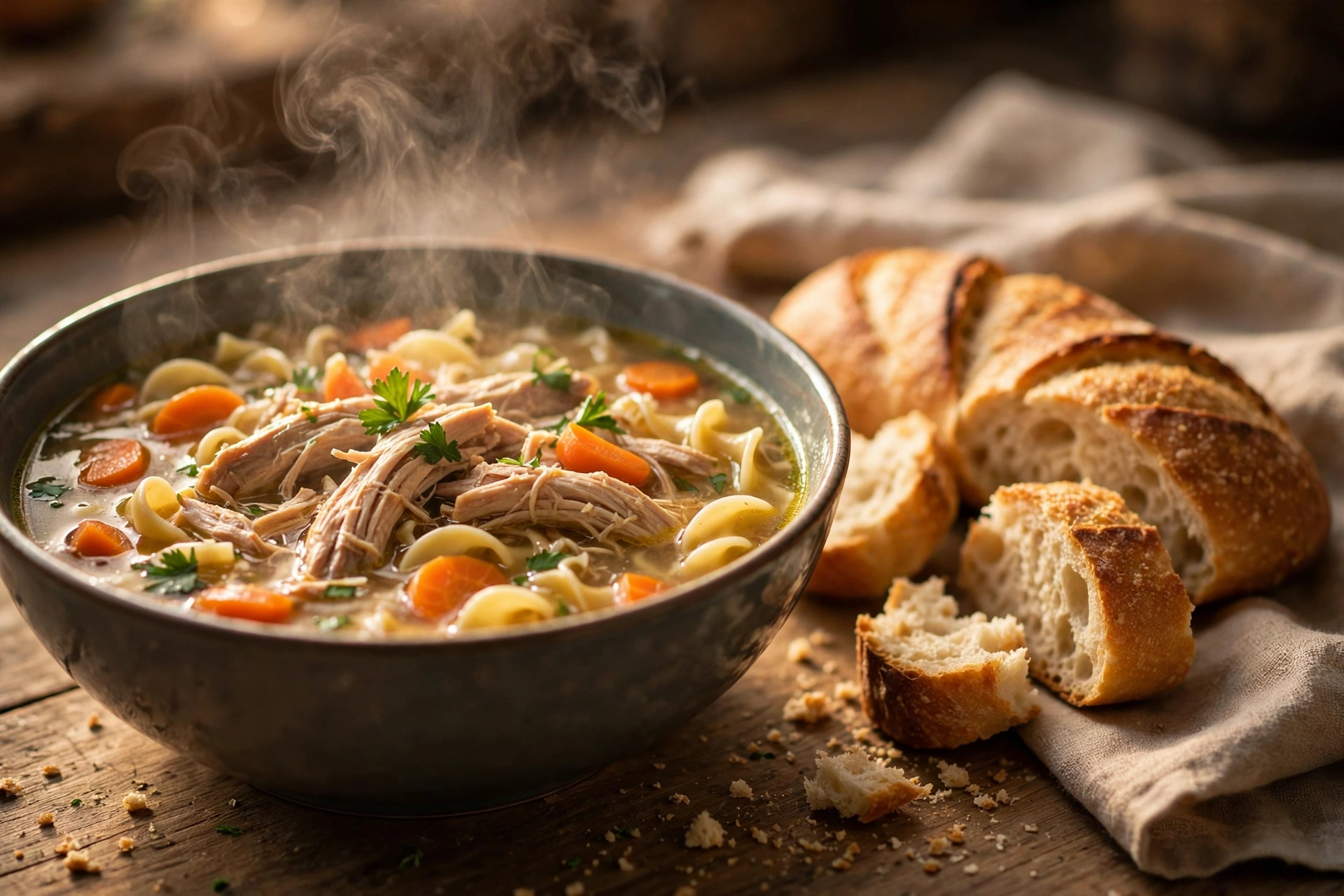
Return the shredded chicken to the pot and stir to combine. Let the soup simmer for one to two minutes more, just until the chicken is heated through. Remove the pot from the heat. Stir in a handful of chopped fresh parsley and a teaspoon or two of lemon juice. Taste once more and adjust the salt, pepper, and lemon juice. The finished soup should taste savory, bright, and balanced, with no single flavor dominating. Serve immediately in warmed bowls, with crusty bread or crackers on the side if desired.
Must Read : Spinach Dip Toast Recipe (Creamy, Cheesy, and Golden from the Oven)
Tips for Better Soup
Timing the noodles is the most important skill in this recipe. Noodles added too early become mushy, and the starch they release thickens the broth unpleasantly. Noodles added at the right time, cooked just until tender, and served promptly stay distinct and pleasant. If the soup will sit before serving, or if leftovers are expected, cook the noodles separately in salted water, drain them, and add them to each bowl at serving time. This keeps the noodles perfect and the broth clear, even after reheating.
Chicken should be handled gently after cooking. Shredding the meat while it is still slightly warm is easiest, and the pieces should be bite-sized rather than stringy. Large chunks of chicken are more satisfying in a spoon than shredded fibers, so cutting the thigh meat into pieces, rather than pulling it into fine shreds, gives a better texture. The skin and bones should be discarded, though the bones can be saved for a future batch of stock if desired.
Vegetable texture can be controlled by when the vegetables are added. Vegetables added at the beginning cook for the full time and become very soft, which suits a traditional, comforting style. For a soup with more distinct vegetable pieces, half the vegetables can be added at the beginning for flavor, and the other half added in the last fifteen minutes of simmering, so they stay slightly firm. Both approaches are correct; the choice depends on the texture preferred.
Seasoning should be finished at the end, not just at the beginning. Salt, pepper, and lemon juice all need a final adjustment after the noodles and chicken are in the pot. The broth changes as it simmers and as the noodles absorb liquid, so a soup that tasted perfectly seasoned halfway through cooking may taste under-seasoned at serving. Tasting the finished soup in a spoon, rather than judging by the smell from the pot, gives the most accurate sense of the seasoning.

Also Read: Creamy Potato Soup Recipe (The Best You’ll Ever Make)
Variations Worth Trying
A lemon and herb version adds more lemon juice and a generous amount of fresh dill and parsley at the end, producing a brighter, greener soup that suits spring and summer. A ginger version adds a few slices of fresh ginger and a splash of soy sauce to the broth, with sliced scallions at the end, giving the soup a warming, aromatic character. A creamy version stirs in half a cup of heavy cream at the end, off the heat, producing a richer soup that is closer to a chowder; the cream should never be boiled, or it may split.
A vegetable-loaded version doubles the carrots and celery, adds a diced parsnip and a cup of green beans in the last fifteen minutes, and uses a little extra stock to keep the soup brothy. A spicy version adds a diced jalapeño with the vegetables and a pinch of red pepper flakes, with a squeeze of lime instead of lemon. A noodle variation uses small pasta shapes such as orzo, ditalini, or broken spaghetti instead of egg noodles; the cooking time should follow the package directions, and the same rule about serving promptly applies.
For a slow cooker version, combine the chicken, vegetables, herbs, and stock in the cooker and cook on low for six to seven hours or on high for three to four hours. Remove the chicken, shred it, return it to the cooker, add the noodles, and cook on high for a further twenty to thirty minutes until the noodles are tender. For an Instant Pot version, use the sauté function for the vegetables, add the chicken and stock, pressure cook on high for ten minutes, release naturally for ten minutes, remove and shred the chicken, then add the noodles and simmer on sauté until tender. Both methods produce excellent soup, though the stovetop method gives the most control over the broth’s clarity.
Storage, Freezing, and Reheating
Chicken noodle soup keeps well, but the noodles require special handling. If the noodles were cooked in the soup, the soup should be eaten within a day or two, because the noodles continue to absorb broth in the refrigerator and become soft. The soup itself, without noodles, keeps for three to four days in the refrigerator in an airtight container. For the best leftovers, store the soup and the noodles separately, and combine them when reheating. Cooked noodles tossed with a teaspoon of oil keep for three days in the refrigerator without sticking together.
For freezing, the soup without noodles is ideal. Cool the soup completely, portion it into freezer-safe containers or bags, leaving room for expansion, and freeze for up to three months. Thaw overnight in the refrigerator, reheat gently on the stove until simmering, and add freshly cooked noodles at serving time. Soup frozen with noodles already in it is still edible, but the noodles become very soft after thawing and reheating, and the texture is noticeably worse. If freezer space is limited, the soup can be frozen in single-serving containers, which makes it easy to reheat one portion at a time.
Reheating should be gentle. Warm the soup over medium-low heat, stirring occasionally, until it simmers. Avoid boiling it hard, which toughens the chicken and clouds the broth. If the soup has thickened in the refrigerator, a splash of water or stock restores the consistency. Taste and adjust the seasoning after reheating, because cold storage dulls flavors and a little extra salt or lemon juice usually improves reheated soup. Microwaving works for single portions: heat in short bursts, stirring between each, until steaming hot throughout. Also Read: Easy Peach Cobbler Recipe
Also Read: Braised Short Ribs Recipe (Fall-Off-the-Bone Tender)
Serving Ideas
Chicken noodle soup is a complete meal on its own, but a few accompaniments make it more satisfying. Crusty bread, buttered rolls, or saltine crackers are the classic partners, giving something to dip and adding texture. A simple green salad with a light vinaigrette balances the warmth of the soup and adds freshness. For a heartier meal, a grilled cheese sandwich or a toasted cheese and tomato sandwich turns the soup into a substantial lunch or supper. For children, the soup can be served with the noodles and chicken prominent and the vegetables cut small, which makes it easier and more appealing to eat.

For serving to someone who is unwell, the soup should be kept simple and gentle. The broth should be well seasoned but not heavily spiced, the noodles soft but not mushy, and the chicken in small, tender pieces. Serving it hot, but not scalding, in a mug or a bowl that is easy to hold, makes it more comfortable. Small, frequent servings are often better received than one large bowl. The soup can also be strained for someone who can manage only broth, with the solids served separately or saved for later.

For a gathering, chicken noodle soup can be made in a large pot and kept warm on the lowest heat, with the noodles cooked separately and added to each bowl. This approach keeps the soup at its best for hours, because the noodles never sit in the hot broth and turn soft. A toppings bar of fresh parsley, lemon wedges, grated Parmesan, and hot sauce lets guests adjust their own bowls, which suits mixed tastes and dietary needs. A pot of soup, a stack of bowls, and a loaf of bread is one of the simplest and most welcoming meals to offer a group.
Also Read: Chicken Tinga Recipe (Smoky, Saucy & Weeknight-Fast)
The History and Culture of Chicken Noodle Soup
Chicken soup with noodles has existed in some form for centuries, and nearly every cuisine has its own version. In China, chicken noodle soups with wheat noodles, ginger, and scallions have been cooked for generations. In Jewish Ashkenazi cooking, chicken soup with kneidlach or lokshen noodles became a central dish for Sabbath and holidays, and it carried the affectionate name penicillin in popular culture because of its reputation for restoring health. In Greece, avgolemono thickens chicken soup with egg and lemon. In Mexico, sopa de fideos uses thin toasted noodles in a tomato broth, often with chicken. In Vietnam, pho ga pairs chicken with rice noodles, herbs, and a spiced broth. The American version, with egg noodles, carrots, celery, and onion, draws most directly from European traditions brought by immigrants and adapted to ingredients available in the United States.
The canned version of chicken noodle soup, popularized in the twentieth century, made the dish a pantry staple and introduced it to millions of households, but it also flattened expectations of what the soup could be. Canned soup is necessarily uniform, with soft noodles and a mild broth designed for a long shelf life. Homemade soup is different in kind, not just in degree. The broth is clearer and more flavorful, the chicken is real pieces rather than small shreds, the vegetables have texture, and the seasoning can be adjusted to taste. Cooking it from scratch restores the dish to what it was before canning: a proper meal made from simple ingredients, rather than a convenience product.
The soup’s association with illness has been studied as well as celebrated. Warm fluids, steam, and salt all provide genuine, if modest, relief for colds and congestion, and a meal that is easy to eat has real value when appetite is low. The psychological comfort matters too. A dish associated with care and home cooking carries associations that go beyond nutrition, and that is part of why it remains the first thing many people cook for someone who is unwell. Understanding that context does not change the recipe, but it explains why the details matter: a soup made for comfort should be made with care, because the care is part of the point.
Choosing Ingredients: Fresh Versus Convenience
Every ingredient in chicken noodle soup can be bought fresh or in a convenient form, and the trade-offs are worth understanding. Fresh chicken thighs give the best broth and texture, but a good-quality rotisserie chicken can substitute when time is short. In that case, the meat should be added near the end of cooking, and the broth should be good store-bought stock simmered briefly with vegetables and herbs to give it more depth. The result will not be quite as rich, but it will be far better than canned soup and ready in about thirty minutes.
Fresh vegetables are noticeably better than frozen in this soup, because carrots and celery keep their texture and sweetness when fresh, while frozen vegetables tend to go soft quickly. Pre-cut fresh vegetables from the store, such as diced mirepoix mix, are a reasonable middle ground and save preparation time without sacrificing much quality. Garlic should ideally be fresh, because jarred minced garlic has a sharper, less clean flavor, though it works in a pinch. Fresh parsley at the end makes a real difference; dried parsley adds color but little flavor and is not a good substitute for the finishing herb.
Stock choice is the most consequential convenience decision. Low-sodium stock is preferred, because it allows the cook to control the salt level. Regular stock can be used, but the added salt must be reduced and the final seasoning checked carefully. Stock from a carton is generally better than stock from a powder or cube, which tends to taste more artificial, though a good-quality paste base dissolved in water is a solid option. Homemade stock, made by simmering a chicken carcass with vegetables, is the best of all, and it freezes well, so a batch made after a roast chicken can supply several future soups. Keeping a container of homemade stock in the freezer is one of the most useful habits a soup cook can develop.
Noodle choice also involves a trade-off. Dried egg noodles are inexpensive, keep for months in the pantry, and cook reliably. Fresh egg noodles, found in the refrigerated section, cook faster and have a more delicate texture, but they break down more quickly in hot broth and are better added at the very last moment. For soup that will be stored or reheated, dried noodles cooked separately are the most practical choice. For soup served immediately, fresh noodles give a slightly more luxurious result. Either way, the noodles should be a shape that fits comfortably on a spoon alongside a piece of chicken and a slice of carrot, because soup is eaten with a spoon, and oversized noodles make it awkward.
Equipment and Pot Choice
The pot used for chicken noodle soup affects the result more than many cooks expect. A large, heavy-bottomed pot, preferably enameled cast iron or heavy stainless steel, distributes heat evenly and maintains a gentle simmer without hot spots. A thin pot scorches the vegetables during the sweating stage and produces uneven cooking, with the bottom layer overcooking while the top stays underdone. The pot should be large enough to hold the chicken, vegetables, and eight cups of liquid with at least two inches of headroom, because a pot filled to the brim boils over easily and is difficult to stir. A six to eight quart pot is the right size for this recipe.
A lid that fits well matters too. During the simmering stage, the pot should be partially covered, which allows a little steam to escape while keeping the heat in. A pot without a lid loses too much liquid and the broth concentrates too far, becoming salty. A pot with a tight lid and no vent can build up too much heat and push the soup toward a boil. Partially covering the pot, with the lid ajar by an inch or so, gives the best control. If the stove runs hot even on its lowest setting, a heat diffuser placed under the pot spreads the heat and prevents scorching, which is a useful investment for any cook whose burners run strong.
The remaining tools are simple. A sharp knife and a stable cutting board make the vegetable preparation faster and safer, because even pieces cook evenly and dull knives slip. A wooden spoon is best for stirring, because it does not scratch the pot and does not conduct heat. A fine-mesh skimmer or a large spoon removes foam efficiently during the first twenty minutes of simmering. Tongs lift the chicken thighs out of the hot broth without breaking them apart. A ladle serves the soup neatly, and warmed bowls keep it hot at the table. None of this equipment is specialized, but having it ready before cooking starts makes the whole process smoother, because the recipe moves quickly once the pot is on the heat.
Ingredients
Method
- Heat the butter or oil in a large, heavy-bottomed pot over medium heat. Add the onion, carrots, and celery with a pinch of salt and cook 6 to 8 minutes until the onion is translucent and the vegetables soften slightly.
- Add the garlic and cook 30 seconds until fragrant.
- Add the chicken thighs in a single layer and pour in the water or stock to cover by about 1 inch. Add the bay leaves and thyme.
- Bring to a gentle simmer over medium-high heat, then reduce to low, partially cover, and skim foam from the surface during the first 20 minutes.
- Simmer gently 25 to 30 minutes until the chicken reaches 165 degrees Fahrenheit and is tender. Do not boil vigorously.
- Remove the chicken to a plate. Discard the bay leaves and thyme. Taste the broth and adjust salt.
- Bring the broth back to a steady simmer, add the egg noodles, and cook 6 to 8 minutes per package directions until just tender.
- While the noodles cook, discard the chicken skin and bones and cut or shred the meat into bite-sized pieces.
- Return the chicken to the pot and simmer 1 to 2 minutes until heated through.
- Remove from the heat, stir in the parsley and lemon juice, taste and adjust salt, pepper, and lemon, and serve immediately.
Frequently Asked Questions
Should I use chicken breasts or thighs for chicken noodle soup?
Thighs are preferred. Bone-in, skin-on thighs stay moist during simmering and add richness to the broth from the bones and skin. Breasts work but dry out more easily and should be added later in the cooking time and removed as soon as they reach 165 degrees Fahrenheit. For the best flavor and texture, thighs are the safer choice.
Why do my noodles get mushy in chicken noodle soup?
Noodles become mushy when they are cooked too long or left sitting in hot broth. Cook them only until tender with a slight bite, serve the soup promptly, and for leftovers or soup that will sit, cook the noodles separately and add them to each bowl at serving time. This keeps the noodles distinct and the broth clear.
Can I use store-bought stock instead of making broth from scratch?
Yes. Good-quality low-sodium chicken stock works well, especially when the chicken is still simmered in it, because the chicken adds fresh flavor and body. Taste the stock before using it, since some brands are very salty, and adjust the added salt accordingly. A combination of stock and water, or stock enriched with a few extra vegetables and herbs simmered briefly, also works.
How long does chicken noodle soup last in the refrigerator?
Soup without noodles keeps for three to four days in an airtight container. Soup with noodles already in it is best within one to two days, because the noodles soften and absorb broth. Store noodles separately whenever possible, and reheat the soup gently, adjusting seasoning after reheating.
Can I freeze chicken noodle soup?
Yes, for up to three months, but freeze the soup without noodles for the best texture. Cool it completely, portion it into freezer-safe containers, and thaw overnight in the refrigerator. Reheat gently and add freshly cooked noodles at serving time. Soup frozen with noodles is edible but the noodles become very soft.
What noodles are best for chicken noodle soup?
Wide or medium egg noodles are traditional and hold up well in broth because the egg gives them a tender but sturdy texture. Small pasta shapes like orzo or ditalini also work. Rice noodles and gluten-free pastas can be used but should be cooked separately and added at serving, because they break down faster in hot broth.
How do I make the broth richer without making it greasy?
Use bone-in chicken, simmer gently rather than boiling, and skim the foam in the first twenty minutes. A small amount of fat left in the broth adds richness, but excess fat can be skimmed from the surface or removed after chilling. Adding a roasted onion or a few extra vegetables during simmering also deepens the flavor without adding grease.
Can I make chicken noodle soup in a slow cooker?
Yes. Combine the chicken, vegetables, herbs, and stock, and cook on low for six to seven hours or on high for three to four hours. Remove and shred the chicken, return it to the cooker, add the noodles, and cook on high for twenty to thirty minutes more until the noodles are tender. The slow cooker method is convenient, though the stovetop method gives more control over broth clarity.
Is chicken noodle soup gluten free?
Not with standard egg noodles, which contain wheat. For a gluten-free version, use certified gluten-free noodles or rice, cooked separately and added at serving, and check that the stock is certified gluten free. The rest of the soup, including the chicken, vegetables, and broth, is naturally gluten free.
Can I add other vegetables to chicken noodle soup?
Yes. Parsnips add sweetness, green beans add texture, peas add color, and corn adds a gentle sweetness. Root vegetables should be added early so they cook through, while tender vegetables like peas and spinach should be added in the last few minutes. Keep the total volume of vegetables balanced so the soup stays brothy rather than becoming a stew.
Why does my soup taste bland even though I followed the recipe?
Bland soup is usually under-seasoned or missing acid. Taste the finished soup and adjust the salt first, then add a teaspoon or two of lemon juice, which brightens the flavors without making the soup sour. A pinch of black pepper and a handful of fresh parsley at the end also help. Broth that was made with unsalted stock and under-seasoned chicken is the most common cause.
How do I serve chicken noodle soup for a crowd?
Make the soup without noodles in a large pot and keep it warm on the lowest heat. Cook the noodles separately and add them to each bowl at serving time, so they never sit in the hot broth and turn soft. Set out fresh parsley, lemon wedges, grated Parmesan, and hot sauce so guests can adjust their own bowls, and serve with crusty bread.

Hi, I’m Angela. I cook the way busy people actually cook — simple, tasty food with ingredients you already have. On CookBookBite I share easy recipes, honest kitchen tips, and dishes my family asks for again and again.
Pingback: Air Fryer Coconut Shrimp (Crispy & Easy)
Pingback: 13 Easy Summer Meals: Quick Dinners for Hot Days