
Classic homemade meatloaf is one of the most familiar dishes in American home cooking, and also one of the most misunderstood. At its worst, it is dry, dense, and gray, the kind of food that gives comfort food a bad name. At its best, it is juicy, tender, and deeply savory, with a caramelized glaze on top and a slice that holds together on the plate but yields easily to a fork. The difference between those two outcomes is not talent or luck. It is a handful of techniques: the right blend of meats, a panade to keep the loaf moist, gentle mixing, a free-form shape that browns on all sides, and a proper rest before slicing. This guide covers all of them, with a complete recipe card at the end.
A Brief History of Meatloaf
Meatloaf descends from a long tradition of ground meat dishes found in many cuisines. Roman cooks made seasoned meat patties, medieval European cooks made minced meat dishes stretched with bread and spices, and German, Belgian, and Dutch kitchens each developed their own versions of seasoned meat loaves. The dish came to America with immigrants and adapted to local ingredients and circumstances. During the Great Depression, meatloaf became a staple because it stretched a small amount of meat with breadcrumbs, oats, or crackers and fed a family cheaply. During the Second World War, when meat was rationed, the same economy made it a practical choice again.
In the post-war decades, meatloaf became a symbol of home cooking, served with mashed potatoes and green beans in diners and family kitchens across the country. Its reputation suffered in later years, partly because institutional versions, in school cafeterias and cheap diners, were often overcooked and made with low-quality meat. The home version, made with good meat, proper seasoning, and careful cooking, never deserved that reputation. A well-made meatloaf is a genuinely good dinner: inexpensive, forgiving, excellent as leftovers, and easy to adapt to different tastes.
Understanding the Structure of a Good Meatloaf
A meatloaf has five structural components, and each one matters. The meat provides flavor and body. The panade, a mixture of bread and milk, keeps the loaf moist and tender. The eggs bind the mixture together. The aromatics, usually onion, garlic, and herbs, provide flavor. The glaze adds sweetness, acidity, and a caramelized top. When any component is missing or mishandled, the loaf suffers. Without a panade, the loaf dries out. Without eggs, it crumbles. Overmixed, it becomes dense and rubbery. Under-seasoned, it tastes flat no matter how good the meat is.
The meat blend is the first decision. A mixture of ground beef and ground pork is the classic choice. Beef provides deep, savory flavor. Pork adds fat and tenderness. An 80/20 ground beef, meaning eighty percent lean meat and twenty percent fat, gives enough fat to keep the loaf juicy without making it greasy. Very lean beef, such as 90/10 or leaner, produces a drier loaf unless extra pork or fat is added. A blend of equal parts beef and pork is reliable, but a blend of two parts beef to one part pork is also excellent and slightly beefier in flavor. Ground veal can be added for a more delicate texture, though it is not necessary. Ground turkey can be used for a lighter loaf, but it needs extra fat and moisture, such as added olive oil and a larger panade, or it will dry out.
The panade is the most important technique in this recipe and the one most often skipped. A panade is made by soaking bread in milk until it forms a soft paste, then mixing that paste into the meat. The starch in the bread absorbs moisture and holds it during cooking, while the milk proteins add tenderness. The result is a loaf that stays moist even when cooked to a safe internal temperature. Fresh white bread, torn into pieces, makes the best panade, because it soaks evenly and disappears into the mixture. Breadcrumbs can be used instead, but they absorb less evenly and produce a slightly denser texture. Rolled oats are a traditional alternative and give a heartier, more rustic loaf, though the texture is noticeably different.
Eggs bind the loaf. Two large eggs are enough for a two-pound meat mixture. More eggs make the loaf rubbery and dense, because the egg proteins set firmly during cooking. Fewer eggs, or none, leave the loaf crumbly and difficult to slice. The eggs should be beaten lightly before they are added, so they distribute evenly without requiring extra mixing. Milk in the panade and eggs together provide the moisture and binding the loaf needs; adding extra liquid beyond the panade, such as broth or tomato juice, can make the mixture too wet and cause the loaf to fall apart or steam rather than bake.
Aromatics and seasoning give the loaf its character. Onion is essential. It should be finely diced and, ideally, cooked briefly in butter or oil until soft before it is added to the meat. Raw onion releases water during cooking and can leave crunchy pieces in the finished loaf, while cooked onion blends in smoothly and adds sweetness. Garlic should be minced finely and added with the onion. Herbs such as parsley, thyme, and a little oregano add freshness and depth. Worcestershire sauce adds savory, umami depth that plain salt cannot provide. Dijon mustard adds a sharp background note. Salt must be generous: ground meat needs more salt than most cooks expect, roughly one teaspoon of kosher salt per pound of meat, adjusted for the saltiness of other ingredients such as the glaze and any cheese. Black pepper adds warmth. A pinch of cayenne or red pepper flakes adds a gentle background heat without making the loaf spicy.
The glaze is the finishing touch and should not be treated as an afterthought. A classic glaze is made from ketchup, brown sugar, and a splash of vinegar, sometimes with a little mustard. It is spread over the top of the loaf partway through baking, so it caramelizes without burning. The sugar in the glaze browns in the oven, producing a sticky, slightly sweet crust that contrasts with the savory meat. A glaze applied at the start of baking can burn during the long cooking time, so it should be applied in the last twenty to thirty minutes. An alternative glaze of barbecue sauce, or a mixture of tomato paste, honey, and vinegar, works equally well, as long as it contains both sweetness and acidity. Also Read: Sourdough Pizza Crust Recipe
Step-by-Step Method
Begin by preparing the panade. Tear three slices of fresh white bread, crusts removed if they are very thick, into small pieces and place them in a large mixing bowl. Pour half a cup of whole milk over the bread and let it soak for five to ten minutes, until the bread is completely soft. Mash the mixture with a fork into a smooth, thick paste. The paste should be soft and uniform, with no large dry pieces of bread remaining. If the bread is very dry, an extra tablespoon or two of milk can be added, but the paste should not be runny.
While the bread soaks, cook the aromatics. Heat one tablespoon of butter or olive oil in a skillet over medium heat. Add one finely diced medium onion and a pinch of salt, and cook, stirring occasionally, for five to seven minutes, until the onion is soft and translucent but not browned. Add two minced garlic cloves and cook for thirty seconds more, just until fragrant. Remove from the heat and let the mixture cool for a few minutes. Adding hot onion to the meat would begin to cook the meat prematurely and make the mixture harder to handle.
Add the cooled onion mixture to the bowl with the panade, along with two beaten large eggs, two tablespoons of Worcestershire sauce, one tablespoon of Dijon mustard, one tablespoon of ketchup, one teaspoon of kosher salt, half a teaspoon of black pepper, a quarter teaspoon of cayenne pepper if using, and two tablespoons of chopped fresh parsley. Stir these ingredients together until evenly combined. Mixing the wet ingredients and seasonings before the meat goes in means the meat itself needs less handling later, which is the key to a tender loaf.
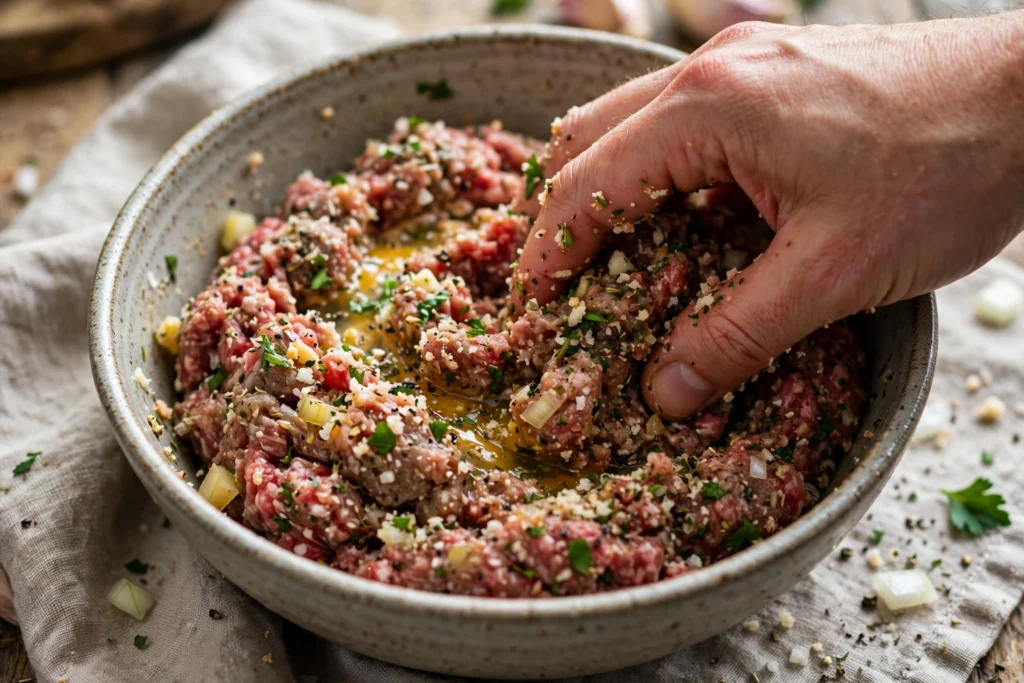
Add one pound of 80/20 ground beef and one pound of ground pork to the bowl. Mix gently with clean hands or a fork, folding the meat into the wet mixture until it is just combined and no streaks of plain meat remain. Stop as soon as the mixture looks uniform. Overmixing is the single most common cause of dense, tough meatloaf. When meat is worked too much, the proteins link together tightly and squeeze out moisture during cooking, producing a loaf that is rubbery rather than tender. The mixture should feel soft and slightly loose, not compacted. If it feels stiff, a tablespoon of milk can be worked in gently, but it should not need much adjustment.
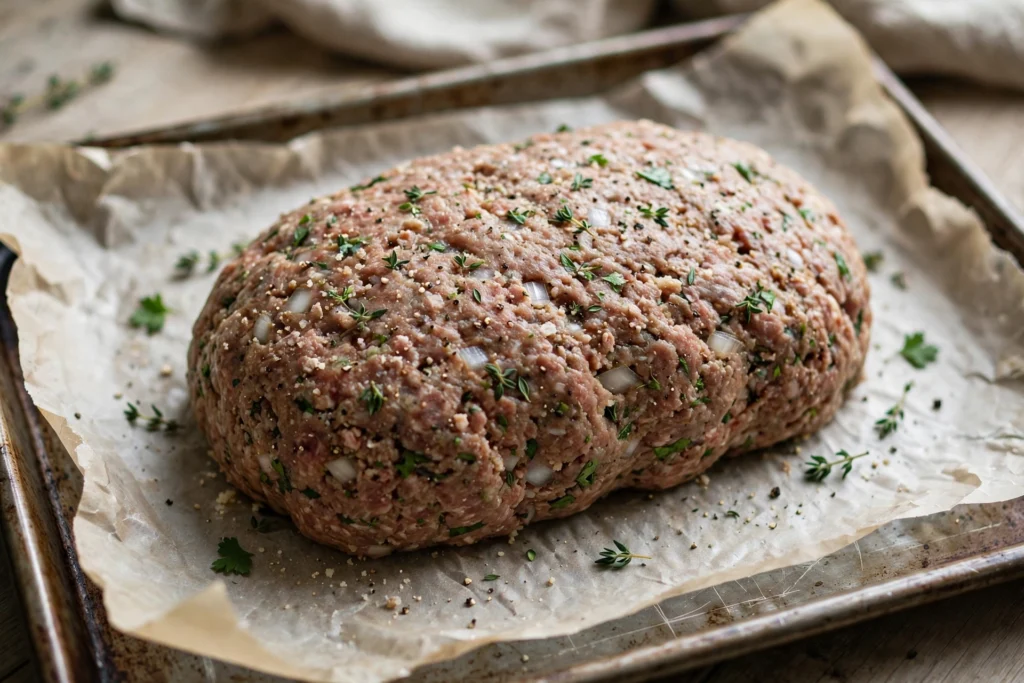
Shape the mixture into a loaf on a parchment-lined baking sheet, rather than packing it into a loaf pan. A free-form loaf has more surface area exposed to the oven’s heat, which means more browning and a better crust, and it allows fat to drain away instead of pooling around the meat. The loaf should be about nine inches long, five inches wide, and three inches high, with a smooth, slightly domed top. The ends should be tucked under neatly so the loaf holds its shape. Wet hands make shaping easier and prevent the mixture from sticking to the fingers. Do not pack the mixture tightly; a gently shaped loaf cooks more evenly and stays more tender than a compressed one.
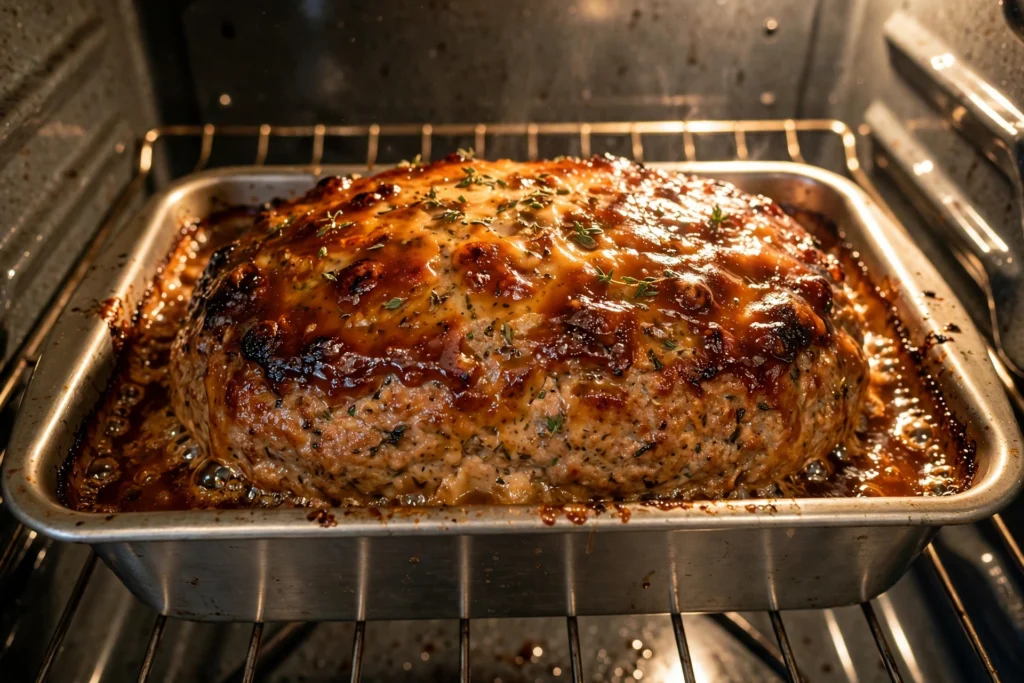
Place the loaf in a preheated oven at 350 degrees Fahrenheit (175 degrees Celsius). Bake for forty minutes without the glaze. After forty minutes, remove the loaf from the oven and spread the glaze evenly over the top and sides. The glaze is made by stirring together half a cup of ketchup, two tablespoons of brown sugar, and one tablespoon of apple cider vinegar, with a teaspoon of Dijon mustard if desired. Return the loaf to the oven and bake for a further twenty-five to thirty-five minutes, until the glaze is caramelized and the internal temperature reaches 160 degrees Fahrenheit when measured with an instant-read thermometer inserted into the center of the loaf. Total baking time is usually sixty-five to seventy-five minutes.
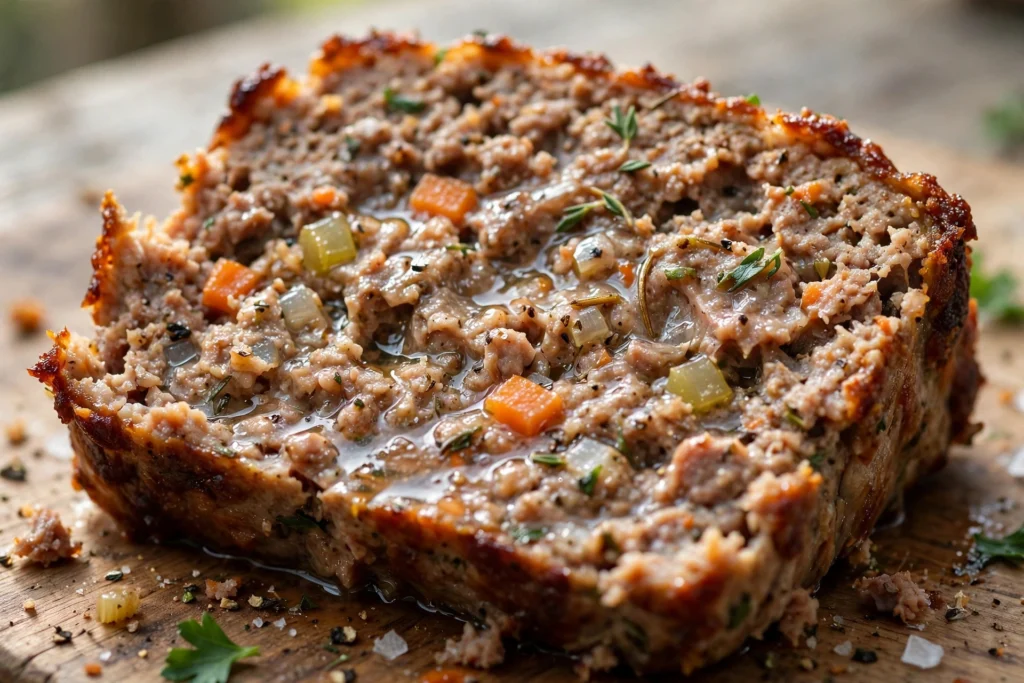
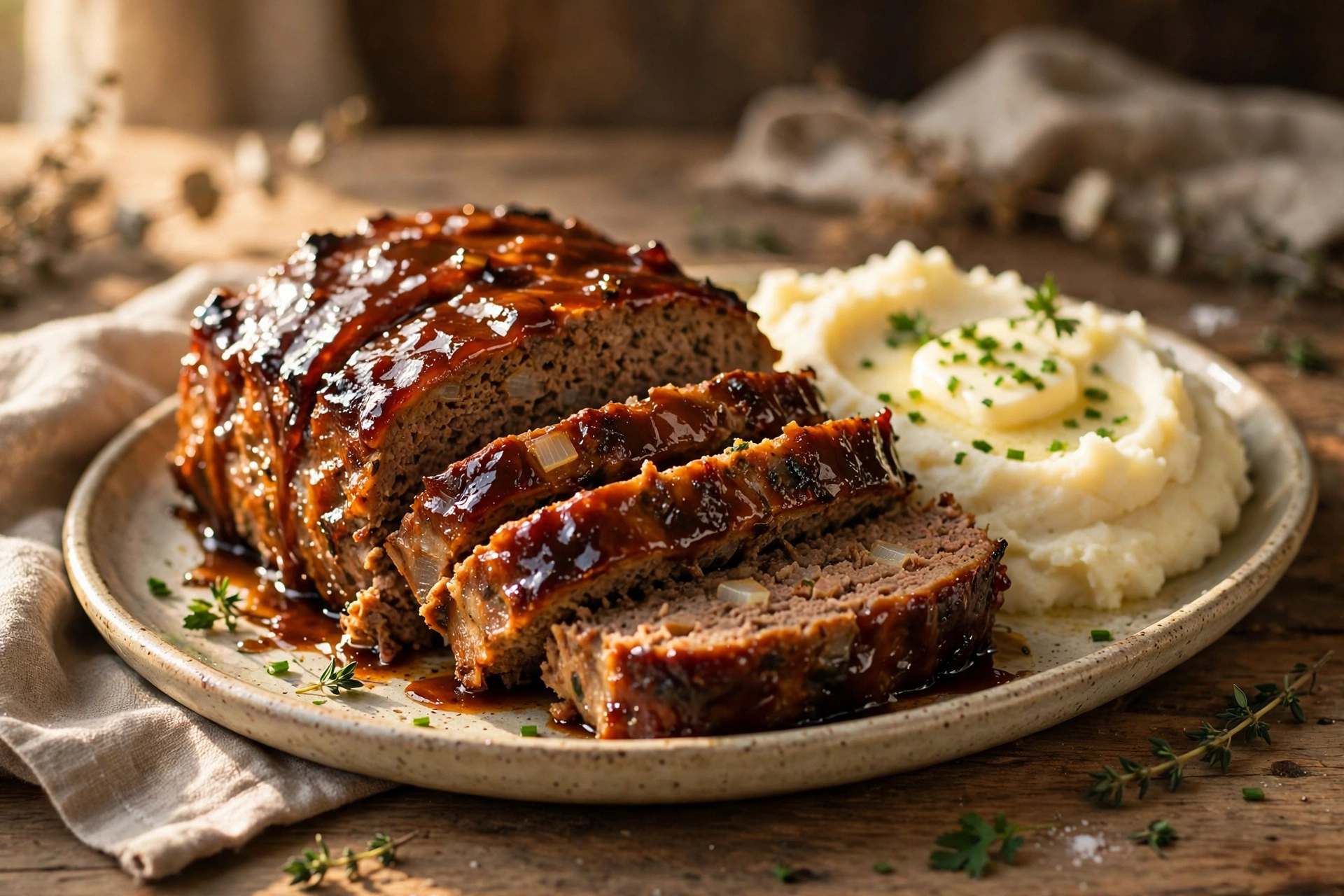
Resting is essential and should not be skipped. Remove the loaf from the oven and let it rest on the baking sheet for ten to fifteen minutes before slicing. During the rest, the juices redistribute through the meat instead of running out onto the cutting board, and the loaf firms up enough to slice cleanly. Slicing too early produces crumbly slices and a dry loaf, because the juices escape before they have settled. Use a sharp, serrated knife or a long chef’s knife and cut slices about three quarters of an inch thick, wiping the blade between cuts for the cleanest slices. Serve warm, with extra glaze or pan juices spooned over if desired. Also Read: Soft Whole Wheat Bread Recipe
Tips for a Juicy, Tender Loaf
Temperature control matters as much as technique. An oven thermometer is worth using, because an oven that runs hot will overcook the outside before the center is done, and an oven that runs cool will leave the center undercooked while the glaze looks finished. The internal temperature is the reliable guide: 160 degrees Fahrenheit is the safe temperature for a beef and pork loaf, and the temperature will rise a few degrees during resting. Removing the loaf at 155 degrees and letting carryover cooking finish the job is a safe approach that guards against overcooking, provided the thermometer reading is accurate and the rest is a full ten minutes.
Fat content is the second major factor in juiciness. Lean meat produces a dry loaf no matter how carefully it is handled, because there is simply not enough fat to keep the meat moist during a long bake. If only lean beef is available, adding ground pork, or a tablespoon or two of olive oil worked gently into the mixture, compensates. Conversely, very fatty meat, such as 70/30 beef, produces a loaf that shrinks considerably and sits in a pool of grease. The 80/20 beef and pork blend in this recipe hits the balance that most cooks find ideal.
Mixing technique deserves emphasis because it is the step where most meatloaves are ruined. The meat should be mixed only until combined, using hands or a fork, with a folding motion rather than a kneading motion. Kneading develops the proteins in the same way that kneading bread develops gluten, and the result is a dense, springy texture that is unpleasant in a meatloaf. If the mixture is being mixed in a stand mixer, it should be mixed on the lowest speed for no more than thirty to sixty seconds. For most cooks, hands are the better tool, because the change in texture as the mixture comes together can be felt directly.
The choice between a loaf pan and a free-form loaf affects both texture and cooking time. A loaf pan produces a loaf that steams in its own juices and has a soft, pale exterior, with fat pooling around the sides. A free-form loaf on a baking sheet browns on all sides, drains fat away, and cooks slightly faster. For cooks who prefer the loaf pan shape, a compromise is to bake the loaf in the pan for the first half of the cooking time and then turn it out onto a baking sheet for the second half, which gives both structure and browning. A wire rack set over the baking sheet also works, lifting the loaf out of its juices entirely.
Variations Worth Trying
Once the classic homemade meatloaf version is comfortable, the recipe adapts easily. An Italian-style meatloaf adds a cup of grated Parmesan, a teaspoon of dried oregano, and a pinch of red pepper flakes to the mixture, and replaces the ketchup glaze with a thin layer of marinara sauce applied in the last twenty minutes. A Mexican-style meatloaf adds a teaspoon of cumin, a teaspoon of chili powder, a small can of diced green chiles, and a handful of chopped cilantro, with a glaze of ketchup mixed with a spoonful of chipotle in adobo. A barbecue meatloaf replaces the ketchup glaze with barbecue sauce and adds a tablespoon of smoked paprika to the mixture.
A cheese-stuffed meatloaf places a row of mozzarella sticks or a thick layer of shredded cheddar down the center of the loaf before shaping, so that slicing reveals a melted cheese core. The cheese should be kept away from the edges of the loaf, or it will leak out during baking. A bacon-wrapped meatloaf drapes strips of bacon over the top of the loaf before baking, which bastes the meat as it cooks and adds a smoky, crisp top. The bacon should be thin-cut so it crisps fully in the baking time; thick-cut bacon may stay soft in the center.
A lighter turkey meatloaf uses ground turkey in place of the beef and pork, with an extra tablespoon of olive oil and a slightly larger panade to compensate for the leanness of the turkey. The cooking time is similar, but the internal temperature should reach 165 degrees Fahrenheit for poultry. A gluten-free meatloaf replaces the bread panade with gluten-free bread or with cooked rice, and checks that the Worcestershire sauce and glaze ingredients are certified gluten free. The texture is slightly different but the method is identical.
Vegetable additions can stretch the loaf and add flavor. A cup of finely grated carrot or zucchini, squeezed dry in a clean towel, adds moisture and sweetness without changing the structure. A cup of finely chopped mushrooms, cooked until their liquid evaporates, adds savory depth. Finely chopped bell pepper adds color and a mild sweetness. Any vegetable addition should be finely cut and, for wet vegetables, pre-cooked or squeezed dry, because excess water makes the loaf soft and difficult to slice.
Also Read: Braised Short Ribs Recipe (Fall-Off-the-Bone Tender)
What to Serve with Meatloaf
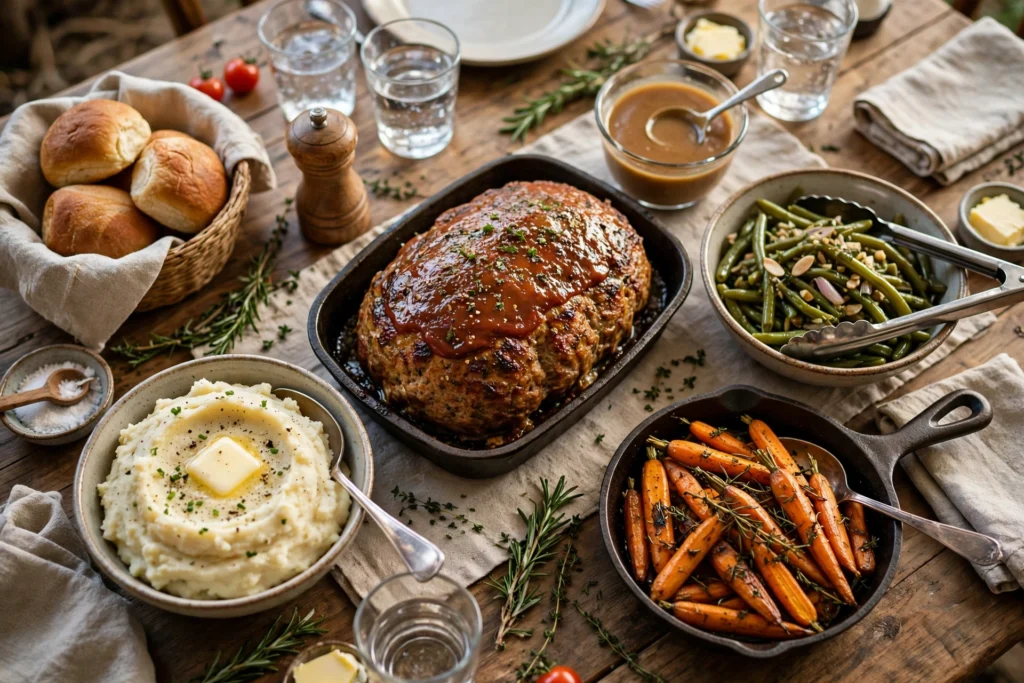
The classic accompaniments are mashed potatoes, green beans, and a simple gravy or extra glaze. Mashed potatoes suit meatloaf because they absorb the pan juices and the glaze, and their soft texture contrasts with the firm slices of meat. Green beans, whether steamed, roasted, or cooked with garlic, add freshness and color. A simple salad with a light vinaigrette balances the richness of the meat. Roasted carrots, glazed with a little honey, echo the sweetness of the glaze. Macaroni and cheese turns the meal into a full comfort-food dinner, though it is a heavy pairing best saved for occasions.
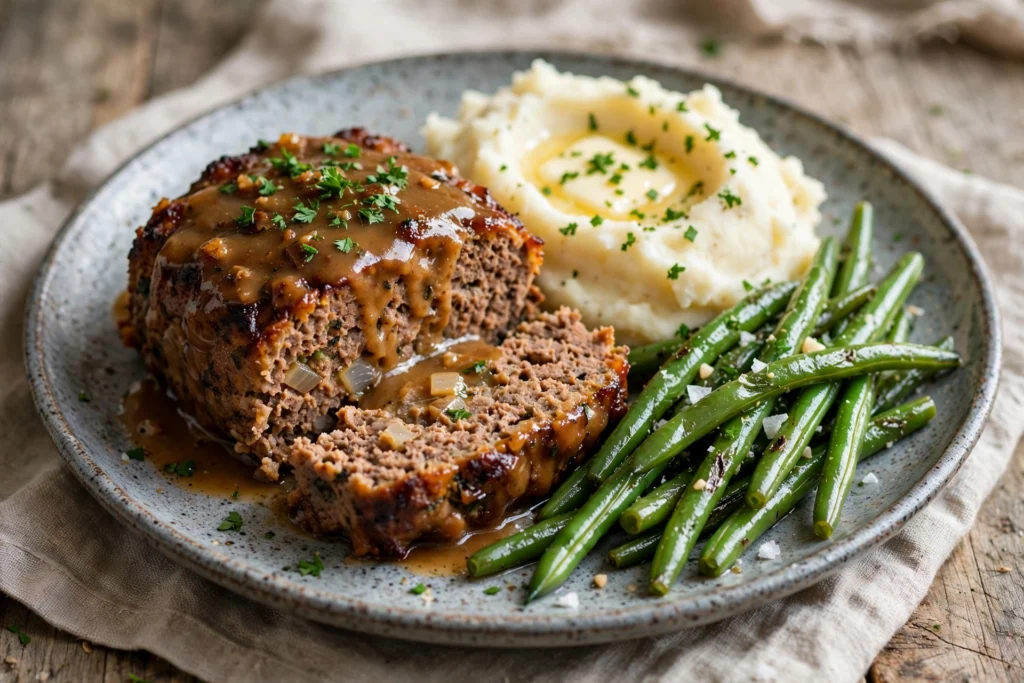
For a lighter meal, classic homemade meatloaf pairs well with a baked sweet potato, a simple coleslaw, or a cucumber and tomato salad. The coleslaw’s acidity cuts through the richness of the meat, and the sweet potato adds a natural sweetness that complements the glaze. Corn on the cob, roasted broccoli, or a tray of roasted root vegetables all work as well. The guiding principle is the same as for any rich main dish: one starchy side, one fresh or acidic vegetable, and the meat itself. That combination produces a balanced plate without overcomplicating the meal.
The Meatloaf Sandwich: The Best Leftover
Cold or reheated meatloaf makes one of the best sandwiches in home cooking, and it is worth planning for leftovers deliberately. A thick slice of meatloaf on soft white bread or a toasted roll, with a smear of mayonnaise, a little extra glaze or ketchup, lettuce, and sliced tomato, is the classic version. Variations include adding melted cheese, pickles, or a fried egg. The sandwich should be built with the meatloaf warm, not hot, so the bread does not go soggy, and the slice should be thick enough to be the dominant element rather than a thin layer.
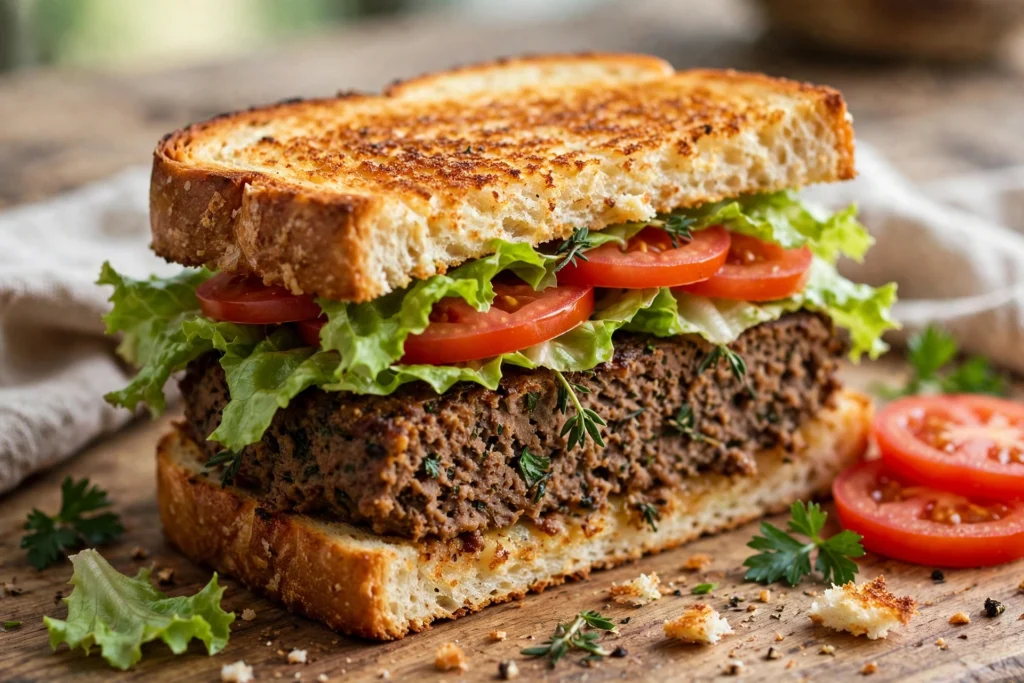
For a hot sandwich, a slice of meatloaf can be reheated in a skillet with a little butter until crisped on both sides, then placed on toasted bread with melted cheese. This version, sometimes called a meatloaf melt, is closer to a grilled cheese sandwich with meat and is excellent for lunch. Leftover meatloaf can also be crumbled into pasta sauce, chopped into a hash with potatoes and onions, or sliced and served over a salad. Planning a double batch, with one loaf for dinner and one for sandwiches, is an efficient way to feed a household for several days.
Also Read: Creamy Potato Soup Recipe (The Best You’ll Ever Make)
Storage, Freezing, and Reheating
Meatloaf keeps well in the refrigerator for three to four days. It should be stored in an airtight container, either whole or sliced, with any leftover glaze spooned over the top to keep the surface moist. Slicing before storage makes it easier to reheat single portions, but a whole loaf retains moisture slightly better. To reheat, slices can be warmed in a covered skillet over medium-low heat with a splash of water or broth, which steams them gently and prevents drying. A microwave works for single slices: cover the slice loosely and heat in short bursts until hot throughout. An oven at 325 degrees Fahrenheit, with the loaf or slices wrapped in foil, reheats evenly in fifteen to twenty minutes.
For freezing, meatloaf should be cooled completely, wrapped tightly in plastic wrap, then in foil, and placed in a freezer bag with the air pressed out. It can be frozen whole or in slices, and it keeps for up to three months. Slices frozen individually, separated by parchment, are the most convenient, because a single portion can be removed without thawing the whole loaf. Thaw overnight in the refrigerator and reheat by any of the methods above. A whole frozen loaf can also be baked from frozen in an emergency, though the cooking time nearly doubles and the glaze should be applied halfway through rather than at the start.
Uncooked meatloaf mixture can also be frozen. Shape the loaf, wrap it tightly, and freeze it raw for up to three months. Thaw overnight in the refrigerator and bake as usual, adding a few extra minutes to the cooking time to account for the chill. This is a useful strategy for busy weeks: preparing two loaves at once, baking one and freezing one, gives a future dinner with almost no additional effort. Also Read: Easy Peach Cobbler Recipe
Meatloaf Science: Why These Techniques Work
Understanding why the techniques in this recipe work makes it easier to adapt the recipe without breaking it. The panade works because starch granules in the bread absorb water and swell, and during cooking they hold that water in place rather than letting it squeeze out as the meat proteins contract. Meat proteins contract as they heat, which is why an overcooked piece of meat becomes dry: the protein network tightens and pushes water out. A panade interrupts that network, giving the water somewhere to stay. This is the same principle behind adding breadcrumbs to meatballs and burgers, and it is why a meatloaf without any starch-based binder dries out even when it is not overcooked.
Gentle mixing matters for a related reason. When ground meat is worked, the proteins on the surface of the meat particles link together into a tighter network, a process similar to what happens when bread dough is kneaded. A lightly mixed loaf has a loose network that stays tender and releases its juices slowly. A heavily mixed loaf has a tight network that contracts firmly during cooking, squeezing out moisture and producing a dense, rubbery texture. This is also why the meat should be kept cold while mixing. Warm meat smears rather than mixing, and the fat begins to melt into the mixture instead of staying in distinct pieces that baste the meat as they render.
Resting works because of the same contraction principle. When meat comes out of the oven, its proteins are at their tightest and its juices are concentrated in the center. As the meat cools slightly, the proteins relax and the juices redistribute more evenly throughout the loaf. Slicing immediately after baking cuts through a loaf whose juices are still pooled, and they run out onto the board. Waiting ten to fifteen minutes allows the juices to settle, so each slice stays moist. The loaf also firms up as it cools slightly, because the rendered fat and gelatin begin to set, which is why rested meatloaf slices cleanly while unrested meatloaf crumbles.
The free-form shape works because of heat transfer. A loaf pan insulates the sides of the loaf and traps steam and fat around it, so the exterior stays soft and pale. A free-form loaf on a baking sheet exposes all sides to hot, dry oven air, which browns the surface through the Maillard reaction, the browning process that creates hundreds of flavor compounds when proteins and sugars are heated together. That browning is a major source of the savory flavor of a good meatloaf, and it is the reason the top and sides of a free-form loaf taste better than the sides of a pan-baked loaf. The fat that drains away on a baking sheet also prevents the bottom from becoming greasy, which is a common complaint about pan-baked meatloaf.
Also Read: Crispy Potato Skins Recipe (Better Than the Restaurant)
Equipment Choices for Meatloaf
The equipment for meatloaf is simple, but a few choices affect the outcome. A rimmed baking sheet lined with parchment paper is the ideal surface for a free-form loaf. The rim catches any fat that drains off, and the parchment prevents sticking without adding grease. A wire rack set inside the baking sheet lifts the loaf out of its juices entirely and gives the most even browning on the bottom, though the loaf must be shaped firmly enough to hold together on the rack. A loaf pan is acceptable for cooks who prefer the traditional shape, but it should be a standard metal pan rather than a glass or ceramic one, because metal conducts heat more evenly and produces a better crust on the sides.
An instant-read thermometer is the single most useful tool for meatloaf. Color and time are unreliable guides, because ovens vary and loaf shapes vary, but an internal temperature of 160 degrees Fahrenheit is an objective measurement. A thermometer with a thin probe causes the least damage to the loaf when inserted, and it should be inserted into the center of the loaf from the top, not from the end, to get the truest reading. A thermometer also prevents the most common meatloaf failure, which is overcooking out of caution. Many cooks bake meatloaf longer than necessary because they are unsure whether it is done, and the extra time dries it out. A thermometer removes that uncertainty.
A large mixing bowl, a fork or clean hands for mixing, a sharp knife for slicing, and a small bowl for the glaze complete the list. No special equipment is required, and the recipe works in any standard home oven. The most important preparation step is reading the recipe through once before starting, because the method moves quickly once the meat is out of the refrigerator, and the glaze needs to be ready when the forty-minute mark arrives. Having the glaze mixed and waiting beside the oven avoids a rushed job at the moment when the loaf needs to go back in promptly.
Ingredients
Method
- Tear the bread into a large bowl, pour over the milk, and soak 5 to 10 minutes. Mash with a fork into a smooth, thick paste.
- Heat the butter or oil in a skillet over medium heat. Cook the onion with a pinch of salt 5 to 7 minutes until soft and translucent. Add the garlic and cook 30 seconds until fragrant. Cool slightly.
- Add the cooled onion mixture to the panade with the eggs, Worcestershire sauce, mustard, ketchup, salt, pepper, cayenne, and parsley. Stir until evenly combined.
- Add the ground beef and ground pork. Mix gently with hands or a fork until just combined; do not overmix.
- Shape into a loaf about 9 inches long, 5 inches wide, and 3 inches high on a parchment-lined baking sheet, with a smooth, slightly domed top.
- Bake in a preheated 350 degree Fahrenheit (175 degree Celsius) oven for 40 minutes without glaze.
- Stir the glaze ingredients together. Remove the loaf, spread the glaze evenly over the top and sides, and return to the oven.
- Bake 25 to 35 minutes more until the glaze is caramelized and the internal temperature reaches 160 degrees Fahrenheit in the center.
- Rest on the baking sheet for 10 to 15 minutes before slicing into 3/4 inch slices. Serve warm.
Frequently Asked Questions
Why is my meatloaf always dry?
Dry meatloaf is usually caused by lean meat, a missing panade, overmixing, or overcooking. Use 80/20 beef blended with pork, include the bread-and-milk panade, mix only until combined, and cook to an internal temperature of 160 degrees Fahrenheit rather than by time alone. Resting the loaf for ten to fifteen minutes before slicing also keeps the juices in.
Should I cook meatloaf in a loaf pan or free-form on a baking sheet?
Free-form on a baking sheet is preferred. It browns on all sides, drains fat away, and cooks slightly faster. A loaf pan produces a softer, paler exterior with fat pooling around the sides. A compromise is to start the loaf in the pan and turn it out onto a baking sheet halfway through baking.
How do I know when meatloaf is done?
Use an instant-read thermometer inserted into the center of the loaf. For a beef and pork loaf, the safe temperature is 160 degrees Fahrenheit. The temperature rises a few degrees during resting, so removing the loaf at 155 degrees and resting it for ten minutes is a safe approach. Color and time alone are unreliable guides.
Can I make meatloaf ahead of time?
Yes. The mixture can be shaped, covered, and refrigerated for up to twenty-four hours before baking. It can also be frozen raw for up to three months; thaw overnight in the refrigerator and bake as usual with a few extra minutes added. Cooked meatloaf keeps for three to four days in the refrigerator and freezes well in slices.
Why does my meatloaf fall apart when I slice it?
Crumbly meatloaf is usually caused by too little binding, too much liquid, or slicing too soon. Two eggs are enough for two pounds of meat, the panade should be a thick paste rather than runny, and the loaf must rest for ten to fifteen minutes before slicing so it firms up and the juices settle.
Can I use ground turkey instead of beef and pork?
Yes, with adjustments. Turkey is leaner, so add an extra tablespoon of olive oil and a slightly larger panade to keep it moist, and cook to an internal temperature of 165 degrees Fahrenheit for poultry. The texture will be lighter and less rich than the beef and pork version, but the method is the same.
What is a panade and why does it matter?
A panade is a paste of bread soaked in milk, mixed into the meat before shaping. The starch in the bread holds moisture during cooking and the milk proteins add tenderness, producing a loaf that stays moist even when cooked to a safe temperature. Skipping the panade is the most common reason homemade meatloaf turns out dry.
When should I apply the glaze?
In the last twenty to thirty minutes of baking, not at the start. A glaze applied at the beginning burns during the long cooking time, because the sugar in it caramelizes and then darkens too far. Applying it after forty minutes of baking gives it time to set and caramelize without burning.
Can I make meatloaf gluten free?
Yes. Replace the bread panade with gluten-free bread or cooked rice, and check that the Worcestershire sauce, mustard, and glaze ingredients are certified gluten free. The method and cooking time are unchanged, though the texture is slightly different from a wheat-bread panade.
How thick should I slice meatloaf?
About three quarters of an inch is ideal for serving. Thinner slices fall apart more easily and cool quickly, while very thick slices can feel heavy and are harder to heat through when reheated. A sharp, serrated knife, wiped between cuts, gives the cleanest slices.
What sides go best with meatloaf?
The classic pairing is mashed potatoes and green beans, with extra glaze or a simple gravy. Roasted carrots, a green salad with vinaigrette, coleslaw, or a baked sweet potato also work well. The guiding principle is one starchy side and one fresh or acidic vegetable alongside the rich meat.
Can I cook meatloaf in a slow cooker?
Yes, though the texture differs. Shape the loaf, place it in the slow cooker on a bed of sliced onions or a rack to lift it out of its juices, and cook on low for six to seven hours or on high for three to four hours, until the internal temperature reaches 160 degrees Fahrenheit. The top will not brown or caramelize the way oven-baked meatloaf does, so the glaze should be applied and the loaf briefly broiled or finished in a hot oven if a caramelized top is wanted.

Hi, I’m Angela. I cook the way busy people actually cook — simple, tasty food with ingredients you already have. On CookBookBite I share easy recipes, honest kitchen tips, and dishes my family asks for again and again.
Pingback: 3 Ingredient Lemonade Scones (Fluffy, Foolproof and instant)