

There are two kinds of potato soup in this world. There’s the thin, sad, watery kind that tastes like boiled potatoes and regret — the kind that makes you wonder why anyone bothers. And then there’s the other kind: thick enough to coat the spoon, silky enough to feel luxurious, deeply savoury with a richness that makes you close your eyes on the first bite. This creamy potato soup recipe is firmly the second kind, and the difference between the two is not luck, effort, or some secret ingredient you can’t pronounce. It’s a handful of small, learnable techniques that anyone can master in one afternoon.
Here’s the promise: one pot, about 40 minutes start to finish, pantry-friendly ingredients, and a soup that tastes like it simmered for hours. You’ll learn exactly which potatoes to buy (it matters more than anything else in this creamy potato soup recipe), how to get that thick, creamy body without flour or cornstarch, and how to build layers of flavour so the soup tastes complete rather than one-note. We’ll cover every way this soup can go wrong — gluey texture, bland base, grainy cream — and exactly how to fix each one.
And when you want to dress it up, there’s a whole section on the loaded baked potato treatment: crispy bacon, sharp cheddar, sour cream, chives, and a crispy topping that turns Tuesday-night soup into something people actually get excited about. This creamy potato soup recipe is the one that ends up in the permanent weeknight rotation, the one people ask you for after one bowl.
Let’s start with the question that decides everything about this soup before you even light the stove.
Choosing Your Potatoes: The One Decision That Changes Everything

If you learn nothing else from this article, learn this: the variety of potato you use determines the texture of your soup more than any technique, ingredient, or piece of equipment. Potatoes are not interchangeable here. Using the wrong one is the single most common reason homemade potato soup turns out grainy, watery, or gluey.
Potatoes fall into two broad families: starchy and waxy. Starchy potatoes (Russets, Idahos) have dry, fluffy flesh that breaks down beautifully when cooked — exactly what you want in a soup that’s meant to be thick and creamy. As they simmer, their cell walls burst and release starch into the broth, naturally thickening the soup into that velvety body. Waxy potatoes (red potatoes, fingerlings, new potatoes) hold their shape when cooked — wonderful in a potato salad, terrible in a blended soup, where they turn stubborn and refuse to break down, leaving you with chunks floating in thin broth.
Russet potatoes are the correct choice for this soup. They are cheap, available everywhere, and purpose-built for this job. Their high starch content means the soup practically thickens itself. Yukon Golds are the runner-up: they have medium starch, a naturally buttery flavour, and produce a slightly richer-tasting soup, though you’ll want to simmer them a bit longer and blend a touch more to get the same thickness. Many cooks prefer Yukon Golds for the flavour; many prefer Russets for the texture. Either works — just never reach for red potatoes or fingerlings if you want a creamy result.
What to look for at the store: firm potatoes with smooth, unblemished skin and no green spots. Green patches indicate solanine, a bitter compound that develops in light exposure — cut away any green generously, or pick a different potato. Avoid sprouting potatoes, soft spots, or wrinkled skin. A large, firm Russet that feels heavy for its size is exactly right. You’ll need about 2 1/2 pounds, which is roughly 5-6 medium Russets.
One more decision: to peel or not to peel? Peel. Russet skins are thick and papery, and even after blending, skin fragments show up as dark flecks with a slightly tough texture. Five minutes of peeling gives you a cleaner, silkier soup. (Save the peels for another use — toss them with olive oil and salt and roast at 425°F for crispy potato-skin chips. Nothing wasted.)
Why You’ll Love This Creamy Potato Soup Recipe
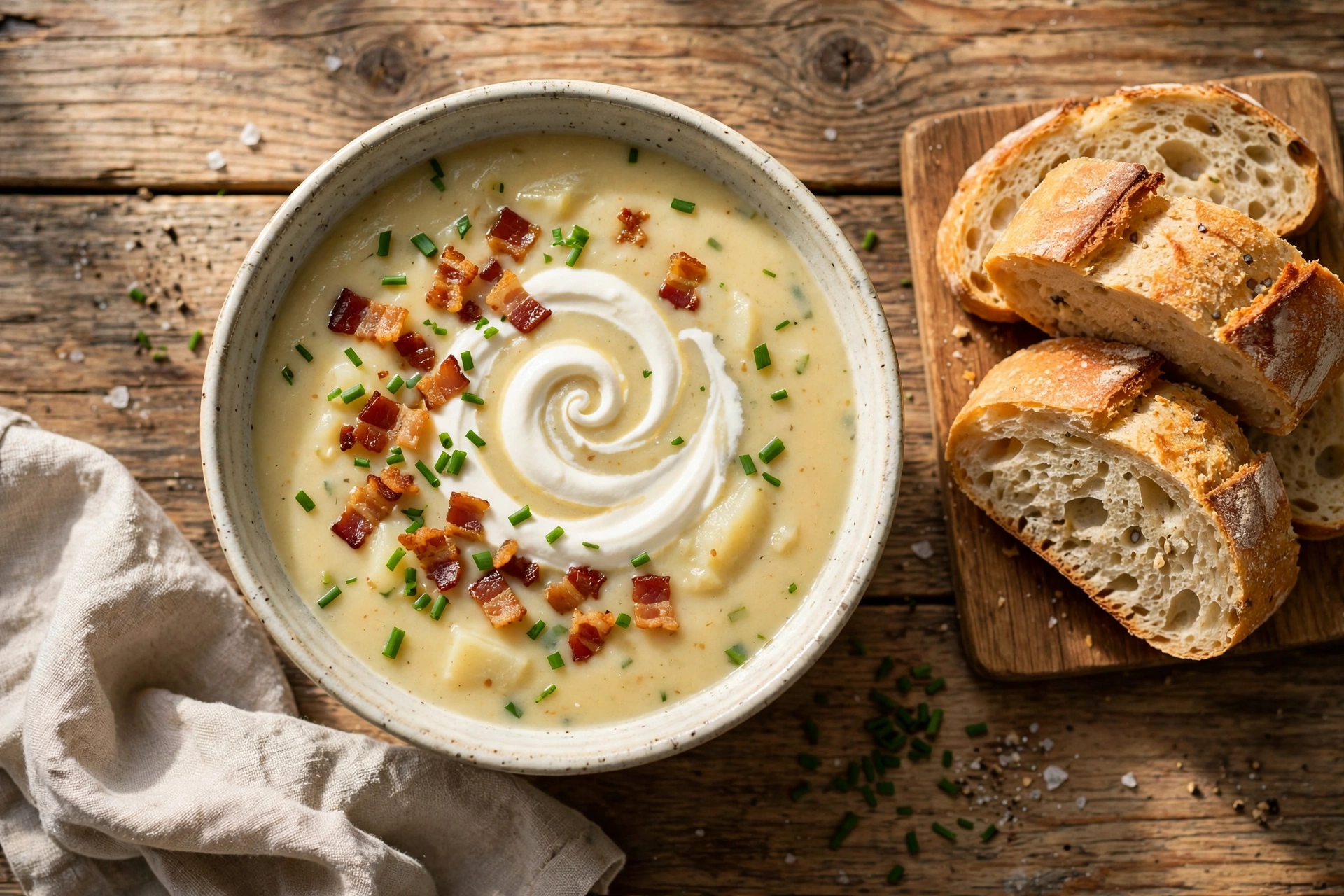
First, the texture is the headline: thick, velvety, and spoon-coating, with a few tender potato chunks left in for contrast. There’s no flour, no cornstarch, no roux — the thickness comes from the potatoes themselves plus a smart blending technique, which means the potato flavour stays front and centre instead of tasting muted and pasty.
Second, it’s genuinely a one-pot, 40-minute dinner. Everything happens in a single Dutch oven or heavy pot: the bacon renders, the aromatics soften, the potatoes simmer, and the soup gets finished right there. Weeknight cooking doesn’t get more forgiving than this.
Third, it’s endlessly customisable without changing the base. The soup itself is a blank canvas in the best way — mild, creamy, savoury — which means every bowl can be different. Loaded baked potato style with bacon and cheddar, lighter with just herbs and a swirl of olive oil, or spicy with jalapeños and pepper jack. One recipe, a dozen different dinners.
Fourth, the ingredients are humble and cheap. Potatoes, onion, garlic, broth, butter, milk, sour cream — nothing exotic, nothing you’ll need to hunt for. This is peasant food in the best sense: simple ingredients transformed by technique into something far greater than the sum of its parts.
And finally, it reheats beautifully and feeds a crowd. A double batch of this soup, a pot of chili-style toppings, and a basket of crusty bread is a complete dinner party menu that costs almost nothing and makes everyone happy. It’s the kind of recipe that quietly becomes “your” recipe — the one people associate with you.
Ingredients for Creamy Potato Soup
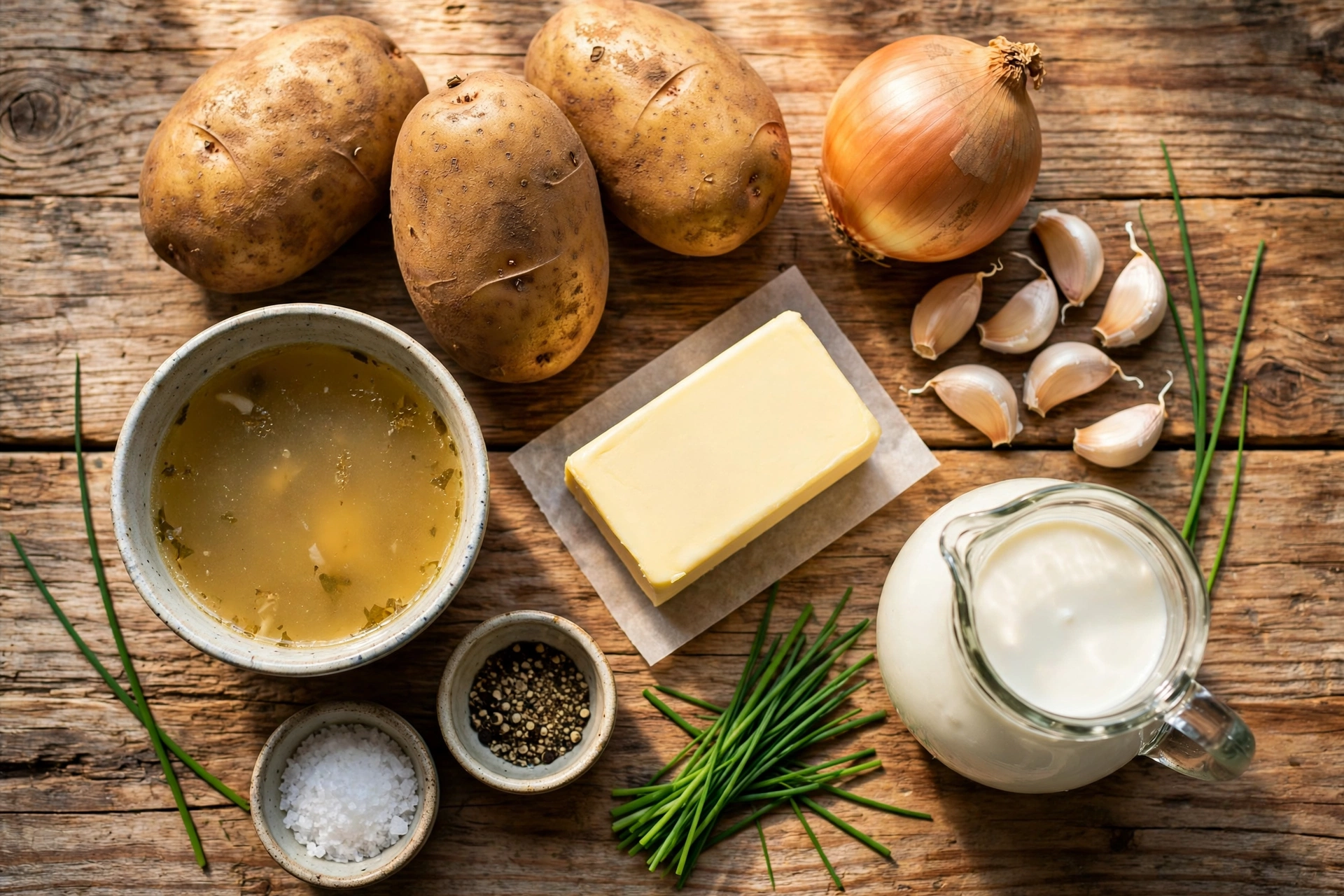
Every ingredient here earns its place. There are no passengers — each one does a specific job, and understanding the job helps you substitute wisely when you need to.
Russet potatoes (2 1/2 lbs / about 1.1 kg): The star and the thickener. As discussed above, high-starch Russets break down into the broth and create that naturally thick body. Cut them into uniform 3/4-inch cubes so they cook evenly — uneven pieces mean some dissolve into mush while others stay hard in the centre.
Bacon (6 slices, thick-cut): Does triple duty: it renders fat for sautéing the aromatics, contributes smoky depth to the broth, and becomes the crispy topping. Thick-cut matters — thin bacon shrivels into nothing. For a vegetarian version, skip it and start with 3 tablespoons of butter or olive oil, then add a teaspoon of smoked paprika to the aromatics for that smoky note.
Yellow onion (1 large, diced): The aromatic foundation. Yellow onions turn sweet and mellow as they soften; don’t rush this step. White onion works too but is sharper; sweet onion (Vidalia) is fine but can make the soup slightly sweet.
Garlic (4 cloves, minced): Added after the onion softens so it doesn’t burn. Fresh garlic only — the jarred kind has an off, acidic taste that shows up in a mild soup like this.
Chicken or vegetable broth (4 cups / 1 quart): The cooking liquid. Low-sodium is non-negotiable — regular broth plus bacon plus cheese makes an oversalted soup you can’t fix. Use a broth you would happily sip on its own; the soup can only taste as good as its liquid.
Butter (3 tablespoons): Added with the aromatics for richness and to help the onion soften without browning. The milk solids in butter add a subtle nutty depth that oil alone doesn’t provide.
Whole milk (1 1/2 cups): This is what makes it “creamy” without heaviness. Whole milk has enough fat to feel rich but won’t weigh the soup down the way all-cream would. The most common mistake is adding cold dairy to hot soup and watching it curdle — you’ll learn the fix in the troubleshooting section.
Sour cream (1/2 cup, full-fat): Stirred in off the heat at the end. It adds a gentle tang that keeps the richness from feeling flat, plus extra body. Full-fat only — light sour cream is stabilised with gums that can make the soup slimy, and fat-free will break.
Sharp cheddar (1 1/2 cups, freshly grated): Melted in at the very end, off the heat. Sharp cheddar has the most flavour per ounce, so a little goes a long way. Grate it yourself — pre-shredded cheese is coated in anti-caking starch that makes soup grainy.
Seasonings: 1 teaspoon fine sea salt (plus more to taste — potatoes need assertive seasoning), 1/2 teaspoon black pepper, 1/2 teaspoon garlic powder (yes, in addition to fresh garlic — it adds a different, deeper garlic note), 1/4 teaspoon smoked paprika, and 2 bay leaves for the simmer. Fresh chives or green onions for serving.
A note on salt: potatoes are salt sponges. They absorb an enormous amount of seasoning, which is why under-salted potato soup is the most common complaint. Season in layers — a pinch with the onions, more with the broth, and a final adjustment at the end. Taste, taste, taste.
Equipment You’ll Need
Nothing fancy. A heavy-bottomed Dutch oven or soup pot (5-6 quart) is ideal — heavy pots distribute heat evenly and prevent scorching on the bottom, which matters when you’re simmering starch-heavy soup. A wooden spoon, a sharp chef’s knife, and a cutting board cover the prep.
For blending, you have two good options. An immersion (stick) blender is the easiest: blend right in the pot, no transferring hot liquid, minimal cleanup. Blend in short pulses and stop while there are still some chunks — over-blending is what causes gluey soup (more on the science below). A countertop blender also works, but blend in batches, never fill more than halfway, and vent the lid (remove the centre cap and cover with a towel) so steam doesn’t blow the lid off. Hot liquid in a sealed blender is a genuine burn hazard — respect it.
A ladle, a box grater for the cheese, and small bowls for toppings round out the list. That’s it. No specialty equipment, no excuses.
How to Make Creamy Potato Soup (Step by Step)

Step 1 — Render the bacon. Place the chopped bacon in a cold Dutch oven over medium heat. Starting cold lets the fat render slowly instead of seizing. Cook, stirring occasionally, until crisp and deeply golden, 8-10 minutes. Lift out with a slotted spoon onto a paper-towel-lined plate. Leave every drop of that rendered fat in the pot — it’s liquid gold and the foundation of the whole soup. Pour off all but about 2 tablespoons if there’s an excessive amount.
Step 2 — Soften the aromatics. Add the butter to the bacon fat, then the diced onion and a pinch of salt. Cook over medium heat, stirring occasionally, until the onion is completely soft, translucent, and sweet — 6-8 minutes. Don’t rush this and don’t let it brown; browned onion gives the soup a darker colour and a caramelised flavour that fights the clean potato taste. When the onion is soft, add the minced garlic and cook 60 seconds more, just until fragrant.
Step 3 — Add potatoes, broth, and seasonings. Stir in the cubed potatoes, coating them in the onion mixture. Pour in the broth, add the bay leaves, salt, pepper, garlic powder, and smoked paprika. The liquid should just barely cover the potatoes — if it doesn’t, add a splash of water. Too much liquid is the enemy of thick soup; you can always thin later, but you can’t easily remove water.
Step 4 — Simmer until tender. Bring to a boil, then reduce to a gentle simmer. Cook uncovered for 15-20 minutes, until the potato cubes are completely tender and a few are starting to fall apart at the edges. Test with a fork — it should slide through with zero resistance. Undercooked potatoes will not blend smooth no matter how long you blend; this is the step where patience pays. Remove and discard the bay leaves.
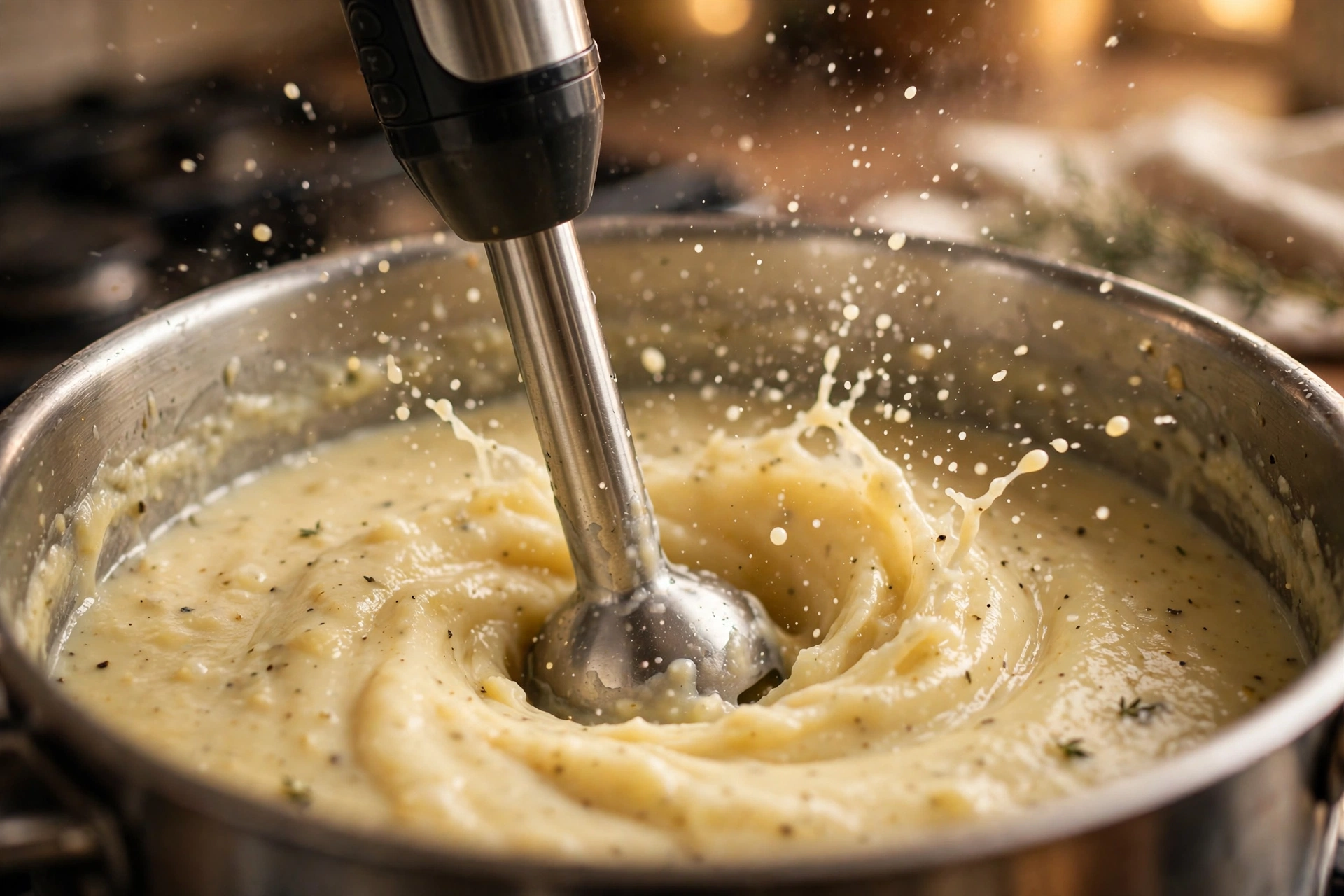
Step 5 — Partial blend. This is the technique step that makes the soup. Using an immersion blender, pulse 4-6 times in different spots around the pot — just enough to break down about two-thirds of the potatoes into a thick purée while leaving plenty of tender chunks. The goal is texture contrast: silky base, satisfying bites. If using a countertop blender, transfer about 3 cups of soup, blend smooth, and return it to the pot. Whatever you do, do NOT blend the entire pot smooth — fully puréed potato soup turns gluey within minutes (the science section explains why).
Step 6 — Add the dairy (the right way). Reduce the heat to low. Pour in the milk, which should be at room temperature or gently warmed — cold milk hitting hot soup can curdle, and even if it doesn’t fully break, it can turn grainy. Stir well, then let the soup warm through for 2-3 minutes without boiling. Boiling after dairy is added is the second great curdling risk; keep it at a bare simmer, with lazy bubbles at most.
Step 7 — Finish with sour cream and cheddar. Take the pot OFF the heat entirely. Stir in the sour cream until fully incorporated, then add the grated cheddar a handful at a time, stirring until each addition melts before adding the next. Adding cheese to boiling soup makes it seize into stringy clumps; off-heat melting gives you a smooth, glossy finish. Taste and adjust: more salt (almost always), more pepper, maybe a squeeze of lemon juice if the richness needs brightening.
Step 8 — Serve loaded. Ladle into warm bowls and top with the reserved crispy bacon, extra cheddar, a dollop of sour cream, and a shower of sliced chives or green onions. Serve immediately with crusty bread for dunking. The contrast between the silky soup and the crunchy, salty toppings is what takes this from good to unforgettable.
Troubleshooting: When Potato Soup Goes Wrong
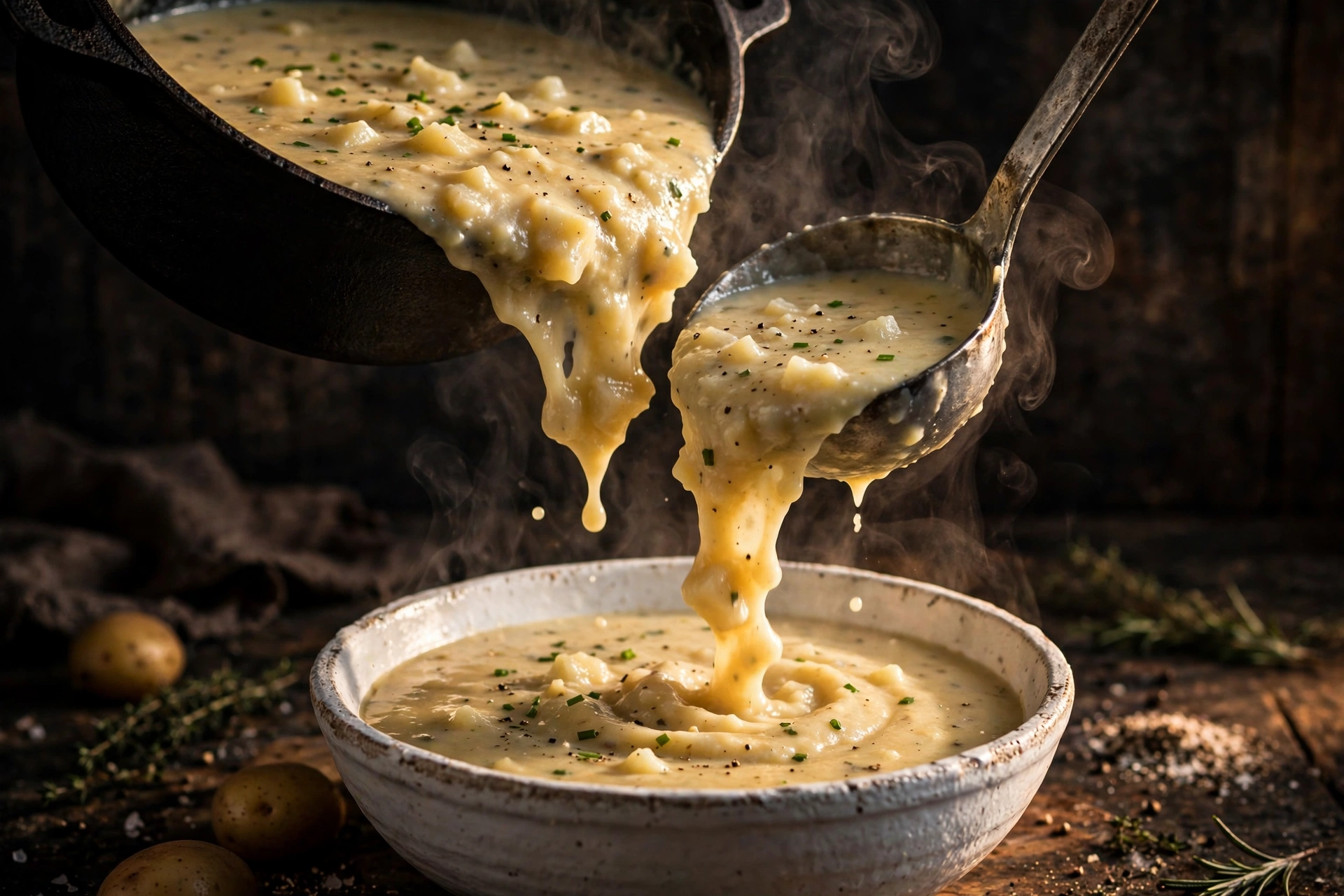
Every common potato soup disaster has a cause and a fix. Here’s the full diagnostic guide.
Problem: Gluey, gummy, wallpaper-paste texture. This is the number-one potato soup failure, and it has one cause: overworked starch. When potato cells are ruptured too aggressively (over-blending, or stirring a fully puréed soup too much), they release excessive amylose starch, which forms long chains that feel gluey on the tongue. The fix is prevention: blend only partially, pulse rather than running the blender continuously, and once the soup is blended, stir gently. If it’s already gluey, you can’t fully reverse it — but you can rescue the bowl by thinning with warm broth and adding an extra splash of cream, which dilutes the starch concentration and masks the texture. For next time: less blending, more chunks.
Problem: Thin and watery. Usually too much liquid or not enough simmering time. Fix it by simmering uncovered for 10-15 more minutes to reduce, then blending a bit more of the potatoes to release their starch. In a real emergency, mash a cup of the potato chunks against the side of the pot with a fork and stir them back in — instant thickener, no flour needed. To prevent it: measure your broth, keep the liquid just covering the potatoes, and remember that the soup thickens slightly as it cools.
Problem: Bland, tastes like nothing. Under-seasoning, almost guaranteed. Potatoes absorb salt aggressively, so the amount that seems right is usually half of what you need. Fix: add salt in 1/4-teaspoon increments, tasting after each, until the flavours suddenly “wake up” — you’ll know the moment. Also check acid: a teaspoon of lemon juice or a splash of white wine vinegar at the end brightens everything without tasting sour. And make sure your broth was flavourful to begin with.
Problem: Grainy or curdled dairy. Caused by boiling after dairy was added, or adding cold dairy to very hot soup. Fix for mild graininess: blend the soup briefly — sometimes the texture smooths out. For a fully broken soup, strain it, then whisk the strained liquid with a cornstarch slurry (1 tablespoon cornstarch + 2 tablespoons cold water) and simmer gently to re-emulsify. Prevention: warm your milk, add dairy off the boil, and never let the soup boil after the milk goes in.
Problem: Cheese turned stringy or clumpy. The soup was too hot when the cheese went in, or pre-shredded cheese was used. Fix: fish out the clumps if you can, then blend briefly to smooth. Prevention: grate your own cheese, add it off the heat in handfuls, and stir each addition until melted. Low-moisture cheeses (aged cheddar, Parmesan) melt more cleanly than young, high-moisture ones.
Problem: Potatoes still hard after 20 minutes. The cubes were cut too large, or the simmer wasn’t actually simmering (too low). Fix: keep cooking — there’s no shortcut, just give them time. Cut any remaining large pieces in half in the pot. Prevention: uniform 3/4-inch cubes and a visibly bubbling (not violently boiling) simmer.
Problem: Soup tastes flat despite enough salt. Missing acid or missing aromatic depth. Fix: a squeeze of lemon juice, a teaspoon of Dijon mustard stirred in (it disappears into the background but adds complexity), or a splash of Worcestershire sauce. A pinch of cayenne or white pepper can also wake up a flat soup without making it spicy.
My Best Tips for Perfect Potato Soup
These are the small things that separate good potato soup from the kind people remember.
Warm your dairy. Cold milk into hot soup is the fastest route to graininess. Set the milk and sour cream on the counter when you start cooking so they’re at room temperature by the time you need them. For the milk, 30 seconds in the microwave takes the chill off completely.
Grate your own cheese. Pre-shredded cheese contains cellulose and potato starch to prevent clumping in the bag — and those same anti-caking agents prevent smooth melting in your soup. A box grater and two minutes gives you cheese that melts into silk.
Under-blend, always. You can always blend more; you can never un-blend. Start with 3-4 pulses, stir, and look. The ideal is a thick, creamy base with visible tender chunks throughout — roughly 60-70% blended. Restaurants that serve fully smooth potato soup use techniques (ricers, tamis sieves) that don’t rupture starch the way blenders do.
Salt in layers, finish with acid. Salt the onions, salt the broth, salt at the end. Then, right before serving, add a tiny squeeze of lemon juice or a splash of vinegar. Acid doesn’t make soup taste sour at these quantities — it makes every other flavour taste more like itself. This is the professional secret behind “restaurant” flavour.
Warm the bowls. Hot soup in a cold bowl drops 10-15 degrees instantly, and lukewarm potato soup tastes noticeably less rich. Run bowls under hot water for a minute, dry them, then ladle. It’s a two-minute step that makes the soup taste better for the entire bowl.
Don’t skip the toppings. Potato soup without toppings is a 7 out of 10. With crispy bacon, sharp cheddar, cool sour cream, and fresh chives, it’s a 10. The toppings aren’t decoration — they add the salt, fat, acid, and crunch contrasts that make each spoonful interesting.
Delicious Variations to Try
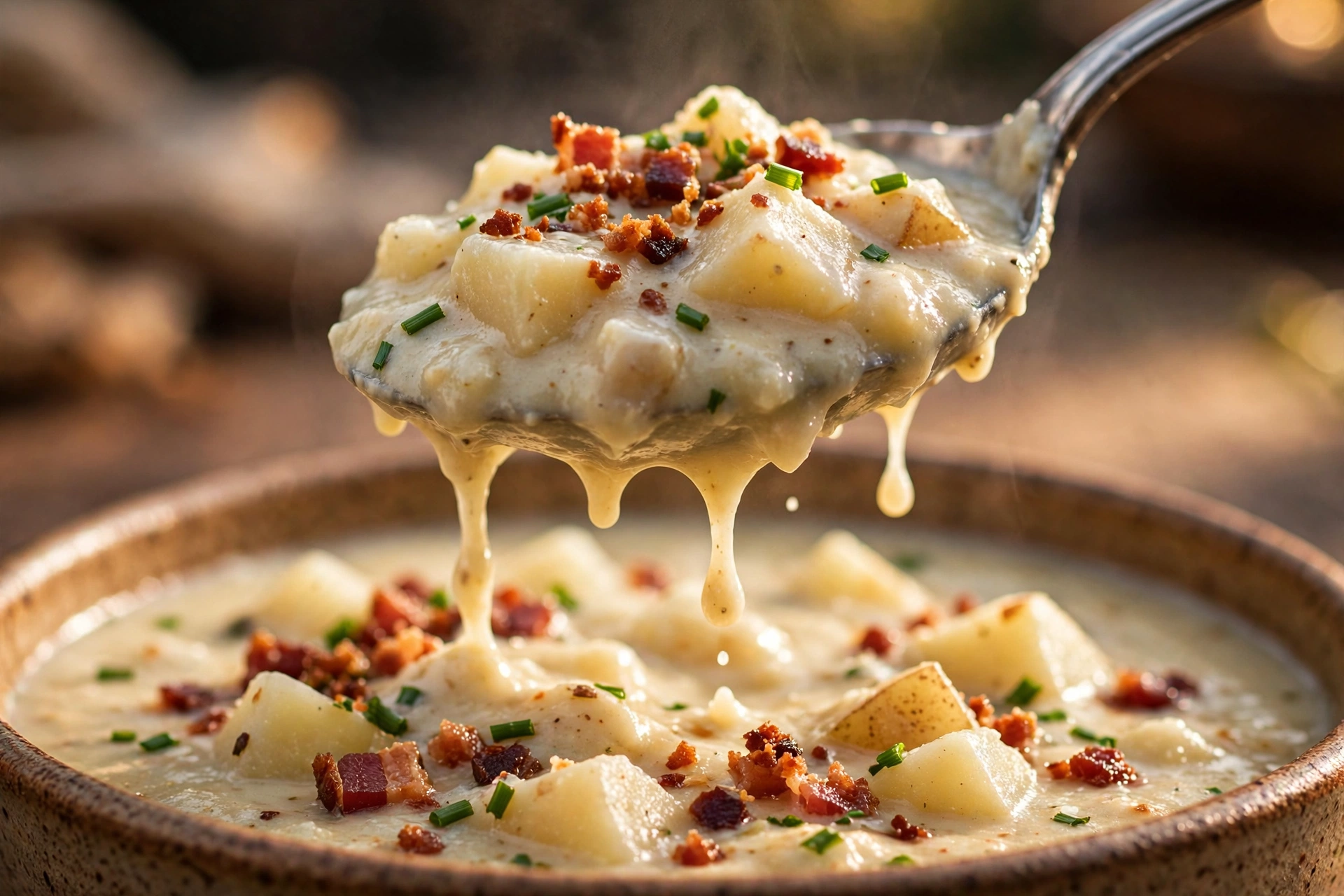
Once you’ve mastered the base, this soup becomes a template. Here are the variations worth knowing, each tested to work with the same foundation.
Loaded Baked Potato Soup: The classic. Make the base exactly as written, then go heavy on the toppings bar: crispy bacon, shredded sharp cheddar, sour cream, sliced green onions, and a pinch of smoked paprika over each bowl. For extra indulgence, stir 4 ounces of cream cheese into the soup with the sour cream — it adds body and a tangy richness that tastes like the inside of a twice-baked potato.
Broccoli Cheddar Potato Soup: Add 3 cups of small broccoli florets to the pot for the last 8 minutes of simmering, before blending. The broccoli softens into the soup and the cheddar ties it all together. Use a full 2 cups of cheddar in this version — it’s essentially two great soups in one pot.
Smoky Chipotle Potato Soup: Add 1-2 minced chipotle peppers in adobo sauce with the garlic, and swap the smoked paprika for 1 teaspoon of ground cumin. Top with pepper jack instead of cheddar, plus coriander and a squeeze of lime. The smokiness plays beautifully against the creamy potatoes.
Leek and Potato (Vichyssoise-Style): Replace the onion with 3 large leeks (white and light green parts only, sliced and thoroughly washed — leeks hide grit between their layers). Skip the bacon and cheddar; finish with a swirl of cream and fresh chives. Serve hot in winter or chilled in summer as vichyssoise. Elegant, simple, and proof that the technique matters more than the ingredient list.
Vegetarian / Vegan Version: Skip the bacon (start with butter or olive oil + 1 teaspoon smoked paprika), use vegetable broth, swap the milk for unsweetened oat milk or cashew cream, use a vegan sour cream, and either skip the cheese or use a good melting vegan cheddar. The potato-starch thickening technique works identically — the soup is still thick and satisfying.
Lighter Version: Skip the bacon and cheese entirely, use olive oil instead of butter, and finish with 1/2 cup of Greek yogurt instead of sour cream plus a big handful of fresh herbs (parsley, dill, chives). You lose some richness but gain a fresh, bright soup that still satisfies — around half the calories per bowl.
Clam Chowder Crossover: Add a bottle of clam juice (8 oz) to the broth and stir in a can of chopped clams (drained) with the dairy. Finish with oyster crackers and Old Bay seasoning. It’s not traditional New England chowder, but it’s a delicious weeknight approximation that scratches the same itch.
Storing & Make-Ahead
Potato soup is a meal-prep champion with one important rule: dairy goes in fresh, not before storage. The base soup (everything through the blending step, before milk, sour cream, and cheese) refrigerates and freezes beautifully. The finished soup with dairy is fine refrigerated for 3-4 days but doesn’t freeze well — the dairy separates and turns grainy when thawed.
Refrigerating: Cool the soup to room temperature within 2 hours (divide into shallow containers to speed cooling), then refrigerate up to 4 days. The soup will thicken considerably when cold — this is normal starch behaviour, not a problem. Reheat gently over medium-low heat, stirring occasionally, and thin with a splash of warm broth or milk until it returns to the right consistency. If you stored the base without dairy, add the milk, sour cream, and cheese during reheating, following the same off-heat method.
Freezing (dairy-free base only): Ladle the blended base into freezer containers or zip-top bags, leaving an inch of headspace. Freeze up to 3 months. Thaw overnight in the refrigerator, then reheat gently and finish with the dairy as if freshly made. Label with the date — frozen soup all looks the same after a month.
Make-ahead for a crowd: Make the base up to 2 days ahead and refrigerate. On serving day, reheat, finish with dairy, and set up a toppings bar. The bacon can be cooked a day ahead and recrisped in a 375°F oven for 5 minutes. Grate the cheese ahead and refrigerate. Slice the chives just before serving so they stay bright.
What not to do: Don’t freeze the finished soup with sour cream and cheese — it will separate. Don’t store in the pot it cooked in for more than a day (acidic ingredients can react with some pot materials, and it cools too slowly). And don’t reheat in the microwave on high — the uneven heat can break the dairy; use 50% power in short bursts with stirring, or better yet, the stovetop.
What to Serve with Potato Soup
Potato soup is rich and filling, so the best pairings add contrast: crunch, acidity, or freshness.
Bread (non-negotiable): A crusty sourdough, a warm baguette, or homemade dinner rolls for dunking. The crispy-chewy contrast with silky soup is the whole point. Garlic bread is excellent too — the garlic echoes the soup’s aromatics. In a pinch, even saltine crackers work; there’s a reason every diner serves them with soup.
Salad: A crisp green salad with a sharp vinaigrette cuts through the richness. Arugula with lemon dressing, a classic Caesar, or a simple cucumber-tomato salad all work. The acid in the dressing resets your palate between spoonfuls.
Sandwiches: Soup-and-sandwich is a classic for a reason. A grilled cheese (made with the same sharp cheddar) is the ultimate companion — dip it directly in the soup. A BLT, a turkey club, or even a simple ham and Swiss on rye all turn the soup into a complete, satisfying meal.
For a dinner party: Start with the soup as a first course in small cups, then serve a lighter main — roasted chicken, a big salad with protein, or a vegetable tart. The soup’s richness means the main should be comparatively light. Finish with something bright and acidic for dessert: lemon tart, fruit sorbet, or apple crisp — or, if it’s a Friday night, a classic paloma alongside the soup.
The Science of Creaminess: Why This Soup Thickens Itself
Understanding what’s happening in the pot turns you from a recipe-follower into a cook who can improvise. The creaminess of this soup comes from three overlapping mechanisms, and knowing them explains every technique in the recipe.
Mechanism 1: Starch gelatinisation. Raw potato starch exists as tight granules. When heated in liquid above about 140°F, those granules absorb water, swell, and eventually burst — releasing long starch molecules (amylose and amylopectin) into the broth. This is gelatinisation, and it’s the same process that thickens gravy and sets custard. Russet potatoes are ideal because their high starch content means more granules bursting, more starch released, more body. This is also why the soup thickens as it simmers and thickens further as it cools: the starch molecules continue to tangle and trap water.
Mechanism 2: Mechanical breakdown. Blending ruptures potato cell walls directly, spilling their starchy contents into the liquid instantly. This is fast thickening — but it’s also where the gluey-soup danger lives. Gentle blending ruptures some cells (good, thickening); aggressive blending ruptures nearly all of them and shears the released starch molecules into long, gummy chains (bad, gluey). The partial-blend technique is the sweet spot: enough ruptured cells for body, enough intact chunks for texture, and the starch chains stay short enough to feel silky rather than pasty.
Mechanism 3: Fat emulsion. The butter, bacon fat, milk fat, and cheese don’t just add richness — they form a loose emulsion with the starchy liquid, where tiny fat droplets are suspended throughout. Fat droplets interrupt the starch network, keeping it from setting too firmly, which is why the soup feels creamy and flowing rather than stiff. This is also why low-fat versions can taste oddly thick-but-not-creamy: without enough fat to lubricate the starch network, the texture reads as pasty. The sour cream added at the end contributes both fat and acid; the acid slightly weakens starch bonds, keeping the final texture silky.
Putting it together: the simmer gelatinises starch gradually, the partial blend releases a controlled burst of starch, and the dairy fats emulsify everything into a stable, spoon-coating soup. Every “rule” in this recipe — Russets not reds, partial not full blending, dairy off the boil, room-temperature milk — exists to manage these three mechanisms. Once you see the system, you can troubleshoot any soup, not just this one.
The Loaded Soup Bar: Feeding a Crowd
For parties, game days, or family gatherings, turn this soup into an interactive experience. A toppings bar lets everyone build their perfect bowl, accommodates picky eaters and dietary restrictions without cooking separate meals, and looks impressive with almost no extra effort.
The setup: Make a double batch of the soup base (use a large stockpot; the recipe scales linearly). Keep it warm in the pot over the lowest heat, or transfer to a slow cooker on the WARM setting — never on LOW or HIGH for serving, which will keep cooking the soup and risk breaking the dairy. Set out toppings in small bowls with spoons, arranged from most popular to most adventurous.
Essential toppings (the classics): Crispy bacon crumbles, shredded sharp cheddar, sour cream, sliced green onions or chives. These four cover 90% of what people want.
Upgrade toppings: Diced jalapeños (fresh or pickled), crumbled blue cheese, caramelised onions, roasted garlic cloves, hot sauce bottles, crispy fried shallots, everything-bagel seasoning, and a bowl of oyster crackers or croutons for crunch.
Quantity math: Plan on 1 1/2 cups of soup per person as a main course, 3/4 cup as a starter. For 12 people as a main: triple the recipe (about 7 1/2 pounds of potatoes, 3 quarts of broth). Toppings: 1 1/2 pounds of bacon, 1 pound of cheddar, 2 cups of sour cream, and 2 bunches of green onions will generously cover 12 loaded bowls.
Logistics: Put the soup at one end of the table and the toppings in serving order after it, so the line flows naturally. Provide wide, shallow bowls (easier to load toppings than deep mugs) and large spoons. Keep extra broth warm on the side — the soup thickens as it sits, and a splash per bowl keeps the texture right over a long party. Label anything spicy; your guests will thank you.
The Complete Meal Prep & Freezer Guide
This soup is one of the best meal-prep candidates in existence — cheap, filling, reheats well, and endlessly re-toppable so it never gets boring. Here’s the full system.
The Sunday batch: Make a double batch of the dairy-free base (through the blending step). This takes about an hour of mostly hands-off time. Divide into 6-8 individual portions in microwave-safe containers. Refrigerate what you’ll eat within 4 days; freeze the rest. Also prep a toppings kit: cook a pound of bacon and crumble it (refrigerates 5 days), grate 2 cups of cheddar, slice a bunch of green onions, and portion sour cream into small containers. The entire week’s lunches are now a 3-minute assembly job.
Daily assembly: Reheat one portion of base on the stove or in the microwave (50% power, stirring halfway). Stir in a splash of milk, a spoonful of sour cream, and a handful of cheese per portion. Top and eat. Each bowl tastes freshly made because the dairy and toppings ARE freshly added — the base is just the canvas.
Freezer strategy: Freeze the base flat in zip-top bags (lay them flat until solid, then stack like files — they thaw faster and store efficiently). A flat quart bag thaws in about an hour on the counter or overnight in the fridge. Keep a “soup base” section of your freezer with 4-6 bags and you’ll always be one step from dinner. Remember: never freeze the finished soup with dairy; always freeze the base and finish fresh.
Preventing boredom: The base is neutral enough to become a different meal each day. Monday: classic loaded. Tuesday: broccoli cheddar (add frozen broccoli while reheating). Wednesday: chipotle (stir in adobo sauce and top with pepper jack). Thursday: light version (Greek yogurt, fresh herbs, no cheese). Friday: use it as a sauce — thin slightly and pour over baked potatoes or roasted vegetables. Same base, five different dinners, zero complaints.
What keeps and what doesn’t: The base keeps 4 days refrigerated, 3 months frozen. Cooked bacon keeps 5 days refrigerated (recrisp in a hot skillet). Grated cheddar keeps 5 days refrigerated. Sliced green onions keep 3 days (store in a damp paper towel inside a bag). Sour cream keeps 2 weeks unopened. Assembled bowls with dairy keep 3 days but the texture is best within 2.
Final Thoughts
Potato soup is humble food, and that’s exactly its power. It doesn’t rely on expensive ingredients or complicated technique — it relies on understanding a few fundamentals and executing them with care. Choose the right potato. Season boldly. Blend partially. Add dairy gently. Those four sentences are the entire recipe, and they’ll serve you in every soup you ever make.
But beyond technique, there’s something about a pot of potato soup on the stove that changes the feeling of a house. It’s the smell of onion softening in bacon fat, the sound of a gentle simmer, the ritual of ladling into warm bowls and passing the toppings. It’s comfort you can make with your own hands in 40 minutes, and that never stops feeling like a small miracle.
So make the big pot. Top it generously. Share it with people you like. And when someone asks for the recipe — because they will — you’ll know exactly why it works, and you’ll be able to explain every step. That’s the difference between following a recipe and owning it.
Creamy Potato Soup
Ingredients
Equipment
Method
- Render the bacon. Place the chopped bacon in a cold Dutch oven over medium heat and cook, stirring occasionally, until crisp, 8–10 minutes. Lift out with a slotted spoon and set aside, leaving the rendered fat in the pot.
- Soften the aromatics. Add the butter to the bacon fat, then the diced onion and a pinch of salt. Cook over medium heat, stirring often, until soft and translucent, 5–6 minutes. Stir in the garlic and cook for 1 minute more.
- Add the potatoes, broth and seasonings. Stir in the cubed potatoes to coat them in the onion mixture. Pour in the broth, add the bay leaves, salt, black pepper, garlic powder and smoked paprika, and stir to combine.
- Simmer until tender. Bring to the boil, then reduce to a gentle simmer. Cook uncovered for 15–20 minutes, until the potato cubes are completely tender when pierced with a knife.
- Blend partially. Fish out and discard the bay leaves. Using an immersion blender, pulse 4–6 times in different spots, leaving plenty of chunks for texture. Never blend it smooth — over-blending makes the soup gluey.
- Add the milk. Reduce the heat to low and pour in the milk, which should be at room temperature. Stir gently and do not let the soup boil from this point on.
- Finish with sour cream and cheddar. Take the pot off the heat entirely. Stir in the sour cream until fully incorporated, then add the grated cheddar a handful at a time, stirring until melted. Taste and adjust the salt.
- Serve loaded. Ladle into warm bowls and top with the reserved crispy bacon, extra cheddar, a dollop of sour cream and sliced chives.
Frequently Asked Questions
What are the best potatoes for potato soup?
Russet potatoes are the best choice for this creamy potato soup recipe — their high starch content breaks down during cooking and naturally thickens the soup into a creamy, velvety texture. Yukon Golds are a good second choice with a slightly buttery flavour. Avoid waxy potatoes like red potatoes or fingerlings, which hold their shape and leave the soup thin.
Why did my potato soup turn out gluey?
Over-blending is the cause. Aggressive blending ruptures too many potato cells and releases excess starch, which forms gummy chains. Fix it by blending only partially (4-6 pulses, leaving chunks) and stirring gently afterward. You can always blend more, but you can never un-blend.
Can I make potato soup without cream?
Yes — this creamy potato soup recipe uses milk and sour cream rather than heavy cream, and the thickness comes from the potatoes themselves, not dairy. For an even lighter version, use olive oil instead of butter, skip the cheese, and finish with Greek yogurt. The soup stays thick because of the starch, not the fat.
How do I keep the soup from curdling when I add milk?
Three rules: bring the milk to room temperature first, reduce the heat to low before adding it, and never let the soup boil after dairy goes in. Cold dairy hitting hot soup, or boiling after dairy is added, causes the proteins to seize and turn grainy.
Can I freeze potato soup?
Freeze the base BEFORE adding dairy — the blended potato-broth base freezes perfectly for up to 3 months. Finished soup with milk, sour cream, and cheese will separate and turn grainy when thawed. Thaw the base overnight, reheat gently, then finish with fresh dairy.
Why is my soup bland even though I added salt?
Potatoes absorb an enormous amount of salt, so under-seasoning is the most common issue. Add salt in layers and taste at the end — the amount that seems right is usually half of what’s needed. A squeeze of lemon juice or splash of vinegar at the end also brightens flavours without tasting sour.
Can I make this in a slow cooker?
Yes. Cook the bacon separately, then add everything except the dairy to the slow cooker (onion can go in raw — it will soften over the long cook). Cook on LOW 6-7 hours or HIGH 3-4 hours until potatoes are tender, then blend partially and finish with dairy on the stovetop or with the cooker on WARM. Don’t add dairy at the start — the long cook time will break it.
Should I peel the potatoes?
Yes, for this soup. Russet skins are thick and papery, and even after blending they leave dark flecks with a tough texture. Five minutes of peeling gives you a noticeably silkier result. Save the peels — toss with oil and salt and roast for crispy snacks.
How can I thicken thin potato soup?
Simmer uncovered for 10-15 minutes to reduce, then blend more of the potatoes to release their starch. In a hurry, mash a cup of the potato chunks against the pot with a fork and stir back in. Avoid adding flour — it mutes the potato flavour and can taste pasty.
Is potato soup gluten-free?
As written, yes — there is no flour or thickener containing gluten. Just verify your broth is certified gluten-free (some brands contain hidden gluten) and check that your bacon has no gluten-containing additives.
How long does potato soup last in the fridge?
3-4 days in an airtight container. It will thicken considerably when cold — that’s normal starch behaviour. Reheat gently over medium-low heat, stirring occasionally, and thin with a splash of warm broth or milk to restore the texture.
What goes well with potato soup?
Crusty bread for dunking is essential. A crisp green salad with vinaigrette cuts the richness, and a grilled cheese sandwich turns it into the ultimate comfort meal. For toppings: bacon, cheddar, sour cream, and chives are the classic loaded combination.

Hi, I’m Angela. I cook the way busy people actually cook — simple, tasty food with ingredients you already have. On CookBookBite I share easy recipes, honest kitchen tips, and dishes my family asks for again and again.