

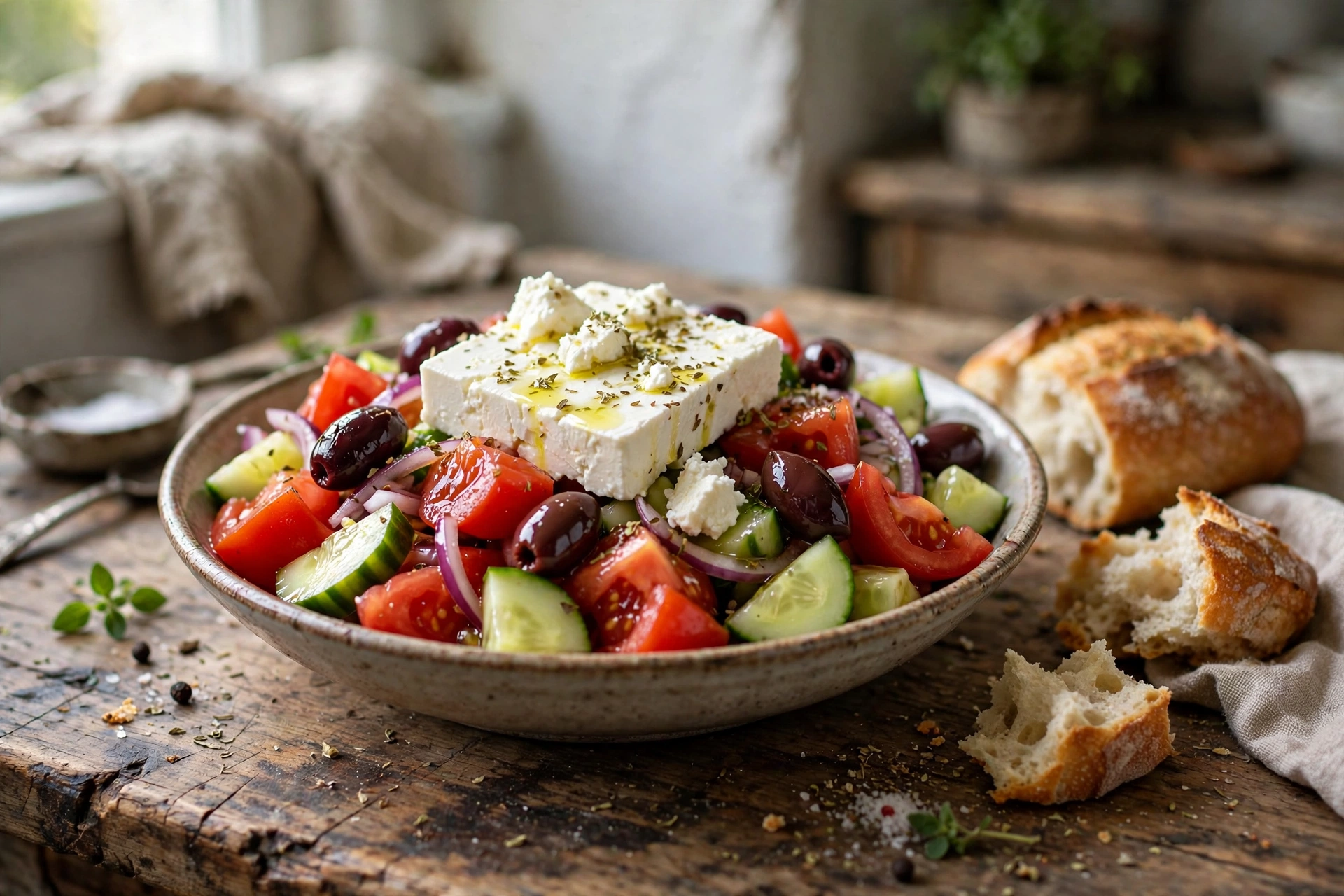
Picture a shallow bowl arriving at a sun-warmed taverna table: chunks of tomato so ripe they’re almost splitting, cool cucumber, purple-red onion sliced paper-thin, olives like polished stones. And on top — not crumbled, never crumbled — a whole proud slab of feta, glistening with green-gold olive oil and dusted with oregano. Nobody tosses this salad. Nobody would dare. You break the feta yourself, with your fork, and drag each bite through the tomato juices pooling at the bottom.
That is horiatiki, the real Greek salad, and it rewires your idea of what a salad can be. Because here’s the truth: most “Greek salads” outside Greece are impostors. They’ve got lettuce (real horiatiki never does), crumbled feta from a plastic tub, and some sad bottled dressing. The authentic version is simpler, bolder, and about ten times more delicious — and it takes fifteen minutes with zero cooking.
This is that salad. Chunky vegetables, a slab of real feta, great olive oil, and nothing else competing for attention. Once you make it right, the lettuce version will taste like a rumor.
Why You’ll Love This Greek Salad Recipe
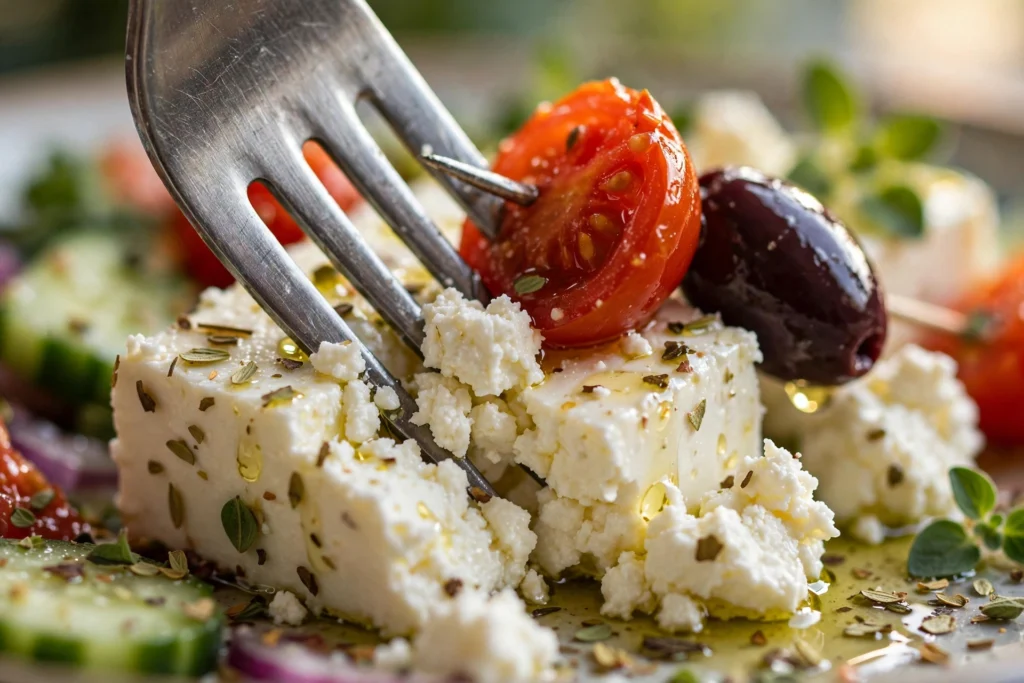
First, it’s proof that simple beats complicated. Six ingredients plus cheese, no cooking, no dressing to emulsify — just great produce, great oil, and the confidence to let them shine. When tomatoes are at their peak, this might be the best thing you’ll eat all summer. The ingredient list is short enough to memorize, which means you’ll actually make it on a Tuesday, not just bookmark it for “someday.”
Second, the feta slab is a revelation if you’ve only had crumbles. A thick slice of briny, creamy feta on top means every bite has a different ratio — sometimes mostly tomato, sometimes a big creamy chunk of cheese. Breaking it apart yourself at the table is half the pleasure. It also looks spectacular, which matters when you’re serving guests. A slab of feta glistening with olive oil is a centerpiece, not a garnish.
Third, there’s no lettuce to go soggy, which makes this the rare salad that’s actually better after sitting for ten minutes. The tomato juices mingle with the olive oil and vinegar into a dressing that no bottle could replicate. Mop it up with bread — in Greece, that’s not optional, it’s the point. The juices at the bottom of the bowl are arguably the best part, and the bread is the delivery system.
Finally, it’s naturally healthy without a single compromise: gluten-free, vegetarian, low-carb, packed with vegetables and heart-healthy olive oil. It works as a light lunch, a side for grilled meats, or the centerpiece of a mezze spread. It fits almost every eating style without any substitution gymnastics — no cauliflower pretending to be rice, no sad compromises. Just food that happens to be good for you.
There’s also the sheer speed. Fifteen minutes, one cutting board, one knife, one bowl. No preheating, no timing, no resting meat, no checking temperatures. On the nights when cooking feels like too much, this is dinner — or at least the brightest part of it.
Ingredients for Authentic Greek Salad
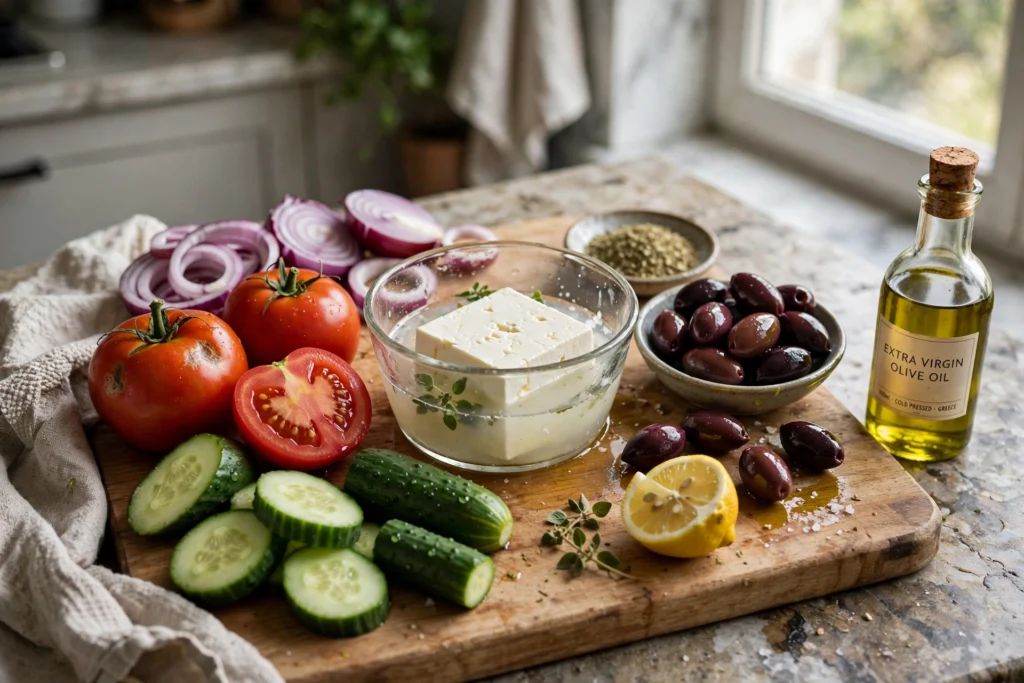
Ripe tomatoes (4 medium, about 1½ lbs) — The entire salad stands or falls here. Use the ripest, most fragrant tomatoes you can find — heirlooms in summer are transcendent. They should smell like a tomato when you sniff the stem end. Out of season, cherry tomatoes are your best bet; they’re reliably sweet year-round. Cut into hearty wedges or chunks, never diced small. The chunk size matters: too small and they release all their juice at once and turn to mush; big rustic wedges hold their shape and release juice slowly, which is exactly what you want.
Cucumber (1 large English cucumber) — Peeled in stripes or fully, then sliced into half-moons about ¼-inch thick. English cucumbers have thin skin and minimal seeds. In Greece, they’d use the local variety; English is the closest widely available match. If you can only find standard waxy cucumbers, peel them completely — the wax coating is unpleasant in a raw salad. Persian cucumbers also work beautifully and need no peeling at all.
Red onion (½ medium, thinly sliced) — Slice it as thin as you possibly can — shaved, really. Thick onion chunks overpower; whisper-thin slices melt into the salad and distribute their sharp-sweet flavor evenly. If raw onion bothers you, soak the slices in ice water for 10 minutes to tame the bite, then pat them thoroughly dry before adding. A mandoline makes this effortless, but a sharp knife and patience work just as well.
Green bell pepper (1, optional but traditional) — Sliced into thin rings or strips. It adds a fresh, slightly bitter crunch that’s very characteristic of the classic version. Some Greek families skip it; many traditional recipes include it. The pepper’s vegetal crunch contrasts beautifully with the soft tomatoes and creamy feta.
Kalamata olives (1 cup) — The real thing: dark purple, almond-shaped, briny and fruity. Buy them with pits if you can — they taste better, and working around pits at a summer table is part of the charm. If you must go pitted for convenience, no judgment. Avoid the bland black “ripe” olives from cans; they have almost no flavor in comparison.
Feta cheese (7 oz / 200g, in one slab) — Buy feta in brine, sold as a block — never pre-crumbled. The block (often labeled “feta in brine”) is creamier, saltier, and infinitely better. Sheep’s milk feta is traditional and tangier; cow’s milk feta is milder. Either works, but get the block. This single choice makes more difference than any other ingredient swap in the recipe.
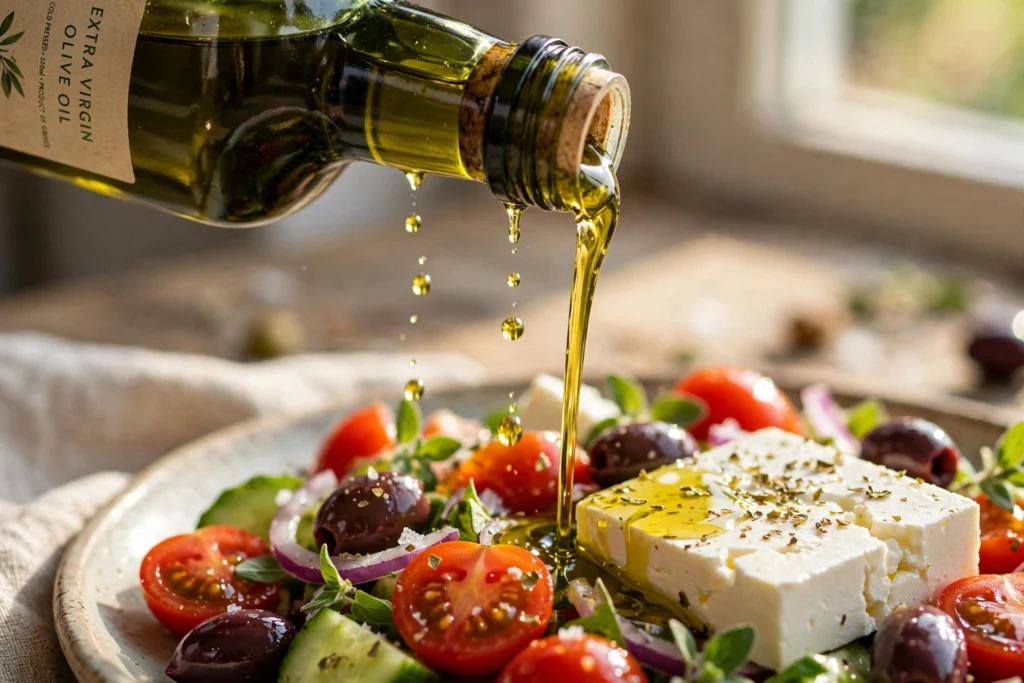
Extra-virgin olive oil (⅓ cup) — Be generous. This is a main ingredient, not a garnish. Use fruity, peppery oil — Greek, if you can find it. The oil pools with the tomato juices at the bottom of the bowl and becomes the sauce; cheap or stale oil will drag the whole salad down. Taste your oil before using it: it should taste alive, with a peppery tickle at the back of your throat.
Red wine vinegar (1 tablespoon) — Just a splash for brightness. Some purists use only lemon or nothing at all, but a tablespoon of vinegar sharpens everything and balances the richness of the oil and feta. Add it sparingly; you can always add more, but you can’t take it back.
Dried Greek oregano (1 teaspoon) — Dried, not fresh — this is one of the rare cases where dried is traditional and better. Rub it between your palms over the salad to wake up the oils. Greek oregano (rigani) has a more intense, almost piney flavor than the milder varieties; if you can find it at a Mediterranean market, it’s worth the trip.
Flaky sea salt — To taste. The feta and olives bring plenty of salt, so season the vegetables first, then adjust. A flaky finishing salt adds little crunchy bursts that fine table salt can’t replicate.
Equipment You’ll Need
A cutting board, a sharp chef’s knife, and a wide shallow serving bowl (not a deep one — you want everything visible and accessible, arranged like a landscape rather than piled in a canyon). That’s it. This is a knife-and-bowl recipe, which is exactly as it should be. A mandoline is a nice luxury for the onion but absolutely not required. If you want to get fancy, a large wooden serving board and a small dish for olive pits complete the taverna setup.
How to Make Greek Salad (Step by Step)
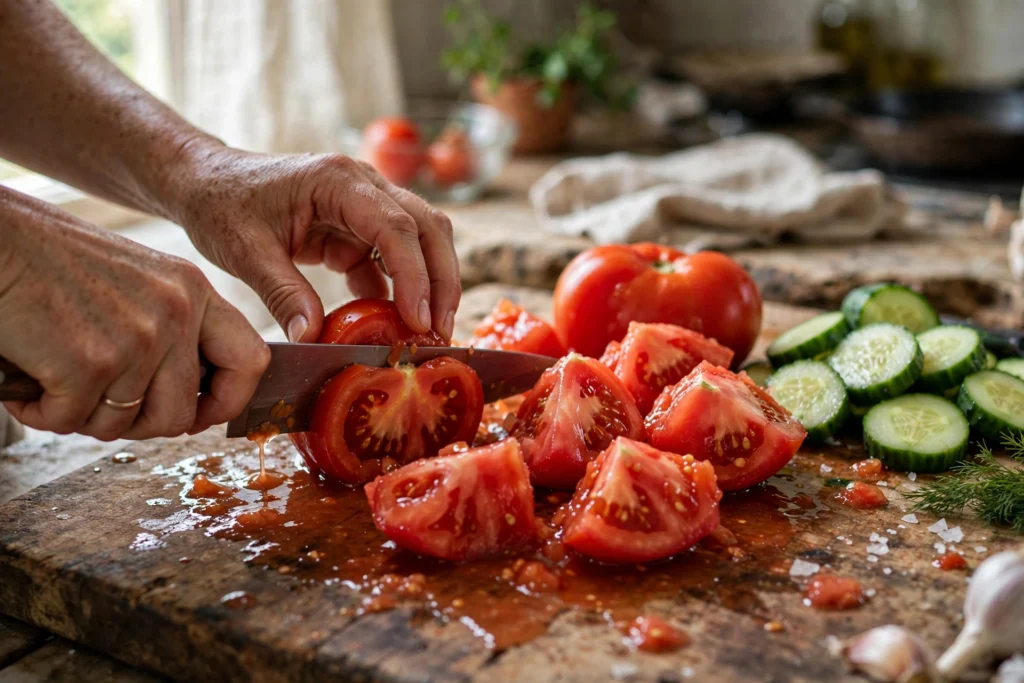
Step 1 — Prep the vegetables. Cut the tomatoes into chunky wedges (6–8 per tomato). Slice the cucumber into ¼-inch half-moons. Shave the red onion as thin as humanly possible. Slice the bell pepper into thin rings. Keep everything chunky and rustic — this is a peasant salad, not a brunoise competition. Uniformity matters less than generosity; big confident cuts are the aesthetic.
Step 2 — Combine (gently). In your serving bowl, combine the tomatoes, cucumber, onion, bell pepper, and olives. Sprinkle with a good pinch of flaky salt. Toss gently with your hands or two spoons — once, lightly. You’re not making coleslaw; the vegetables should stay distinct and the tomatoes should stay intact. Over-tossing bruises the tomatoes and turns the whole thing murky.
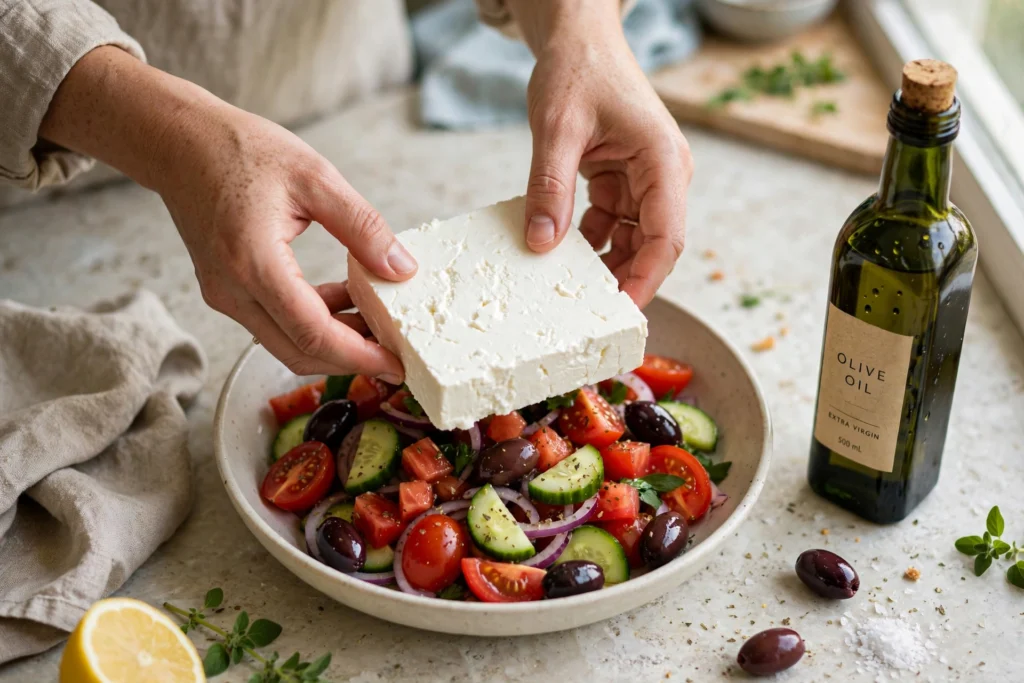
Step 3 — Crown with feta. Lay the whole slab of feta right on top, centered like a monument. Do not crumble it, do not cube it. The slab is traditional, beautiful, and functionally superior — it keeps the cheese creamy instead of dissolving into the juices, and it gives the salad its iconic look. If your feta block is very thick, you can slice it horizontally into one or two wide slabs, but keep them whole.
Step 4 — Dress it. Drizzle the olive oil generously over everything, letting it pool on the feta. Splash over the red wine vinegar. Now rub the dried oregano between your palms directly over the salad, showering it evenly — you’ll smell the difference this makes versus sprinkling it straight from the jar. Finish with another pinch of flaky salt on the vegetables (not the feta — it’s salty enough).
Step 5 — Rest and serve. Let it sit 10 minutes at room temperature so the tomatoes release their juices into the oil. This rest is not optional; it’s when the “dressing” forms. Serve with crusty bread for mopping. At the table, each person breaks off feta with their fork and mixes their own portion. That’s the ritual — don’t pre-mix it. The first person to dig in gets to crack the feta slab, and it’s genuinely a small ceremony.
My Best Tips for Perfect Greek Salad
Tomatoes are everything. If your tomatoes are pale and sad, wait for summer or use cherry tomatoes. A Greek salad made with bad tomatoes is just… vegetables. Made with great ones, it’s transcendent. The sniff test at the stem end never lies: no smell, no flavor.
The feta slab is non-negotiable. Pre-crumbled is convenient, but resist. The block-in-brine feta has a creamy, almost spreadable texture that crumbles can’t match, and the presentation is iconic. This is the single highest-impact upgrade in the recipe.
Don’t overdress — but don’t under-oil either. ⅓ cup of oil sounds like a lot, but this salad wants to swim a little — those juices at the bottom are liquid gold. The bread-mopping is a feature, not a bug. That said, don’t drown it; the vegetables should glisten, not float.
Room temperature, always. Cold mutes flavor. If your ingredients were refrigerated, let the assembled salad sit 15–20 minutes before serving. Tomatoes in particular taste like cardboard when cold — this is food science, not snobbery. Cold dulls the volatile compounds that make tomatoes taste like tomatoes.
Salt the vegetables before the feta goes on. The feta brings its own salt; seasoning the veg first ensures every layer is seasoned without over-salting the whole. Salt also draws the juices out of the tomatoes, which is exactly what you want for that bottom-of-the-bowl sauce.
Make it look abundant. Use a wide shallow bowl, pile it high, keep colors distinct. Greek salad should look like a celebration, not a side dish. The visual contrast — red tomatoes, green cucumber and pepper, purple onion and olives, white feta — is part of the appetite appeal.
Cut everything the same day you serve it. Pre-cut vegetables lose their just-cut brightness. The whole recipe takes 15 minutes; there’s no reason to do it the night before unless you’re meal-prepping components separately (more on that below).
The Feta Buyer’s Guide: How to Get the Real Thing
Feta is the soul of this salad, and the feta aisle is full of traps. Here’s how to navigate it. First, the non-negotiable: buy feta sold as a block in brine. Pre-crumbled feta is coated in anti-caking starch, tastes dry and chalky, and has lost the creamy texture that makes the slab so good. The brine isn’t packaging — it’s preservation. Feta continues to cure in its salty bath, staying moist and developing flavor. A block pulled from brine has a supple, almost spreadable quality; a dry block from a vacuum pack is a shadow of it.
Second, read the milk source. True feta is made from sheep’s milk (or a sheep-and-goat blend) — that’s the traditional recipe, and it tastes tangier, richer, and more complex. Cow’s milk feta is milder and creamier in a blander way; it’s fine, but it’s a different cheese experience. In the EU, “feta” is a protected name (PDO) that legally requires sheep’s milk from specific Greek regions. In the US, the name isn’t protected, so “feta” on the label can mean almost anything — check the ingredients. If the label says “feta-style” or lists cow’s milk first, adjust your expectations.
Third, understand the salt. Feta is a brined cheese, so it’s supposed to be salty — that’s the point. But salt levels vary wildly between brands. If your feta is aggressively salty, you can soak the slab in cold water or milk for 30–60 minutes before using it; this draws out some salt without harming the texture. Conversely, bland feta can’t be fixed — start with a good one. Taste before you commit: a good feta should be tangy and lemony-bright, not just salty.
Storage matters too. Keep leftover feta submerged in its brine in the refrigerator, where it lasts for weeks. If you’ve used up the brine, make your own: dissolve 2 teaspoons of salt per cup of water, submerge the feta in a sealed container, and refrigerate. Never freeze feta — the texture turns grainy and it weeps water when thawed. And don’t throw away leftover brine: it’s liquid gold for brining chicken, seasoning grain bowls, or adding a salty-tangy punch to salad dressings.
For this salad, cut the slab to fit your bowl — a single wide piece about ¾-inch thick is ideal. If the block is very tall, slice it horizontally. The goal is a generous crown that covers a good portion of the salad’s surface, so every serving gets a proper share of cheese.
Olive Oil Is a Main Ingredient Here, Not a Garnish
In most salads, olive oil is a background player. In horiatiki, it’s a co-star. A third of a cup per salad means the oil’s flavor is front and center — it pools with the tomato juices into the sauce you’ll mop up with bread. Using a neutral or stale oil here is like making a martini with cheap gin: the flaw has nowhere to hide.
What to buy: extra-virgin olive oil, and the fresher the better. Look for a harvest date on the bottle (not just a “best by” date) — oil from the most recent harvest tastes vivid and peppery; oil that’s been sitting for two years tastes flat and waxy. A good EVOO should have a fruity aroma and a peppery bite at the back of your throat — that tickle is from polyphenols, the compounds that make olive oil genuinely healthy. If your oil tastes like nothing, it’s past its prime.
Greek oils are the natural pairing — oils from Crete, the Peloponnese, and Kalamata tend to be robust, grassy, and peppery, which stands up to the feta’s salt and the onion’s bite. But any excellent EVOO works: Spanish, Italian, Californian. The origin matters less than the freshness and quality. A fresh mid-priced EVOO beats a stale expensive one every time.
How to store it: cool, dark, sealed. Light and heat are olive oil’s enemies — that pretty bottle next to the stove is slowly killing your oil. Keep it in a cupboard, cap it tightly, and use it within a few months of opening. And don’t save the “good stuff” only for finishing: this salad IS the finishing. Use the good bottle here.
A note on quantity: the ⅓ cup in the recipe is a starting point. Traditional tavernas are famously generous — the oil should pool visibly. If your tomatoes are less juicy, you might want a little more oil to make up the sauce. Taste the juices at the bottom and adjust. The goal is a glossy, golden pool that coats the bread, not a dry tangle of vegetables.
Kalamata Olives: What to Look For (and What to Avoid)
Real Kalamata olives are dark purple to black, almond-shaped, with a fruity, winey flavor and a meaty texture. They’re cured in red wine vinegar brine, which gives them their characteristic tang. Here’s what separates the real thing from the impostors.
First, check the color and shape. True Kalamatas are never jet black and round — those are usually California-style “ripe” olives, which are picked green and oxidized to black with a chemical bath. They taste like nothing. Kalamatas are eggplant-purple, oblong, with a pointed end. If the olives in the jar look like little black tires, keep walking.
Second, pits matter. Olives cured with their pits intact taste better — the pit protects the flesh during curing and contributes subtle flavor. Pitted olives are convenient, but the pitting process bruises the flesh and lets brine seep in unevenly. For a salad where the olives are a featured ingredient, whole olives are worth the minor inconvenience. Keep a small dish on the table for pits.
Third, read the cure. The label should mention brine, red wine vinegar, or “Greek-style” curing. Avoid olives packed in cheap vegetable oil with vague seasoning, and avoid anything with a long list of preservatives and “color stabilizers.” Good olives need: olives, water, salt, vinegar. That’s it.
Worthy alternatives exist if Kalamatas are unavailable. Amphissa olives (green-gold, buttery, mild) are excellent. Halkidiki olives (large green) work well. Even good-quality Castelvetranos, though Italian, bring a buttery sweetness that plays nicely with feta. What doesn’t work: canned black olives, which are flavor ghosts, and heavily stuffed “martini” olives, whose fillings clash with the salad.
Storage: keep opened olives submerged in their brine in the refrigerator. They last for months. If the brine gets low, top it up with a little salted water. Never rinse olives before using — the brine on their surface is seasoning.
Authentic Horiatiki vs. the American Greek Salad
The “Greek salad” most Americans know — chopped romaine, crumbled feta, pepperoncini, bottled Greek dressing — is a real dish with a real history. It was invented in America, mostly by Greek diner owners adapting to American expectations in the mid-20th century. Lettuce stretched the ingredients further, crumbled feta was easier to portion, and bottled dressing was faster than pouring oil tableside. It was a business decision, and it worked: the American Greek salad became a beloved staple.
But it’s a different dish from horiatiki, and knowing the difference makes you a better cook. The authentic version has no lettuce — the vegetables ARE the salad, chunky and unapologetic. The feta is a slab, not crumbles, which changes the cheese-to-vegetable ratio in every bite and keeps the cheese creamy. There’s no bottled dressing — just olive oil, a splash of vinegar, and the juices the salted tomatoes release. Pepperoncini, those pickled peppers in the American version, never appear in Greece; they’re an American-diner garnish. And the American version is tossed; horiatiki is composed — vegetables below, feta crowned on top, mixed only at the table by each eater.
Why does it matter? Each “inauthentic” change has a cost. Lettuce dilutes the intense vegetable-feta-oil flavors and goes soggy within minutes. Crumbled feta dries out and distributes salt unevenly. Bottled dressing, usually heavy on dried herbs and light on actual olive oil flavor, can’t replicate the fresh tomato-juice-and-oil sauce. The American version isn’t bad — it’s a perfectly pleasant chopped salad — but it’s playing a different game.
That said, honesty requires a concession: the American version exists because it solved real problems. Lettuce makes the salad cheaper and more filling. Crumbles are easier for big-batch restaurant service. If you’re feeding twenty people at a barbecue, a big bowl of chopped American-style Greek salad is practical in a way that individually crowned horiatiki isn’t. The trick is knowing which one you’re making and why — and when tomatoes are at their peak and it’s just your table, making the real thing.
How to spot authenticity on a menu: no lettuce, slab feta (ask), olive oil listed as a dressing component rather than “Greek dressing,” and ideally the words “horiatiki” or “village salad.” If the menu says “topped with crumbled feta,” you know what you’re getting — and now you know what you’re missing.
Meal Prep: Greek Salad Lunches All Week
Greek salad is a meal-prep paradox: assembled, it lasts barely a day; as components, it lasts nearly a week. The strategy is separation — prep everything, combine nothing until serving.
Sunday prep (30 minutes): Chop a double batch of tomatoes, cucumbers, onion, and bell pepper. Store each vegetable in its own sealed container (or one large container with the onion bagged separately — onion perfume invades everything). Keep the feta in its brine, uncut. Mix a jar of “dressing” — ⅓ cup olive oil, 1 tablespoon red wine vinegar, 1 teaspoon oregano, a pinch of salt per serving, scaled up. Portion olives into small containers.
Daily assembly (3 minutes): Pile vegetables into a bowl or meal-prep container, lay a slice of feta on top, drizzle with the dressing from your jar, shower with oregano. The whole ritual takes less time than microwaving a frozen meal, and the result is infinitely better.
The grain-bowl upgrade: For heartier lunches that hold up even better, add a base of cooked farro, quinoa, or orzo. The grains absorb the tomato juices and turn the salad into a complete meal with staying power. Cook a big batch of grains on Sunday; they’ll keep 4–5 days refrigerated. This version also travels better — the grains cushion the vegetables and there’s no soggy-lettuce problem because there’s no lettuce.
What not to prep: Don’t dress the salad in advance — the salt draws water out of the vegetables and the feta softens into mush within hours. Don’t pre-slice the feta more than a day ahead; cut it fresh for the best texture. And don’t skip the rest-at-room-temperature step even for meal prep — ten minutes on the counter while you make coffee transforms a cold fridge salad.
Containers: Glass containers with locking lids are ideal — they don’t absorb onion odor the way plastic does. Keep the dressing in a small separate jar so nothing gets soggy. If you’re packing for work, assemble at the office if possible; if not, keep the feta in its own little container and add it at lunchtime.
Troubleshooting: Fixing a Watery, Bland, or Bitter Salad
Greek salad is simple, which means when something’s off, the cause is usually obvious once you know where to look. Here’s the diagnostic guide.
Problem: a puddle of watery liquid at the bottom. Some juice is the goal — that’s the sauce. But a flood means something went wrong. The usual culprits: tomatoes were cut too small (more cut surface = more juice released too fast), the salad sat dressed too long (salt pulls water out over time — fine for 10 minutes, swampy after an hour), or the cucumbers were the seedy, watery kind. Fixes: cut tomatoes into big chunks, not dice; dress and serve within 30 minutes; scoop the seeds out of very watery cucumbers before slicing. If you’re already in trouble, drain off the excess liquid, add a fresh drizzle of oil, and serve immediately — the salad underneath is still fine.
Problem: bland, tastes like nothing. This is almost always under-salting, weak tomatoes, or both. Salt is what makes the tomatoes release their flavor — an under-salted Greek salad is just wet vegetables. Fix: salt the vegetables in layers, taste, and salt again. If the tomatoes are the problem (pale, firm, scentless), there’s no seasoning trick that fully saves them — switch to cherry tomatoes, which are reliably flavorful year-round, or wait for summer. Also check your olive oil: stale oil contributes nothing. And don’t be shy with the oregano — a full teaspoon, rubbed between your palms, makes a measurable difference.
Problem: the onion is harsh and overpowering. Red onion’s bite comes from sulfur compounds that mellow with time and water. Fix it before it hits the bowl: soak shaved onion in ice water for 10 minutes, then pat completely dry. Alternatively, slice the onion first and let it sit while you prep everything else — even 15 minutes of air exposure tames it noticeably. And slice thinner than you think necessary; thick onion rings are the number one cause of “all I taste is onion.”
Problem: bitter or soapy cucumber. Some cucumbers, especially large waxy ones, have bitter compounds concentrated in the skin and stem end. Fix: peel completely, trim a generous slice off the stem end, and taste a piece before committing. English and Persian cucumbers rarely have this problem, which is another reason they’re the better choice.
Problem: feta turned mushy and dissolved. This happens when the salad sits dressed too long, or when low-quality feta (the dry vacuum-packed kind) meets tomato juice. The slab-in-brine feta holds up much better. Fix: add the feta at the last minute, keep it as a slab rather than crumbles (less surface area = slower breakdown), and don’t toss the salad after the feta goes on.
Problem: everything tastes flat despite good ingredients. Check the acid. That single tablespoon of red wine vinegar is doing more work than it appears — without it, the richness of the oil and feta has nothing to push against. Add the vinegar, toss the vegetables lightly, taste, and adjust. A squeeze of lemon works too, though it’s less traditional. Acidity is the difference between “rich” and “heavy.”
Delicious Variations to Try
With lettuce (the American diner version): If you must, add chopped romaine underneath. It’s not authentic, but it’s still delicious. Don’t tell anyone in Greece.
Add protein: Grilled chicken, shrimp, or chickpeas turn it into a full meal. A can of drained chickpeas is the fastest upgrade — their nutty mildness loves the briny feta. Grilled shrimp, tossed with a little of the salad’s oil and oregano before grilling, is the most elegant option.
Dakos-style: Serve over barley rusks (dakos) instead of bread — the rusks soak up the juices like savory sponges. Very Cretan, very good. Look for dakos rusks at Mediterranean markets; they’re twice-baked barley rounds built for exactly this purpose.
With capers: A tablespoon of briny capers alongside the olives adds another layer of salty pop. Common in Santorini versions, where capers grow wild on the cliffs. Rinse them first if they’re packed in heavy salt.
Watermelon feta salad: In high summer, swap half the tomatoes for watermelon chunks. Sweet, salty, and ridiculously refreshing — a modern Greek-island classic. Add fresh mint instead of oregano for this version.
Grain bowl version: Serve over farro or quinoa with the same toppings for a heartier lunch that meal-preps beautifully. The grains drink up the juices and make it a complete meal.
Grilled halloumi addition: Sear thick slices of halloumi until golden and lay them alongside the feta. Two cheeses, two textures — the squeaky, salty halloumi against the creamy feta is a combination worth trying at least once.
Roasted red pepper twist: Swap the green bell pepper for jarred roasted red peppers, sliced into strips. Sweeter, smokier, and a beautiful color contrast. Pat them dry first so they don’t water down the salad.
Storing & Make-Ahead
Best fresh, but… Greek salad is best within a few hours of making. That said, the no-lettuce construction means it holds better than most salads — there’s nothing to wilt, which is a genuine structural advantage.
Refrigerator: Undressed, the chopped vegetables keep 2 days in a sealed container. Once dressed with feta, eat within 24 hours — the feta softens and the vegetables release water. Store the components separately for maximum life: vegetables in one container, feta in its brine, dressing in a jar.
Make-ahead strategy: Chop everything and store the components separately. Assemble, dress, and crown with feta just before serving. Ten minutes of work for a perfect result. See the meal-prep section above for the full weekly system.
Don’t freeze. Obviously. This is a fresh-vegetable salad. Freezing destroys the cell structure of every ingredient in it.
What to Serve with Greek Salad
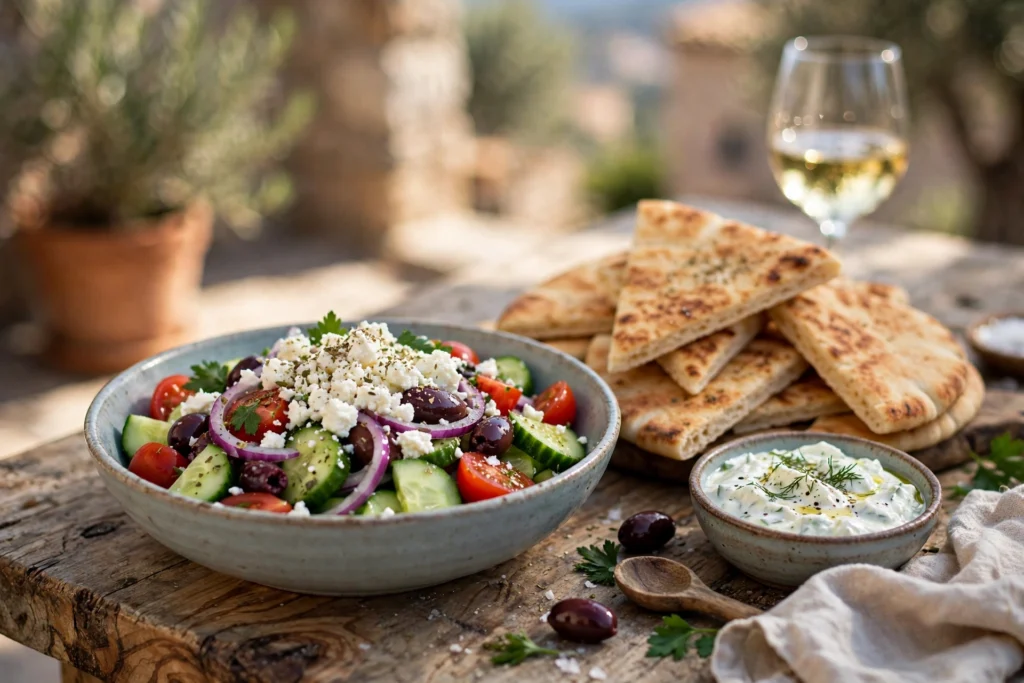
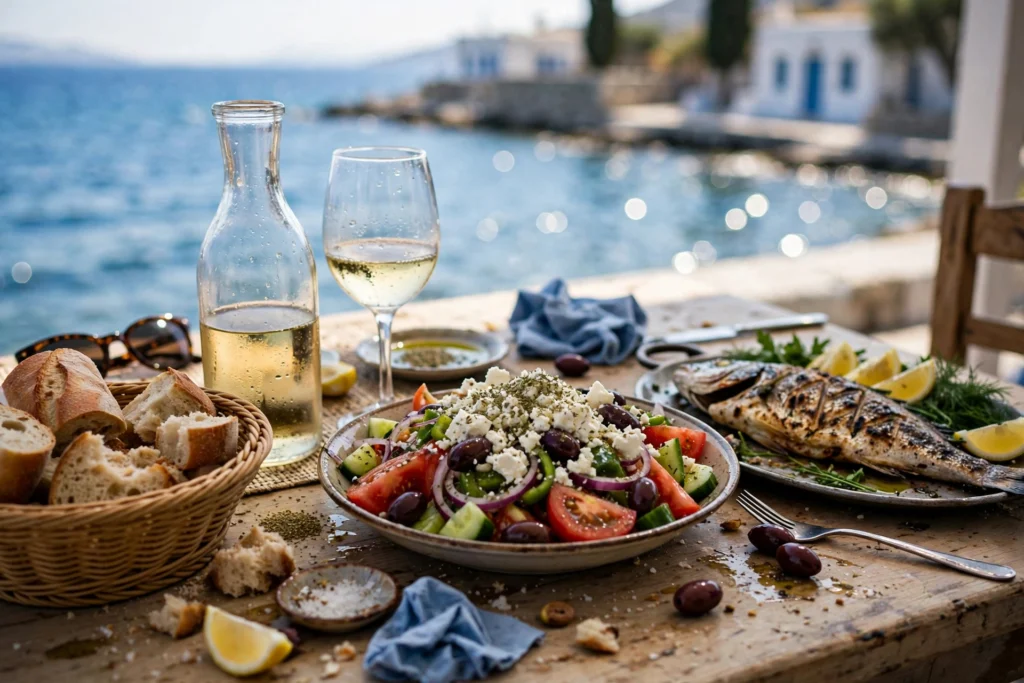
Grilled everything: souvlaki, lamb chops, whole grilled fish, lemon-herb chicken. The salad’s bright acidity and briny punch cut through rich grilled meats perfectly — it’s the cool, fresh counterpoint that makes the whole plate work. It’s also the essential third of the holy trinity: Greek salad + tzatziki + warm pita. For a full Greek night: start with tzatziki and olives, serve the salad alongside moussaka or pastitsio, finish with baklava and coffee. And always, always bread — a crusty village loaf for the juices.
For drinks: a crisp white wine (Assyrtiko if you can find it, otherwise any dry Greek or Italian white), sparkling water with lemon, a classic Paloma, or simply cold water. The salad is assertive enough that it doesn’t need a complicated pairing — clean and cold is the rule.
Final Thoughts
Some recipes impress with technique. This one impresses with restraint. No cooking, no emulsifying, no seventeen ingredients — just ripe vegetables, real feta, and the confidence to leave them alone. Every element is visible, every flavor is identifiable, and nothing hides behind anything else.
The colors alone are worth the effort — red, green, purple, white — a bowl that signals summer even in February. And that moment when the feta slab is cracked open at the table and the oil pools into the tomato juices… that’s the whole recipe, right there. Fifteen minutes, one bowl, zero cooking.
Buy the good tomatoes. Get the block feta. Don’t add lettuce.
Authentic Greek Salad (Horiatiki)
Ingredients
Equipment
Method
- Prep the vegetables: cut the tomatoes into chunky wedges, slice the cucumber into ¼-inch half-moons, shave the red onion paper-thin, and slice the green pepper (if using) into thin rings.
- Tip the vegetables into a wide, shallow serving bowl, scatter over the Kalamata olives and season with a pinch of flaky sea salt. Toss very gently — you want to keep the wedges intact.
- Lay the feta over the top in one proud slab, exactly as it is done in Greece. Do not crumble it.
- Drizzle over the extra-virgin olive oil, splash over the red wine vinegar and shower with the dried oregano.
- Let the salad rest at room temperature for 10 minutes so the juices mingle with the oil, then serve with crusty bread for mopping.
Notes
What makes this Greek salad authentically horiatiki?
No lettuce — that’s the first rule. Real horiatiki is chunky tomatoes, cucumber, red onion, green pepper, Kalamata olives and one proud slab of feta, dressed with olive oil, red wine vinegar and dried oregano. Rest it 10 minutes so the juices mingle.
Why is the feta served as a slab instead of crumbled?
It’s Greek tradition: a thick slab (about ¾-inch) crowns the salad and each person breaks off a piece with their fork. Brined block feta is creamier and less salty than pre-crumbled, and it stays intact instead of dissolving.
What tomatoes work best for Greek salad?
The ripest, most fragrant you can find — heirlooms in summer are ideal. Out of season, sweet cherry tomatoes beat pale, watery large ones every time.
How much olive oil should I use?
⅓ cup for four servings — don’t skimp. The oil is a main ingredient, not a garnish: it combines with the tomato juices and salt to form the dressing. Use a fruity extra-virgin olive oil, Greek if possible.
Which olives are best for Greek salad?
Real Kalamatas: dark purple-black, almond-shaped, fruity and winey. Buy them with pits if you can — they taste better. The label should mention brine or Greek-style curing; avoid dyed jet-black round ones.
Can I make Greek salad ahead of time?
Assemble just before serving for the best texture. Prep components separately — chopped vegetables keep 2 days sealed in the fridge — then add feta, oil and seasoning at the last minute.
How long does Greek salad keep?
Undressed chopped vegetables keep about 2 days sealed in the fridge. Once dressed with feta and oil, eat within a few hours — the tomatoes soften and the feta turns mushy if it sits too long.
How do I stop my Greek salad going watery?
Some juice is the goal — it’s the sauce for your bread. A flood means over-salting, tired tomatoes or cutting too far ahead. Salt just before serving and use ripe, firm tomatoes.
What should I serve with Greek salad?
Grilled everything: souvlaki, lamb chops, whole grilled fish, lemon-herb chicken. Warm pita and tzatziki are essential for the juices. A crisp Assyrtiko or dry white wine is perfect alongside.
Is Greek salad healthy?
Yes — naturally gluten-free, vegetarian and low-carb, packed with vegetables and healthy fats. Watch the salt, though: feta and olives are briny, so season the vegetables lightly.
Can I add protein to make it a full meal?
Absolutely. Grilled chicken, prawns or a tin of drained chickpeas make it complete. Or serve over farro or quinoa as a hearty grain bowl.
Why is there no lettuce in authentic Greek salad?
Traditional horiatiki never has lettuce — the romaine version is an American diner invention. Without it the salad stays crisp and intense, and it’s better after a short rest.

Hi, I’m Angela. I cook the way busy people actually cook — simple, tasty food with ingredients you already have. On CookBookBite I share easy recipes, honest kitchen tips, and dishes my family asks for again and again.
Pingback: Easy Tzatziki Sauce Recipe (10-Minute) – Perfect for Gyros