

Let’s clear something up first: German chocolate cake isn’t German. Not even a little. It’s named after Samuel German, an American baker who developed a sweet baking chocolate for Baker’s in 1852. The cake itself was born in Texas in 1957, when the Dallas Morning News published a reader’s recipe using “German’s chocolate” — submitted by a Dallas homemaker named Mrs. George Clay.
Her recipe was called “German’s Chocolate Cake,” and within months, Baker’s saw chocolate sales jump as much as 100 percent in some markets. America has been confusing everyone about it ever since — and honestly, that story makes me love it more, because it means this iconically “German” cake is as American as it gets.
What makes it unmistakable isn’t the chocolate layers (though they’re wonderfully moist and deeply chocolatey) — it’s the frosting. Not buttercream, not ganache, but a cooked caramel custard loaded with shredded coconut and pecans, spread thick between the layers and dolloped on top.
It’s gooey, chewy, buttery, nutty, and completely unlike any other cake frosting in existence. People who claim they “don’t like coconut” have been converted by this frosting. The combination of caramelized sugar, toasted nuts, and chewy coconut creates something that doesn’t taste like any single ingredient — it tastes like celebration.
This is the classic, from-scratch version — moist chocolate layers, that legendary coconut-pecan frosting, all the technique explained in detail. It takes some time, but every minute is worth it. Whether this is your first layer cake or your fiftieth, I’ll walk you through every step, every potential pitfall, and every trick that makes the difference between good and unforgettable.
Table of Contents
Why You’ll Love This German Chocolate Cake Recipe
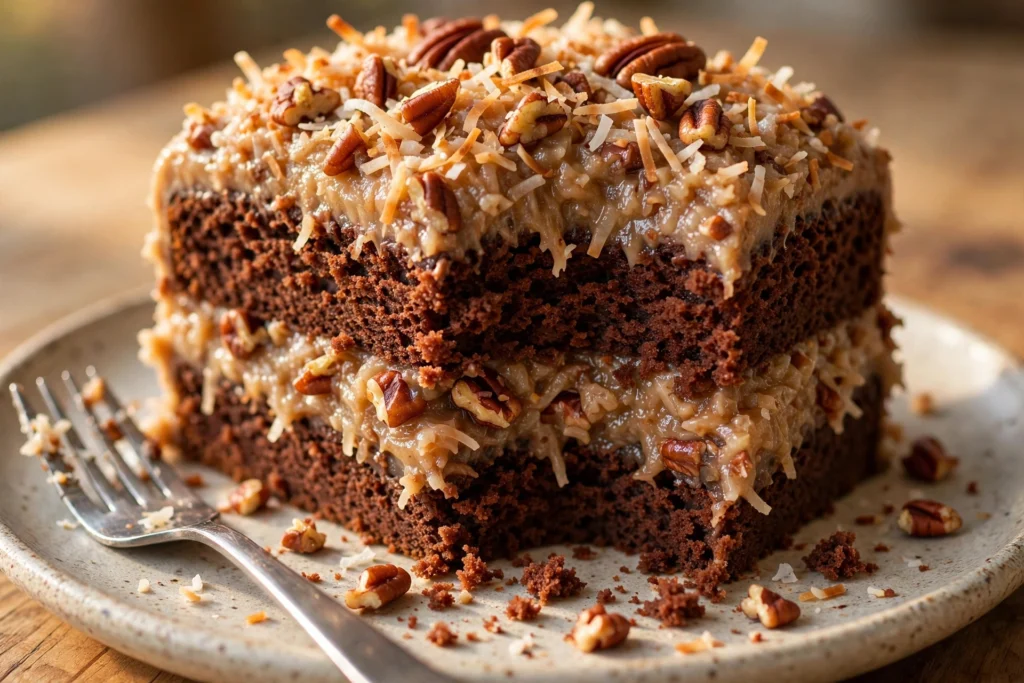
First, the frosting is a revelation. Cooked on the stovetop from evaporated milk, sugar, egg yolks, and butter, then loaded with coconut and pecans — it’s part caramel, part custard, all indulgence. Nothing from a tub comes close. The cooking process caramelizes the sugars and toasts the milk solids, creating deep, complex flavor that no shortcut can replicate. When you taste it warm from the pan (quality control is mandatory), you’ll understand why this frosting has its own devoted following.
Second, the cake layers are deeply chocolatey yet light. The combination of melted sweet chocolate, cocoa powder, and buttermilk creates a tender, moist crumb with real chocolate depth — not too sweet, which matters because the frosting brings the sweetness. The whipped egg whites folded in at the end give the layers an almost airy quality that contrasts beautifully with the dense, chewy frosting. It’s a textural masterpiece: light cake, gooey topping, crunchy nuts.
Third, it’s a showstopper that isn’t fussy. The rustic frosting application (spread thick, let it drip) is forgiving — no smooth buttercream skills required. Imperfection looks intentional here. In fact, the messier the drip, the more authentic it looks. This is the cake to make when you want maximum impact with minimum decorating stress.
Finally, it’s nostalgia in cake form. This is the cake of birthdays and church potlucks and grandmothers who baked from scratch. Making it connects you to all of that. There’s something deeply satisfying about recreating a recipe that has been passed down, hand to hand, for nearly seventy years — and making it exactly right. Planning a full fiesta menu? Start the savoury side of things with tacos al pastor.
The Story Behind the Name (And Why It Matters)
Understanding where this cake comes from actually helps you bake it better, because it explains the unusual choices in the recipe. Samuel German wasn’t a chocolatier in the European tradition — he was an American baker working for Baker’s Chocolate Company in Dorchester, Massachusetts. In 1852, he figured out how to make a sweeter, milder baking chocolate by adding more sugar during manufacturing. The company named it “Baker’s German’s Sweet Chocolate” in his honor — note the possessive “German’s,” which got dropped over the years, creating a century of confusion.
Fast forward to 1957. Mrs. George Clay of Dallas, Texas, sent her recipe for “German’s Chocolate Cake” to the Dallas Morning News as part of their “Recipe of the Day” column. The paper published it on June 3, 1957. General Foods, which owned Baker’s at the time, noticed the recipe gaining traction and began promoting it nationally. The rest is history — but here’s what matters for your baking: the original recipe was designed specifically around that sweet chocolate. The mild chocolate flavor is intentional. The cake layers aren’t supposed to be intensely dark or bitter — they’re a gentle, sweet chocolate canvas that lets the bold coconut-pecan frosting shine. If you “improve” the cake by making it darker and richer, you actually unbalance the whole thing.
Ingredients for German Chocolate Cake (And Why Each One Matters)

For the cake layers:
German’s sweet chocolate (4 oz) — Baker’s German’s Sweet Chocolate is traditional (it’s literally the namesake). Melted into the batter, it gives mild, sweet chocolate flavor that defines the cake. Look for it in the baking aisle — it comes in a distinctive 4-ounce bar. In a pinch, use 4 ounces of semi-sweet chocolate plus 2 tablespoons of granulated sugar. Don’t substitute unsweetened chocolate; the entire recipe’s sugar balance assumes sweet chocolate.
All-purpose flour (2½ cups) — Spooned into the measuring cup and leveled with a knife, never scooped directly from the bag (scooping packs in up to 25% extra flour, which makes dry cake). Cake flour makes it even more tender — you can swap 1:1 if you have it. The lower protein content in cake flour produces a finer, softer crumb.
Unsweetened cocoa powder (½ cup) — Dutch-process for the darkest color and smoothest flavor. Dutch-process cocoa is treated with alkali to neutralize acidity, giving it a darker color and milder taste. This deepens the chocolate beyond what the sweet chocolate alone provides. Natural cocoa works too but gives a slightly lighter color and tangier flavor.
Baking soda (1 teaspoon) + salt (½ teaspoon) — The leavening and seasoning. Buttermilk’s acidity activates the baking soda — that’s the partnership that gives the cake its lift. The salt might seem minor, but it sharpens the chocolate flavor significantly. Don’t skip it.
Buttermilk (1 cup, room temperature) — The acidity tenderizes the crumb by breaking down gluten strands, and reacts with baking soda for lift. Room temperature matters: cold buttermilk can cause the batter to curdle when mixed with the creamed butter. No buttermilk? Stir 1 tablespoon of white vinegar or lemon juice into 1 cup of regular milk and let it rest 5 minutes. It won’t be quite as thick, but the acidity does the job.
Unsalted butter (1 cup / 2 sticks, softened) — Properly softened means cool to the touch but dentable with a finger — about 65-67°F. Too cold and it won’t cream properly; too warm (melty) and the cake will be dense. This creams with the sugar to create tiny air pockets that expand in the oven — that’s the cake’s structure. Take it out of the fridge 45-60 minutes before baking.
Granulated sugar (2 cups) — The cake itself isn’t overly sweet; the frosting handles that job. The sugar also contributes to the tender texture by interfering with gluten formation.
Eggs (4 large, room temperature, separated) — Yolks go in the batter for richness and emulsification; whites get whipped separately and folded in for lift. Room temperature eggs whip to greater volume and incorporate more smoothly. To warm cold eggs quickly, place them in a bowl of warm (not hot) water for 10 minutes.
Vanilla extract (2 teaspoons) — Real vanilla, not imitation. Vanilla doesn’t make things taste like vanilla — it amplifies chocolate perception by adding aromatic complexity. It’s the reason chocolate tastes more chocolatey with vanilla in the recipe.
Hot coffee (½ cup) — The secret weapon. Coffee doesn’t make the cake taste like coffee — it deepens and intensifies the chocolate flavor through a quirk of flavor chemistry. Use it hot; the heat blooms the cocoa powder, releasing more flavor compounds. If you’re caffeine-averse, use hot water — you’ll lose some depth but the cake still works. Decaf coffee is a fine middle ground.
Also Read : Spiderweb Cupcakes — Halloween Cupcakes with Raspberry ‘Bloody’ Filling
For the coconut-pecan frosting:
Evaporated milk (1 cup) — Not sweetened condensed milk! This is the most common mistake. Evaporated milk is unsweetened milk with about 60% of the water removed; it cooks into a caramel custard base. Sweetened condensed milk is already saturated with sugar and will make the frosting cloyingly sweet and wrong-textured. Check the can twice.
Granulated sugar (1 cup) — Dissolves into the custard and caramelizes slightly during cooking, giving the frosting its golden color and toffee notes.
Egg yolks (3 large) — Thicken the frosting into a proper custard. They must be tempered (gradually warmed) so they don’t scramble on contact with the hot milk mixture.
Unsalted butter (½ cup) — Stirred in for richness, gloss, and that melt-in-your-mouth quality. It also helps the frosting set to a spreadable consistency.
Vanilla (1 teaspoon) — Rounds out the caramel flavors and adds warmth.
Sweetened shredded coconut (1⅓ cups) — The signature chew. Sweetened (not unsweetened) is traditional — the extra sugar helps it meld into the caramel. The shreds should be standard size, not finely ground or large flakes, for the right texture.
Chopped pecans (1 cup, toasted) — Toast them first — 8 minutes at 350°F on a baking sheet, shaking once. The difference between raw and toasted pecans is enormous: toasting triggers the Maillard reaction, creating hundreds of new flavor compounds. Raw pecans taste flat and almost waxy by comparison. Let them cool before chopping so they stay crisp.
Equipment You’ll Need (And What You Can Substitute)
Three 8-inch round cake pans are ideal — they give you the classic three-layer look with the right layer thickness. If you only have two 9-inch pans, that works too; the layers will be slightly thinner and may need 2-3 minutes less baking time. Line the bottom of each pan with parchment paper (trace the pan, cut it out) — this is non-negotiable for clean release.
You’ll also need: a stand mixer or hand mixer (for creaming butter and whipping egg whites — this is very difficult by hand), several mixing bowls, a heavy-bottomed saucepan for the frosting (thin pans create hot spots that scorch the custard), wire cooling racks, and an offset spatula for spreading frosting. A kitchen scale helps with accuracy but isn’t required. An instant-read thermometer is useful for checking the frosting’s thickness, though the spoon-coating test works fine.
How to Make German Chocolate Cake (Step by Step)

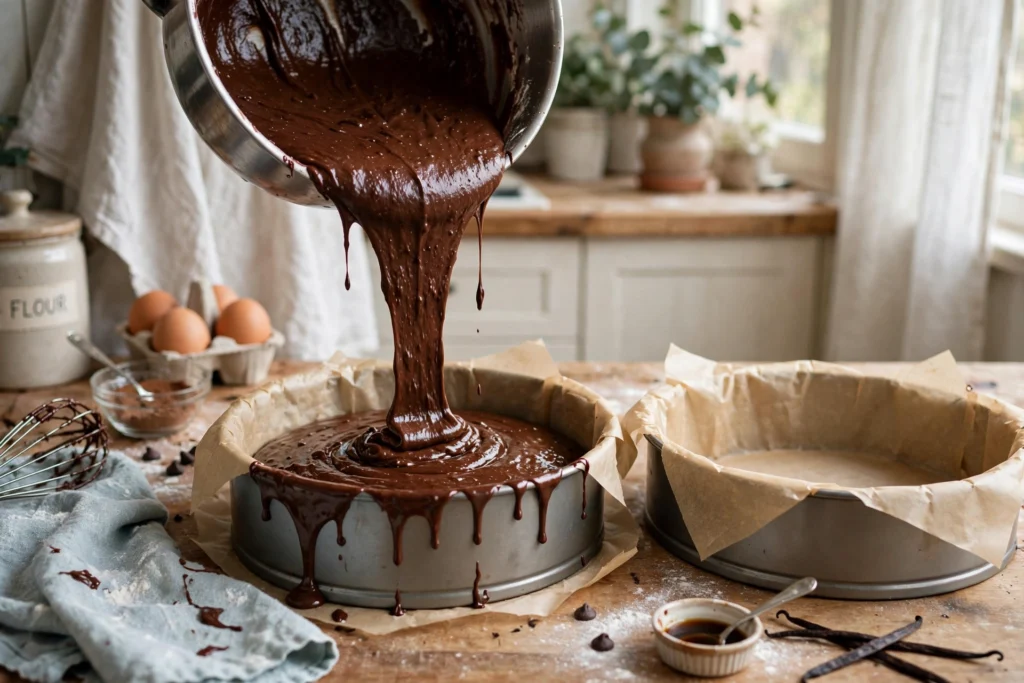
Step 1 — Prep your pans and oven. Heat the oven to 350°F (175°C) with a rack in the center position. Grease three 8-inch round cake pans with butter or baking spray, line the bottoms with parchment paper rounds, then grease the parchment and dust the whole interior with cocoa powder (not flour — cocoa keeps the finished cake dark instead of leaving white flour streaks). Tap out the excess. This triple protection (grease + parchment + cocoa) guarantees clean release.
Step 2 — Melt the chocolate. Break the German’s chocolate into pieces and place in a heatproof bowl with the hot coffee. Set the bowl over a pot of barely simmering water (don’t let the bowl touch the water) and stir until completely smooth, or microwave in 30-second bursts, stirring between each. The coffee should be hot enough to help melt the chocolate. Let the mixture cool to lukewarm — if it’s too hot when added to the batter, it can melt the creamed butter and deflate the air bubbles you worked to create.
Step 3 — Cream butter and sugar. In a large mixing bowl, beat the softened butter and granulated sugar on medium-high speed for a full 3–4 minutes until pale, fluffy, and noticeably increased in volume. This isn’t just mixing — you’re forcing air into the fat, creating thousands of tiny bubbles that expand in the oven. Don’t shortcut this step; under-creamed butter gives dense cake. Scrape down the bowl halfway through.
Step 4 — Add yolks and chocolate. Reduce speed to medium. Beat in the egg yolks one at a time, mixing well after each addition and scraping the bowl. The mixture should look smooth and emulsified. Pour in the lukewarm chocolate-coffee mixture and the vanilla; beat until fully combined. The batter will be dark and smell incredible.
Step 5 — Alternate dry and wet ingredients. In a separate bowl, whisk together the flour, cocoa powder, baking soda, and salt. With the mixer on low speed, add the flour mixture in three additions, alternating with the buttermilk in two additions (dry-wet-dry-wet-dry). Begin and end with the dry ingredients. Mix just until combined after each addition — you should still see a few small flour streaks when you stop the mixer; finish with a spatula. Overmixing develops gluten and makes tough, dense cake. This is the step where most home bakers go wrong.
Step 6 — Whip and fold the egg whites. In a scrupulously clean bowl (any grease prevents whipping), beat the egg whites on medium-high speed until they form soft peaks — when you lift the beaters, the peaks should curl over gently, not stand straight up. Using a large spatula, fold about one-third of the whites into the chocolate batter to lighten it, then gently fold in the remaining whites in two additions. Use a cutting-and-folding motion: cut down through the center, sweep along the bottom, and fold over the top. Stop when just combined — a few white streaks are fine. This is what makes the layers light instead of dense.
Step 7 — Bake. Divide the batter evenly among the three prepared pans (a kitchen scale helps — about 450g per pan for 8-inch). Smooth the tops. Bake 25–30 minutes, until a toothpick inserted in the center comes out with moist crumbs clinging to it (not wet batter, not completely clean). Start checking at 25 minutes — ovens vary. Cool in the pans on wire racks for exactly 10 minutes (longer and the cakes can stick; shorter and they’re too fragile), then run a thin knife around the edges and turn out onto the racks. Peel off the parchment. Cool completely — at least 1 hour — before frosting. Warm layers melt frosting into a sliding mess.
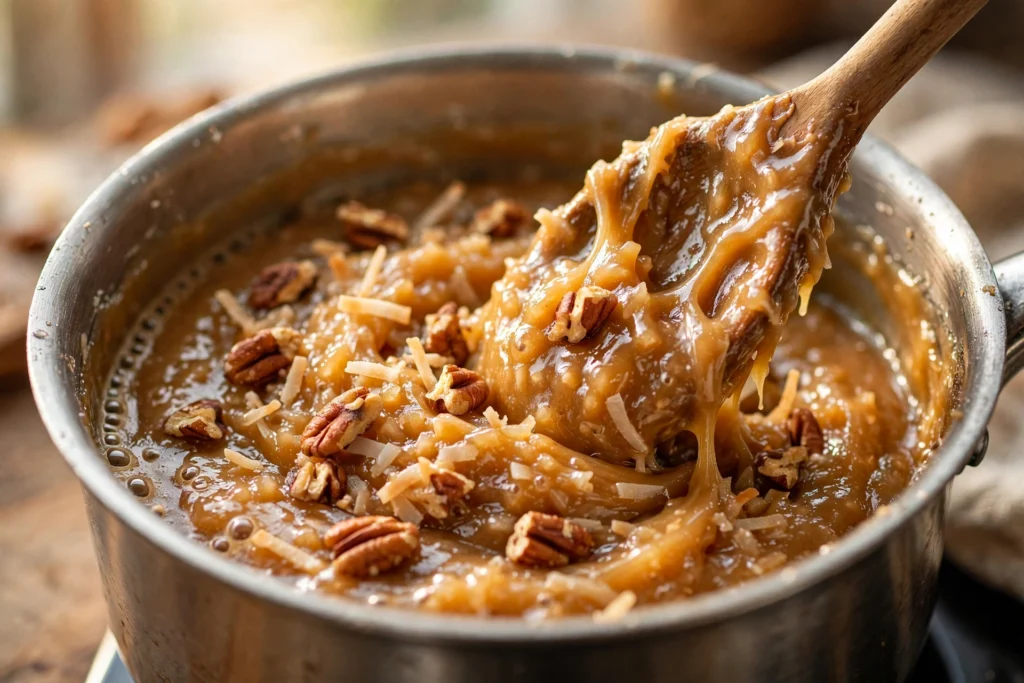
Step 8 — Make the coconut-pecan frosting. In a heavy-bottomed saucepan, whisk together the evaporated milk, sugar, egg yolks, and butter until smooth. Place over medium heat and cook, stirring constantly with a wooden spoon or heatproof spatula (scraping the bottom and corners), for 10–12 minutes. The mixture will gradually thicken — you’ll feel it change from watery to syrupy to custardy. It’s done when it thickly coats the back of the spoon and you can draw a finger through it leaving a clean line, and it has turned a rich golden color. Don’t walk away — custard goes from perfect to scrambled in under a minute. Remove from heat immediately. Stir in the vanilla, then the coconut and toasted pecans. Let cool at room temperature for about 30 minutes, stirring occasionally, until thick enough to spread. It will continue to thicken as it cools — this is normal.
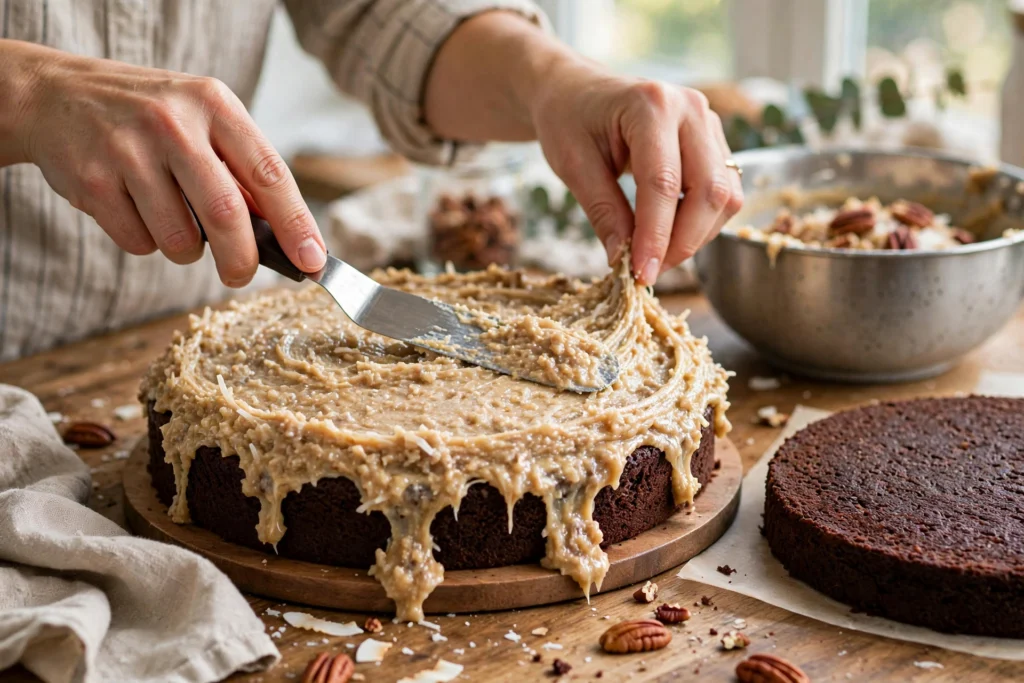
Step 9 — Assemble the cake. If the layers have domed tops, level them with a long serrated knife using a gentle sawing motion (save the trimmings for snacking). Place one layer on a cake stand or serving plate. Spread about one-third of the frosting evenly over the top, going right to the edge — it should be thick and glorious, about ½ inch deep. Place the second layer on top and repeat. Add the third layer and spread the remaining frosting over the top, letting it drip naturally and appealingly over the edges. That’s the signature look — don’t fight it, and don’t try to frost the sides (traditional German chocolate cake has naked sides showing the chocolate layers). If the frosting is too thick to spread after cooling, microwave it in 10-second bursts, stirring between each, until workable.
My Best Tips for Perfect German Chocolate Cake
Toast the pecans — no exceptions. Eight minutes at 350°F until fragrant and slightly darkened. Raw pecans taste flat and waxy; toasted ones taste like themselves, amplified tenfold. This single step makes more difference than almost any other.
Don’t overbake — ever. The number one killer of chocolate cake is an extra 5 minutes in the oven. Start checking at 25 minutes. Moist crumbs on the toothpick means done. A completely clean toothpick means overbaked. Remember that cakes continue cooking from residual heat for a few minutes after leaving the oven.
Cool layers completely before frosting. I know it’s hard to wait. But warm cake plus frosting equals melted slide-off disaster. If you’re in a hurry, 20 minutes in the freezer firms the layers nicely. You can also bake the layers a day ahead — wrapped tightly, they’re fine at room temperature.
Temper the egg yolks carefully. When making the frosting, the yolks must be gradually warmed before joining the hot mixture. The easiest method: whisk the yolks with the cold evaporated milk and sugar from the start (as this recipe does) rather than adding them to hot liquid. If you’re adapting another recipe, always whisk a spoonful of hot liquid into the yolks first, then pour the warmed yolks back into the pan.
Trust the frosting’s thickening process. Don’t panic if it seems thin in the pan — it sets up substantially as it cools. Conversely, if it’s too thick to spread after cooling completely, 10 seconds in the microwave (stirred well) brings it back. The frosting is very forgiving.
Level with a serrated knife, not a straight one. A long bread knife using gentle sawing motions gives flat, even layers that stack straight. Mark the cutting line with toothpicks around the side if you’re nervous about keeping it level.
Room temperature ingredients are not optional. Cold eggs don’t emulsify properly with butter, cold buttermilk can curdle the batter, and cold butter won’t cream. Set everything out 45-60 minutes before you start. This one habit will improve all your baking.
Troubleshooting: When Things Go Wrong
Frosting is too runny: It wasn’t cooked long enough, or wasn’t cooled enough. Return it to the heat for 2-3 more minutes, stirring constantly, then cool again. The spoon-coating test is reliable — if it doesn’t hold a line, keep cooking.
Frosting has scrambled egg bits: The heat was too high or you stopped stirring. Unfortunately, you can’t fix this — strain the frosting through a fine-mesh sieve to remove the bits, and next time use medium (not medium-high) heat and never stop stirring.
Cake layers are dry: Overbaking is the usual culprit. Also check that you measured flour correctly (spoon and level, don’t scoop), didn’t overmix after adding flour, and used room-temperature ingredients for proper emulsion. An oven thermometer ($7) can reveal if your oven runs hot.
Cake sank in the middle: Underbaking, opening the oven door too early (the rush of cool air deflates the structure), or too much leavening. Make sure the toothpick test passes before removing, and don’t open the oven for the first 20 minutes.
Frosting slides off the cake: The layers were still warm, or the frosting was too warm/thin. Chill the assembled cake for 20 minutes to set the frosting, and always start with completely cool layers.
Egg whites won’t whip: Any trace of fat (including egg yolk) prevents whipping. Make sure the bowl is scrupulously clean — wipe it with vinegar first if you’re unsure. Also, room-temperature whites whip to greater volume than cold ones.
Also Read : Light Jello Dessert Recipe (Low-Calorie Berry Treat)
Delicious Variations to Try
Cupcakes: Same batter makes 24 standard cupcakes. Fill liners ⅔ full, bake 18–20 minutes at 350°F. Cool completely, then dollop (don’t pipe — the frosting’s chunky texture is rustic, not pipable) generously with coconut-pecan frosting. Adorable for parties and portion-controlled.
Sheet cake: Pour the batter into a greased 9×13-inch pan, bake 35–40 minutes, and spread all the frosting over the top. This is the potluck classic — easier to transport, easier to serve, same incredible flavor.
Chocolate ganache drip: After frosting as directed, heat 4 oz of chopped semi-sweet chocolate with ½ cup of heavy cream until smooth, cool slightly, and pour over the top edge, letting it drip down naturally. Stunning for celebrations and adds another chocolate dimension.
Bourbon version: Add 2 tablespoons of good bourbon to the frosting along with the vanilla. The oak and vanilla notes marry beautifully with the caramel flavors. The alcohol mostly cooks off, leaving just the flavor.
Salted caramel twist: Sprinkle flaky sea salt (Maldon is ideal) over the finished frosting. The sweet-salty contrast makes the caramel notes pop and adds a sophisticated edge.
German chocolate brownies: Pour the batter into a greased 9×13 pan, bake 25 minutes (they’ll be slightly underdone — that’s correct for brownies), cool completely, and spread with the coconut-pecan frosting. Dangerously good and much faster than the layer cake.
German chocolate icebox cake: Layer thin chocolate wafer cookies with the coconut-pecan frosting in a loaf pan, refrigerate overnight. The cookies soften into cake-like layers. No baking required.
Storing & Make-Ahead (Detailed Guide)
Room temperature: Covered with a cake dome or inverted bowl, 2 days. The frosting’s high sugar content acts as a preservative and keeps it food-safe, and the cake stays moist. Don’t use plastic wrap directly on the frosting — it will stick and pull off.
Refrigerator: Up to 5 days, covered. The cold firms the frosting (which some people actually prefer). Bring slices to room temperature 30 minutes before serving — cold dramatically mutes chocolate flavor, and this cake deserves to be tasted at its best.
Freezer (unfrosted layers): Wrap each completely cooled layer tightly in two layers of plastic wrap, then a layer of foil. Freeze up to 3 months. Thaw overnight in the refrigerator, still wrapped (this prevents condensation from making the surface soggy).
Freezer (frosted cake): Place the frosted cake (on its plate or a cardboard round) uncovered in the freezer until the frosting is firm, about 2 hours. Then wrap tightly in plastic wrap followed by foil. Freeze up to 2 months. Thaw overnight in the refrigerator, then bring to room temperature before serving.
Make-ahead strategy: Bake the layers up to 2 days ahead (cool completely, wrap tightly, keep at room temperature). Make the frosting up to 3 days ahead (refrigerate in an airtight container; bring to room temperature and stir well before using — microwave in 10-second bursts if too firm). Assemble on the day you plan to serve for the best presentation and texture.
What to Serve with German Chocolate Cake
This is a rich cake — serve small slices; a little goes a long way. A glass of cold whole milk is the classic pairing and, in my opinion, non-negotiable. The milk’s cool creaminess cuts through the richness perfectly. Building a whole menu around this cake? Open with something fresh and tangy: authentic Greek salad.
Coffee is another excellent partner — the slight bitterness balances the sweetness beautifully. For an adult gathering, a glass of tawny port echoes the caramel notes in the frosting, while bourbon (neat or with one ice cube) complements the toasted pecans. If you’d rather serve cocktails than coffee at your gathering, shake up a classic paloma cocktail.
On the plate, a small handful of fresh raspberries adds color, tartness, and a refreshing contrast. A scoop of vanilla bean ice cream turns a slice into a full dessert event. For a dinner party, serve with unsweetened whipped cream to let guests adjust the sweetness themselves. Feeding a crowd? Slide another easy bake onto the dessert table: simple banana bread.
The Science of Chocolate Cake (What Makes It Moist)
Moist chocolate cake isn’t luck — it’s chemistry. Four factors determine whether your cake is tender and moist or dry and crumbly:
Fat type and amount: This recipe uses both butter and oil, and that’s deliberate. Butter provides flavor (those complex dairy notes that make cake taste like cake), while oil provides moisture that lasts. Butter is solid at room temperature; when the cake cools, butter firms up, which can make the crumb seem drier the next day. Oil stays liquid, so oil-based cakes taste moist even after days. By using both, you get butter’s flavor and oil’s lasting moisture. If you use all butter, the cake is delicious day-of but dries faster. If you use all oil, it’s moist for days but lacks buttery depth. The combination is the best of both.
Sugar’s role beyond sweetness: Sugar is hygroscopic — it attracts and holds water. More sugar means moister cake, up to a point. Sugar also tenderizes by interfering with gluten formation; it competes with flour proteins for water, limiting gluten development. This is why high-sugar cakes are tender. The brown sugar in the coconut-pecan frosting adds moisture and a caramel note that white sugar alone can’t provide. Don’t reduce sugar thinking you’re making it healthier — you’ll make it drier and tougher.
The hot liquid secret: Many chocolate cake recipes call for hot water or hot coffee added at the end. This isn’t just for mixing — hot liquid blooms the cocoa powder, releasing flavor compounds that are locked in dry cocoa. It also creates a thinner batter, which bakes into a more tender crumb. The batter will look alarmingly thin; that’s correct. Thin batter means the flour proteins are well-hydrated, which translates to a moist, even crumb. Don’t panic and add more flour.
Don’t overbake: This is the #1 killer of moist cake. Chocolate cake continues cooking from residual heat after you pull it from the oven (carryover cooking). Pull it when a toothpick has moist crumbs (not wet batter, not clean). If the toothpick is completely clean, it’s already overbaked. An instant-read thermometer is even better: 200-205°F in the center means done. Every oven is different; start checking 5 minutes before the recipe says.
Coconut-Pecan Frosting: Troubleshooting and Perfection
The coconut-pecan frosting is what makes German chocolate cake iconic, and it’s also where most people struggle. Here’s how to nail it:
The curdling problem: The frosting is essentially a custard — egg yolks, evaporated milk, and sugar cooked until thickened. If it curdles, the heat was too high or you didn’t stir constantly. Cook over medium-low, stirring continuously with a wooden spoon or heatproof spatula, scraping the bottom and corners. It takes 10-12 minutes to thicken. You’ll know it’s ready when it coats the back of a spoon and you can draw a line through it with your finger that holds. If it curdles slightly, immediately strain it through a fine-mesh sieve — you can often save it.
Too thin: It wasn’t cooked long enough. The frosting thickens significantly as it cools, so don’t judge thickness while hot. But it should be noticeably thickened in the pan — if it’s still watery after 12 minutes, keep cooking. Patience is key. Rushing with higher heat causes curdling.
Too thick: Overcooked. If it’s paste-like, whisk in a tablespoon of warm evaporated milk to loosen. Next time, pull it off the heat a minute earlier.
Toasting pecans: Don’t skip toasting — raw pecans are soft and bland; toasted pecans are crunchy, fragrant, and nutty. Spread on a baking sheet, 350°F for 8-10 minutes, shaking once. You’ll smell them when they’re done. Let them cool before chopping; hot pecans release oils that make them greasy. Chop them coarsely — you want distinct pieces, not dust.
Coconut selection: Sweetened shredded coconut is traditional and what the recipe is calibrated for. Unsweetened coconut will make the frosting less sweet and slightly drier — if using unsweetened, add 2 tablespoons extra sugar. Don’t use coconut flakes (the large chips); they don’t distribute evenly. Flaked coconut also doesn’t toast as evenly in the frosting.
Read Also : Mummy Brownies : Easy Halloween Brownie Treats with Candy Eyes
Layer Cake Assembly (Without the Stress)
Layer cakes intimidate people, but the process is straightforward with the right approach:
Leveling: If your layers domed, level them with a long serrated knife. Place the cake on a turntable or plate, hold the knife horizontally at the height of the lowest edge, and saw gently while rotating the cake. Save the scraps for snacking (baker’s privilege). Level layers ensure stability — a domed layer makes the whole cake wobble.
The crumb coat myth: For this cake, you don’t need a crumb coat because the frosting is chunky (coconut and pecans) rather than smooth buttercream. The frosting is spread thickly between layers and on top, not on the sides (traditional German chocolate cake has bare sides). This is actually easier than frosted-side cakes — no smoothing required.
Assembly order: Place the first layer cut-side up (the cut surface grips frosting better). Spread ⅓ of the frosting evenly to the edges. Place the second layer cut-side down (so the smooth bottom is on top). Spread another ⅓ on top, letting it drip slightly over the edges — that’s the rustic look. The remaining ⅓ can be used for touch-ups or served alongside. Some bakers pipe a border of chocolate buttercream around the top edge for a finished look; it’s optional but pretty.
Transporting: Chill the assembled cake for 30 minutes before transporting — the frosting firms up and won’t slide. Place on a sturdy cake board (not just the serving plate) for structural support. If traveling far, insert a few wooden dowels through the layers for stability.
Final Thoughts
Every family has a cake — the one that means celebration, the one whose recipe card is stained and fading, the one that gets requested by name. For a lot of American families, this is that cake. It showed up at birthdays in the 1960s and never left, because some flavors don’t need updating or improving. They’re already exactly right.
I love that this cake carries a case of mistaken identity in its name and doesn’t care one bit. Samuel German’s chocolate, a Dallas newspaper, a Texas homemaker’s recipe — and nearly seventy years later, we’re still making it, still toasting the pecans, still letting the frosting drip. That’s not marketing or trend-chasing. That’s a recipe so good it became folklore, passed from hand to hand, kitchen to kitchen.
So toast the pecans. Temper the yolks. Don’t rush the cooling. Let the frosting drip where it wants to drip. Some cakes you make to impress people; this one you make to belong — to a tradition, to a family, to a table full of people you love.
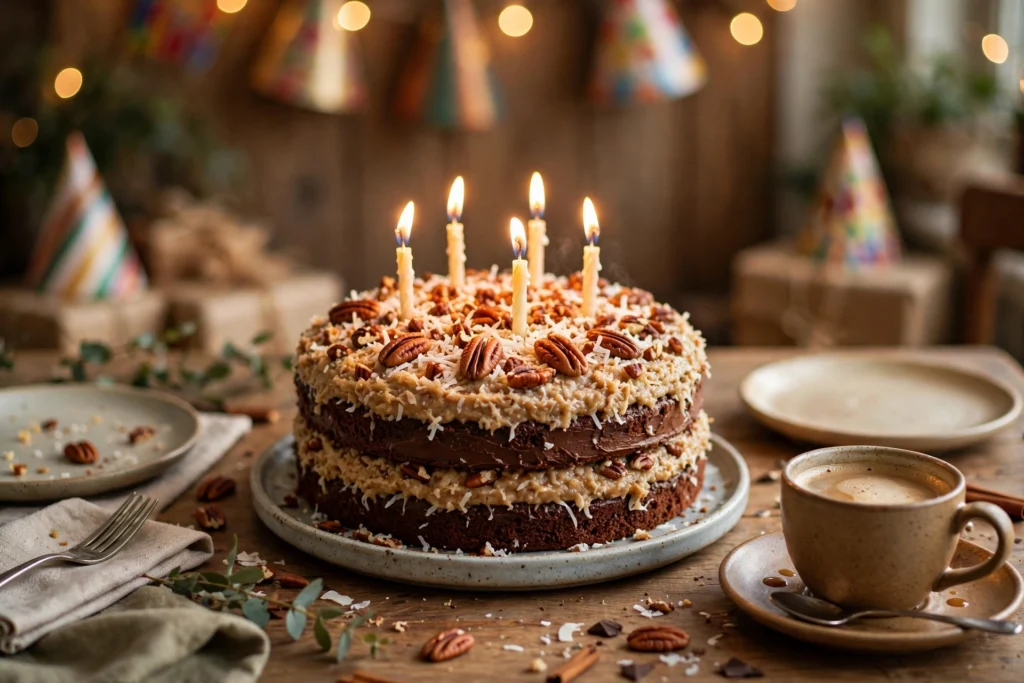

Classic German Chocolate Cake
Ingredients
Equipment
Method
- Heat the oven to 180°C (350°F). Grease three 20cm (8-inch) round cake tins and line the bases with parchment paper.
- Melt the chopped German’s sweet chocolate with the hot coffee in a heatproof bowl over simmering water, stirring until smooth; leave to cool slightly.
- In a large bowl, beat the softened butter and sugar together for 3–4 minutes until pale and fluffy. Beat in the egg yolks one at a time, then the melted chocolate mixture and vanilla.
- Whisk the flour, cocoa powder, baking soda and salt together. Add to the batter in three additions, alternating with the buttermilk, beginning and ending with the dry ingredients. Mix just until combined.
- In a clean bowl, whisk the egg whites to firm peaks. Fold gently into the batter in two additions until no streaks remain.
- Divide the batter between the tins and bake for 25–30 minutes, until a skewer inserted in the centre comes out clean. Cool in the tins for 10 minutes, then turn out onto wire racks to cool completely.
- For the frosting, combine the evaporated milk, sugar, egg yolks and butter in a heavy-bottomed saucepan. Cook over medium heat, stirring constantly, for 10–12 minutes until thickened and golden.
- Remove from the heat and stir in the vanilla, coconut and toasted pecans. Leave to cool until thick enough to spread.
- Place one cake layer on a serving plate and spread over a third of the frosting. Repeat with the remaining layers, finishing with frosting on top. Leave the sides bare, classic-style.
Notes
People Also Ask
Is German chocolate cake actually from Germany?
No, it is entirely American. It is named after Samuel German, who developed German’s Sweet Chocolate for the Baker’s Chocolate Company in 1852. The cake became famous in 1957, when Mrs George Clay of Dallas, Texas, sent her recipe for German’s Chocolate Cake to a local newspaper.
What makes German chocolate cake different from other chocolate cakes?
Two things: the layers are made with German’s sweet chocolate and hot coffee for a mild, moist crumb, and the signature frosting is a cooked custard of evaporated milk, sugar, egg yolks, butter, coconut and pecans. It is not buttercream, and there is no chocolate in the frosting itself.
Can I use a different chocolate instead of German’s sweet chocolate?
Yes. Use the same weight of semi-sweet chocolate and slightly reduce the sugar, or use milk chocolate for a sweeter result. Avoid unsweetened chocolate unless you increase the sugar to compensate.
Why is my coconut-pecan frosting runny?
It was undercooked or spread while too warm. Return it to the heat for 2 to 3 minutes, stirring constantly, until it thickly coats a spoon, then cool until spreadable. It firms up considerably as it cools.
Can I make German chocolate cupcakes instead of a layer cake?
Yes. The same batter makes 24 standard cupcakes. Fill the cases two-thirds full and bake for 18 to 20 minutes at 350°F (175°C). Cool completely before spooning over the frosting.
How do I stop the cake layers from doming?
Do not overfill the tins, bake at 350°F (175°C), and level the cooled layers with a long serrated knife. Baking strips around the tins also help them bake flat.
Can I freeze German chocolate cake?
Yes. Wrap cooled, unfrosted layers in cling film plus foil and freeze for up to 3 months. For frosted cake, chill uncovered until firm, wrap tightly and freeze for up to 2 months. Thaw at room temperature.
Why is my chocolate cake dry?
Usually overbaking. Start checking 5 minutes early and pull the cakes when a skewer shows a few moist crumbs. Spoon and level your flour rather than scooping, and do not skip the hot coffee.
Can I make the coconut-pecan frosting ahead of time?
Yes, up to 3 days ahead. Refrigerate in an airtight container, then soften at room temperature for 30 to 45 minutes and stir well before spreading.
Is there a shortcut version of this recipe?
Use a chocolate cake mix for the layers and make only the frosting from scratch, or bake the batter as a 9×13-inch sheet cake for 35 to 40 minutes and spread all the frosting over the top.
Why did my frosting curdle or get scrambled egg bits?
The heat was too high or the stirring stopped. Temper the yolks and cook over medium-low heat, stirring constantly. Curdled frosting cannot be rescued, so you will need to start again.
Can I use sweetened condensed milk instead of evaporated milk?
No. They are not interchangeable. Sweetened condensed milk is heavily sweetened and would make the frosting cloying and stop it setting properly. Use evaporated milk.
Hi, I’m Angela. I cook the way busy people actually cook — simple, tasty food with ingredients you already have. On CookBookBite I share easy recipes, honest kitchen tips, and dishes my family asks for again and again.
Pingback: Fudgy Brownie Recipe: Rich and Perfect Brownies (One Bowl!)