
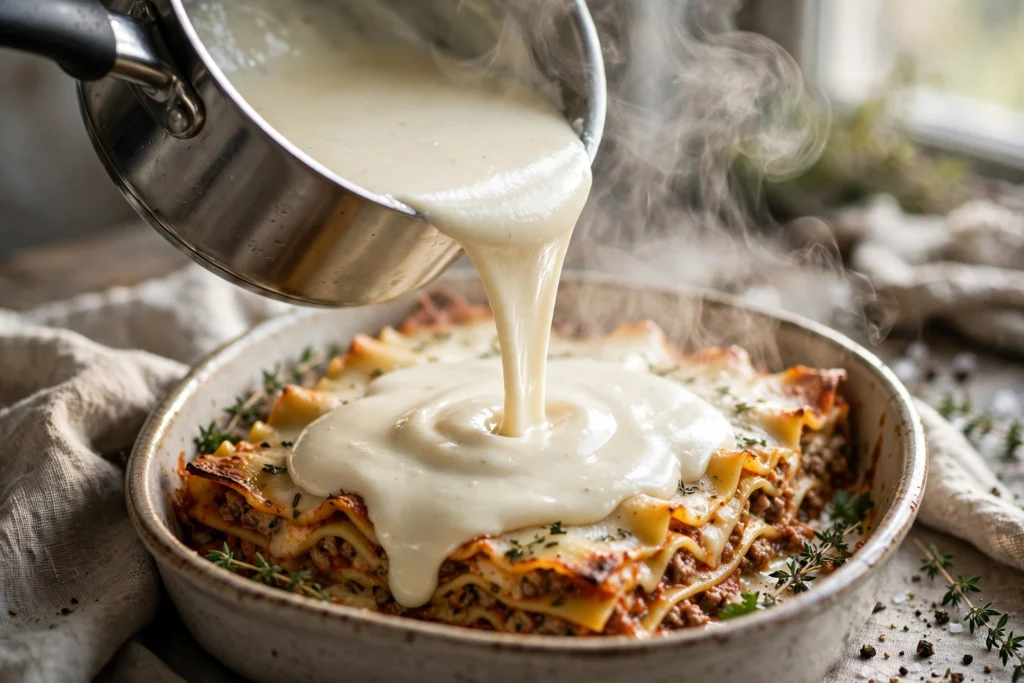
This bechamel sauce recipe demystifies one of the five French mother sauces — the one you’ll use most, and the one most home cooks fear unnecessarily. Bechamel is butter, flour, and milk. That’s it. Three ingredients, ten minutes, one whisk. If you can make gravy, you can make bechamel. If you can’t make gravy, this bechamel sauce recipe will teach you.
But don’t let the simplicity fool you — bechamel is a powerhouse. It’s the creamy layer in lasagna, the base of mac and cheese, the sauce under a proper croque monsieur, the foundation of gratins and soufflés. Learn this one sauce and you unlock a dozen classic dishes. It’s the highest-leverage ten minutes in cooking.
The fear is always lumps. I’ll show you the two techniques that guarantee silkiness every time — warm milk and constant whisking at the right moment. Follow them and your bechamel will be flawless on the first try.
Also Read : Chicken Tinga Recipe (Smoky, Saucy & Weeknight-Fast)
Why You’ll Love This Bechamel Sauce Recipe
First, it’s the foundation of everything creamy. Mac and cheese, lasagna, gratins, creamed spinach, mornay sauce — they all start here. Master bechamel and you master a whole category of comfort food.
Second, it’s fast and simple. Ten minutes, three ingredients, one pan. There’s no reason to buy jarred white sauce ever again (and the jarred stuff tastes like regret).
Third, it’s completely customizable. Add cheese (mornay), add mustard, add nutmeg, add herbs — bechamel is a blank canvas that takes direction beautifully.
Finally, the technique is a skill multiplier. The roux method you learn here applies to gravies, gumbo, chowders, and every cream soup you’ll ever make. Ten minutes now, better cooking forever.
What Is Bechamel? The Mother Sauce Explained
In classical French cooking, there are five “mother sauces” — the foundational sauces from which countless others are derived. Bechamel is the simplest of the five: a white roux (butter and flour cooked briefly) whisked with milk. The other mothers are velouté (roux + light stock), espagnole (brown roux + brown stock), hollandaise (emulsified butter and egg), and tomato sauce.
What makes bechamel the most useful for home cooks is its neutrality. It doesn’t impose strong flavor — it provides creamy body and richness that carries other flavors. That’s why it works in lasagna (carrying the meat and cheese), in gratins (carrying the potato and Gruyère), and in mornay (carrying the cheese). Learn to make it well, and you’ve essentially learned the base technique for dozens of dishes across multiple cuisines.
The name supposedly honors Louis de Béchameil, a steward to Louis XIV — though like many culinary origin stories, the truth is murkier. What matters isn’t the history; it’s that this three-ingredient sauce has survived centuries because it works.
Ingredients for Bechamel Sauce

Butter (4 tablespoons / ½ stick) — Unsalted, so you control the salt. The butter’s flavor is front and center — use good butter.
Since there are only three main ingredients, each one matters. Good butter — the kind you’d happily spread on toast — gives the sauce a clean, rich flavor. Margarine or low-quality butter will work technically, but you’ll taste the difference. This is a sauce with nowhere to hide.
All-purpose flour (¼ cup) — The thickener. Combined with butter, it forms the roux that gives bechamel its body.
Regular all-purpose flour is perfect. You don’t need anything special — no need for “00” flour or bread flour. The protein content of AP flour (around 10-12%) is ideal for a smooth roux. Measure it properly: spoon the flour into your measuring cup and level it off. Scooping directly from the bag compacts it and you’ll end up with too much, which makes a pasty sauce.
Whole milk (3 cups), warmed — WARM milk is the anti-lump secret (more below). Whole milk gives the richest result; 2% works but thinner. Scald it gently — steaming, not boiling.
This is the ingredient where most bechamel goes wrong, and it’s entirely about temperature. Cold milk hitting hot roux causes the starch to seize into lumps before it can disperse. Warm milk — steaming, around 150-160°F, not boiling — incorporates smoothly. You can warm it in a separate saucepan, in the microwave, or even in a measuring cup in the microwave. Just don’t boil it; boiled milk can develop a skin and a slightly cooked flavor.
Whole milk is traditional and gives the richest, most luxurious result. 2% works and the difference is modest. Skim milk makes a noticeably thinner sauce — usable, but not ideal. If you only have skim, add an extra tablespoon of butter to compensate for the lost richness.
Salt (1 teaspoon) — Added after thickening. Bechamel needs assertive seasoning — bland bechamel ruins everything it touches.
This is the most common bechamel mistake after lumps: under-seasoning. An unseasoned bechamel tastes like… warm milk with flour. It needs salt to wake up. A full teaspoon for 3 cups might sound like a lot, but taste it — the sauce should taste savory and complete, not flat. You can always add more, but you can’t take it away, so start with ¾ teaspoon and adjust up.
White pepper (¼ teaspoon) — Traditional (keeps the sauce pristine white). Black pepper works fine if that’s what you have. The flavor difference is minimal; it’s purely about aesthetics. If you’re making this for a dinner party and want that perfect white sauce, use white pepper. For Tuesday night mac and cheese, black pepper is fine.
Freshly grated nutmeg (¼ teaspoon) — The classic bechamel seasoning. A tiny amount adds warmth and depth you can’t quite identify but would miss. Grate it fresh — pre-ground is dusty by comparison.
Nutmeg and bechamel are a classic pairing for a reason. The warm, slightly sweet spice complements the creamy richness without announcing itself. You’ll never think “this tastes like nutmeg” — you’ll just think “this tastes complete.” Buy whole nutmeg and a small grater; it keeps indefinitely and the flavor is dramatically better than pre-ground.
Bay leaf (1, optional) — Steeped in the warming milk for subtle background flavor. Remove before combining. Optional but lovely. It adds a faint herbal depth. If you use it, warm it in the milk for 5 minutes, then remove it before the milk meets the roux.
Must Read : Juicy Turkey Meatballs Recipe (Never Dry, Always Tender)
Equipment You’ll Need
A heavy-bottomed saucepan (2-quart), a whisk (balloon whisk is ideal), and a wooden spoon. A fine-mesh strainer as insurance (for the paranoid — and I mean that lovingly).
The heavy-bottomed pan matters. Thin pans develop hot spots that scorch the roux or the milk solids. A heavy 2-quart saucepan distributes heat evenly and gives you control. As for the whisk — a balloon whisk (the wide, bulbous kind) reaches into the corners of the pan far better than a flat whisk. Those corners are where lumps hide.
The Science: Why Bechamel Works (and Why It Lumps)
Understanding what’s happening in the pan makes the technique intuitive. When you cook flour in butter (the roux), you’re coating each starch granule in fat. This fat coating prevents the granules from clumping when liquid hits them — instead, they disperse evenly and then swell as they absorb the milk, thickening the sauce.
Lumps happen when starch granules hit hot liquid before they’re properly fat-coated, or when cold liquid shocks the roux. The outside of the clump gelatinizes instantly, forming a waterproof shell around dry flour inside. No amount of whisking fully fixes this — which is why prevention (warm milk, gradual addition, constant whisking) matters more than cure.
Cooking the roux for 2 minutes does two things: it eliminates the raw flour taste, and it slightly toasts the starches for better thickening. You’re making a “white roux” — pale, not browned. If it starts coloring, you’ve gone too far for bechamel (though you’ve accidentally started making a blond roux, which is delicious in other contexts).
How to Make Bechamel Sauce (Step by Step)
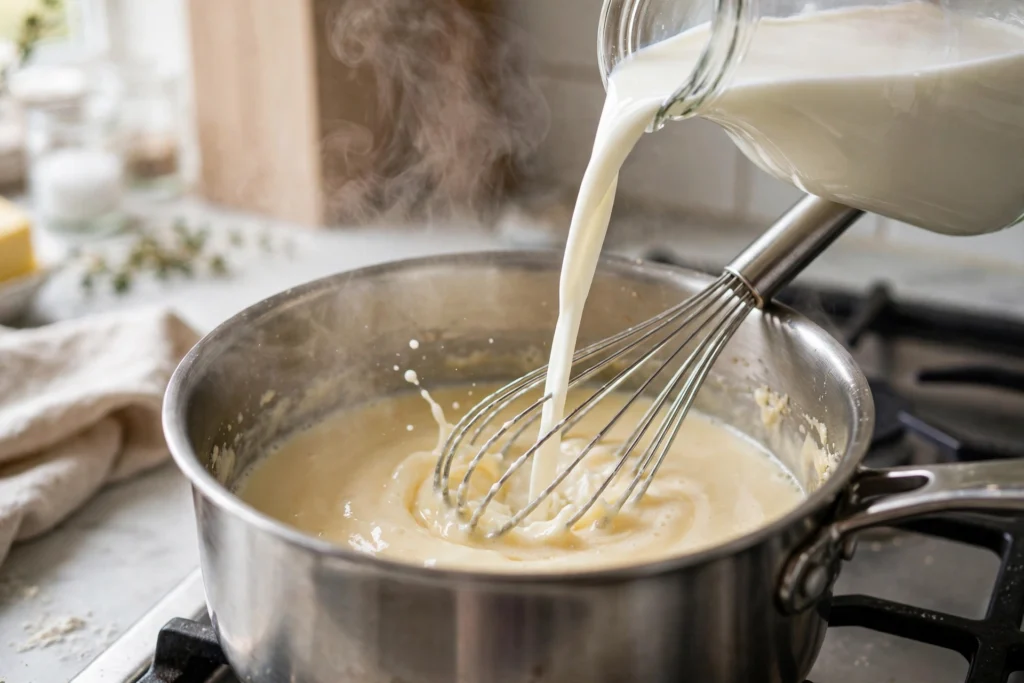
Step 1 — Warm the milk. In a separate pot or the microwave, heat the milk until steaming (with the bay leaf if using) — not boiling. Keep it warm. Warm milk + hot roux = no lumps. Cold milk + hot roux = lump city.
Don’t walk away from the milk. It goes from steaming to boiled-over in seconds, and a boiled-over mess on your stovetop is no way to start. Heat it gently, and once it’s steaming, take it off the heat and cover it to keep warm while you make the roux.
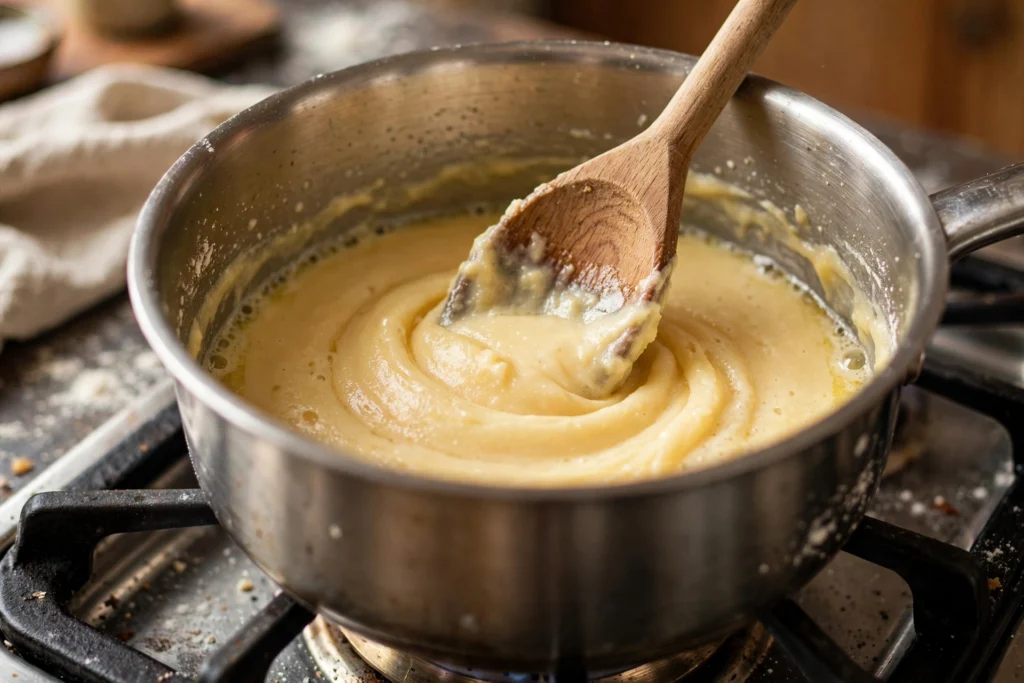
Step 2 — Make the roux. In your saucepan over medium heat, melt the butter until foaming. Whisk in the flour all at once. Cook, whisking constantly, for 2 minutes. It should smell nutty and look like wet sand — pale, not browned. This cooks out the raw flour taste.
Add all the flour at once — don’t sprinkle it in gradually. You want to get it all incorporated quickly so it cooks evenly. The mixture will look like a thick paste. Keep it moving for the full 2 minutes. You’ll smell the change: raw flour smells flat and starchy; cooked roux smells nutty and buttery. That aroma shift is your signal.
Step 3 — Add milk gradually. Here’s the critical moment: pour in about ½ cup of the warm milk while whisking vigorously. It will seize into a thick paste — that’s normal. Keep whisking until smooth, then add another ½ cup. Once it’s smooth and loose, you can add the remaining milk in a steady stream, whisking constantly.
Don’t panic when it seizes. Every first-timer thinks they’ve ruined it at this moment. That thick, gloppy paste is exactly what’s supposed to happen. Keep whisking — it will smooth out. The key is not to add more milk until the current addition is fully smooth. Patience here is everything.
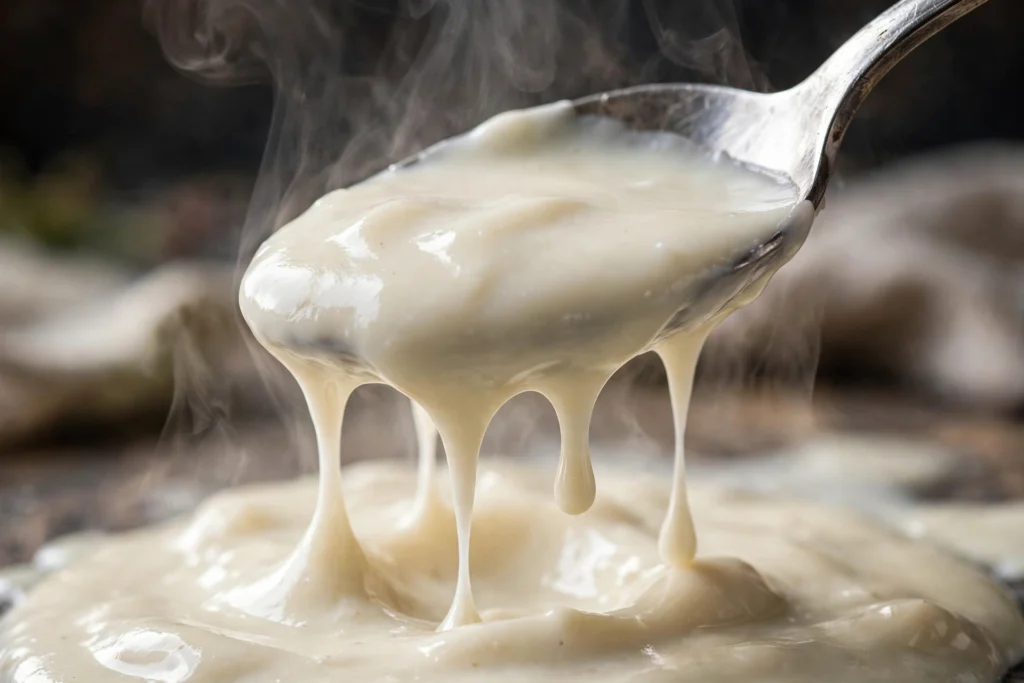
Step 4 — Simmer to thicken. Bring to a gentle simmer, whisking often. Cook 3–5 minutes until the sauce coats the back of a spoon (draw a finger through it — the line should hold). Don’t boil hard.
The “coats the back of a spoon” test (called “nappé” in French) is the definitive doneness check. Dip a spoon in, pull it out, and draw your finger through the coating. If the line holds clean edges without the sauce running back together, it’s done. If it flows back, keep simmering. This usually takes 3–5 minutes, but trust the test, not the clock.
Step 5 — Season. Remove from heat. Fish out the bay leaf. Stir in the salt, white pepper, and nutmeg. Taste — it should be creamy, savory, and well-seasoned. Adjust salt now; bechamel needs it.
Taste critically here. The sauce should taste rich and savory with a warm background note from the nutmeg. If it tastes flat, it needs more salt — add a quarter teaspoon at a time. If it tastes floury, it needs another minute or two of gentle simmering.
Step 6 — Use or store. Use immediately, or press plastic wrap directly onto the surface (prevents a skin) and keep warm. For later, refrigerate (see storage).
If you’re not using it right away, the plastic-wrap-on-the-surface trick is non-negotiable. As bechamel cools, the surface dries and forms a rubbery skin. Pressing plastic wrap directly onto the hot surface prevents air contact and eliminates the problem entirely.
My Best Tips for Lump-Free Bechamel
Warm milk is everything. I cannot stress this enough — the temperature differential between hot roux and cold milk is what creates lumps. Warm (not boiling) milk incorporates smoothly. This one tip solves 90% of bechamel problems.
Add milk in stages. The first additions must be small with vigorous whisking. Once the mixture is smooth and fluid, you can pour freely. Rushing the beginning is where lumps are born. The first cup is the critical phase; after that, it’s smooth sailing.
Whisk, don’t stir. A whisk breaks up flour particles far more effectively than a spoon. Use the whisk for the milk addition; switch to a spoon only if you prefer for the simmer. The whisk’s wires create turbulence that a spoon simply can’t match.
Cook the roux, not just melt it. Two full minutes of cooking the flour-butter paste. Raw roux tastes pasty and floury; properly cooked roux tastes nutty and disappears into the sauce. Set a timer if you need to — it’s easy to undercook when you’re impatient.
Strain if needed. If lumps happen despite everything, pour the sauce through a fine-mesh strainer. No shame — even professionals do this. Then carry on like it never happened. A strained bechamel is indistinguishable from a perfect one.
Salt at the end. Salt early and you can’t judge the final seasoning (reduction concentrates it). Salt after thickening, taste, adjust. This is a general sauce-making principle, not just bechamel.
Keep it moving. Bechamel scorches easily because of the milk solids. Stir or whisk frequently during the simmer, scraping the bottom and corners. A scorched bechamel tastes burnt and can’t be saved — start over if you see brown bits.
Don’t walk away. Ten minutes of active attention. That’s all this sauce asks. The moment you leave it to answer the phone is the moment it lumps, scorches, or boils over. Stay with it.
Thickness Guide: Bechamel for Every Use
Not all bechamel should be the same thickness. Here’s how to adjust:
Thin (for soups and light sauces): Use 2 tablespoons each of butter and flour per 3 cups of milk. Pourable, light-bodied. Good for cream soups and delicate vegetable sauces.
Medium (the standard recipe above): 4 tablespoons butter, ¼ cup flour, 3 cups milk. Coats a spoon thickly. Perfect for lasagna layers, gratins, and creamed vegetables. This is the all-purpose thickness.
Thick (for croquettes and binding): 6 tablespoons butter, ½ cup flour, 3 cups milk. Very thick — almost a paste when cool. Used for croquettes, where the bechamel needs to hold its shape, and for binding fillings.
The ratio to remember: equal parts butter and flour by weight (the roux), and the milk quantity determines thickness. More milk = thinner sauce. Once you internalize this, you can make bechamel at any thickness without a recipe.
Also Read : Hommade Chex Mix Recipe (Bold, Buttery & Dangerously Snackable)
Delicious Variations to Try
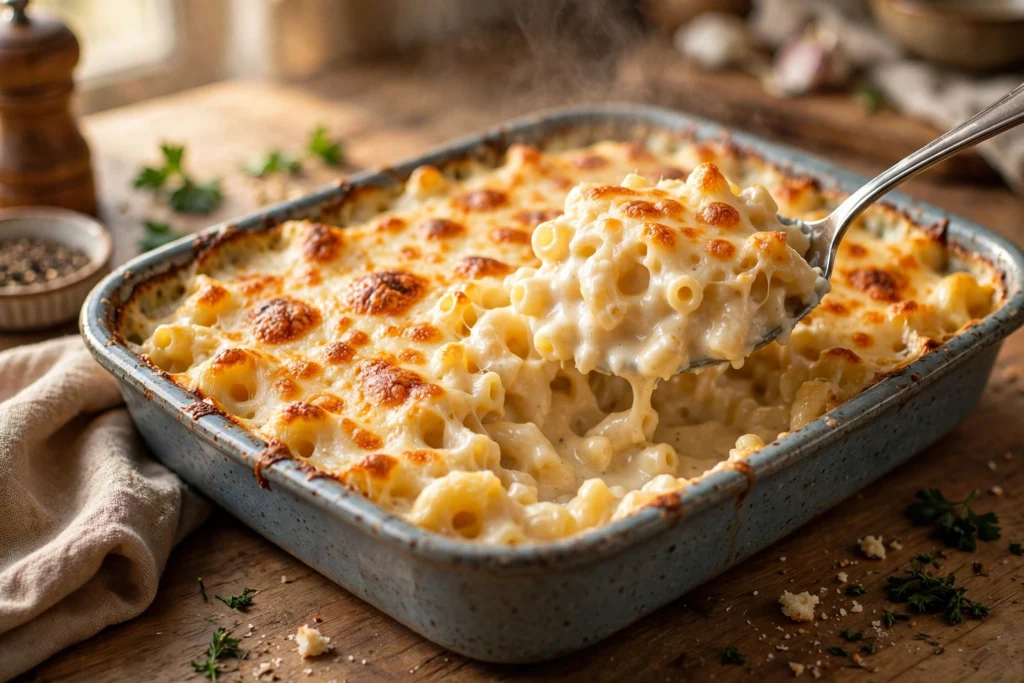
Mornay sauce: Stir in 1 cup of grated Gruyère (or Parmesan) off the heat. The cheese sauce for gratins, croque monsieurs, and the world’s best mac and cheese. Add the cheese after removing from heat — boiling will make it grainy. Stir until melted and smooth.
Mustard bechamel: Whisk in 2 tablespoons of Dijon. Fantastic over vegetables and in gratins. The mustard’s sharpness cuts through the richness beautifully. Whole-grain mustard adds texture too.
Herb bechamel: Stir in ¼ cup of chopped fresh herbs (parsley, chives, tarragon). Lovely with fish and chicken. Add the herbs at the very end so they stay bright green and fresh-tasting.
Onion soubise: Sweat 2 sliced onions in the butter before adding flour. Sweet, silky, incredible with roasted meats. This is technically a different sauce (soubise), but it’s built on the bechamel method. The onions practically dissolve into sweetness.
Curry bechamel: Add 1 tablespoon of curry powder to the roux. Unexpected and wonderful over rice and vegetables. Bloom the curry powder in the butter for 30 seconds before adding flour to wake up the spices.
Vegan bechamel: Use olive oil or vegan butter + unsweetened oat milk. Surprisingly good — the technique is identical. Oat milk is the best dairy-free choice here because it’s naturally creamy and neutral. Avoid sweetened plant milks.
Smoked bechamel: Add ½ teaspoon of smoked paprika and a drop of liquid smoke. Incredible in mac and cheese — adds a barbecue-like depth.
Garlic bechamel: Sauté 4 minced garlic cloves in the butter before adding flour. Perfect for white pizza and garlic bread dipping sauce.
What Bechamel Unlocks: A Dish Guide
Here’s the real payoff — everything this one sauce makes possible:
Lasagna: Traditional Italian lasagna uses bechamel (not ricotta) between the layers. It creates those distinct, creamy strata that define the dish. Use the medium thickness.
Mac and cheese: Mornay sauce (bechamel + cheese) is the base. It’s smoother and more stable than a simple cheese melt, and it reheats better. This is why restaurant mac and cheese is silkier than yours — now you know.
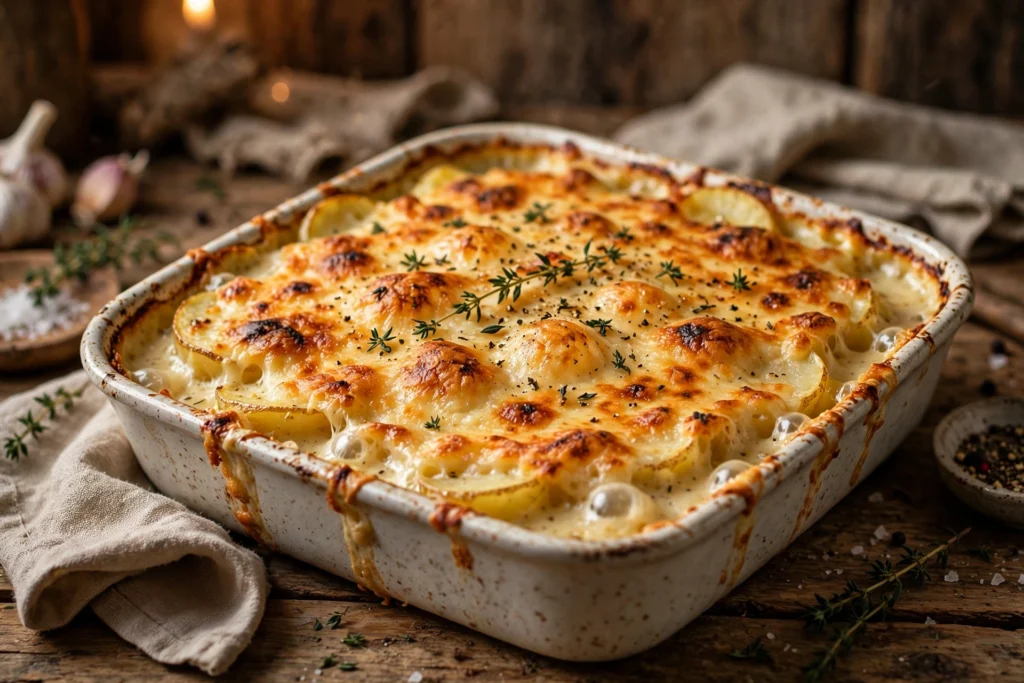
Gratins: Potato gratin, cauliflower gratin — bechamel binds everything and browns beautifully on top. Medium thickness, topped with cheese.
Croque monsieur/madame: The bechamel goes on top of the ham and cheese sandwich before broiling. It’s what makes it a croque and not just a ham sandwich.
Creamed spinach: Wilted spinach folded into bechamel. Steakhouse classic. Squeeze the spinach very dry first or the sauce gets watery.
Soufflés: Cheese soufflé starts with a thick bechamel base. The sauce provides the structure that holds the whipped egg whites.
Storing & Reheating
Refrigerator: 4 days in an airtight container, with plastic wrap pressed on the surface (prevents skin). It will gel when cold — that’s normal. It loosens as it reheats.
Freezer: 3 months. Thaw overnight in the fridge. The texture may be slightly grainy — whisk vigorously while reheating and it’ll come back. Add a splash of warm milk while whisking for the smoothest recovery.
Reheating: Gentle heat, whisking constantly, with a splash of milk to loosen. Never microwave on high — it breaks the emulsion and you’ll get a greasy, separated mess. Low and slow on the stovetop, or microwave at 50% power in short bursts with whisking between.
Skin prevention: That rubbery skin forms when the surface dries. Press plastic wrap directly onto the hot sauce’s surface. Every time. No exceptions. If a skin does form, just peel it off — the sauce underneath is fine.
What to Serve with Bechamel (What to Make WITH It)

Bechamel is an ingredient more than a serving sauce — but here’s what it unlocks: lasagna (the creamy layers), mac and cheese (mornay version), potato gratin, creamed spinach, croque monsieur/madame, moussaka, soufflés, and white pizza. As a sauce: over steamed vegetables, poached eggs, or baked chicken.
For a dinner party trick: make a mornay, pour it over blanched asparagus in a baking dish, top with breadcrumbs and Parmesan, and broil. Ten minutes to an impressive side dish, all built on the bechamel you just learned.
Bechamel Across Cuisines
While bechamel is French in origin, the roux-thickened milk sauce concept appears across culinary traditions:
Italian besciamella: Essentially identical to French bechamel, used in lasagna and cannelloni. The Italians often add Parmesan directly to the sauce.
Greek béchamel: Used in moussaka and pastitsio, often enriched with egg yolks and cheese for a richer, more custardy topping that browns beautifully.
British white sauce: Parsley sauce (bechamel + parsley) served with fish; onion sauce for roast meats. A staple of traditional British cooking.
American cream gravy: Essentially a bechamel made with meat drippings instead of plain butter — the foundation of biscuits and gravy.
The technique is universal because the chemistry is universal. Learn it once, and you can cook creamy sauces from half a dozen culinary traditions.
Roux Mastery: The Foundation Technique in Depth
The roux is the heart of bechamel, and understanding it deeply will improve all your sauce-making.
What is a roux, exactly? It’s a cooked mixture of equal parts fat and flour by weight. The fat coats the flour’s starch granules, which does two critical things: it prevents the granules from clumping when liquid is added, and it allows them to swell gradually and evenly, creating a smooth, stable thickening. Without the fat coating, starch granules would form lumps instantly on contact with hot liquid.
White, blond, and brown roux: Bechamel uses a white roux — cooked just long enough to eliminate the raw flour taste (about 2 minutes) but not long enough to develop color. A blond roux (cooked 3–5 minutes until pale golden) is used for velouté and has a slightly nuttier flavor. A brown roux (cooked 15–30 minutes until deep brown) is the foundation of gumbo and espagnole — completely different flavor profile. For bechamel, stop at white. If you see color developing, you’ve gone too far (though the result is still usable — it’ll just have a slightly nutty flavor and off-white color).
Fat choices: Butter is traditional and gives the best flavor. But you can make roux with any fat: olive oil (for a dairy-free version), bacon drippings (for smoky depth in savory applications), duck fat (luxurious). The technique is identical; only the flavor changes. Clarified butter makes an even more stable roux because the milk solids (which can burn) are removed.
The weight ratio: Professional recipes specify roux by weight (equal parts fat and flour), not volume. That’s because flour’s volume varies wildly depending on how it’s measured, while weight is consistent. For home cooking, the volume measurements in this recipe (4 tablespoons butter, ¼ cup flour) are close enough to the ideal ratio. But if you want precision, weigh it: 60g butter + 60g flour.
Also Read : Perfect Pan-Seared Scallops Recipe (Golden Crust Every Time)
Bechamel in Professional Kitchens
How do restaurants handle bechamel, and what can home cooks learn from them?
Batch production: Professional kitchens make bechamel in large batches (gallons, not cups). The technique scales perfectly — the only difference is the whisk size and arm strength required. They use the same warm-milk-gradual-addition method, just with bigger pots.
Holding: Restaurants hold bechamel warm for service (in a bain-marie or on the stove’s back burner on lowest heat). The key is stirring every 15–20 minutes and keeping plastic wrap on the surface. At home, if you’re making bechamel as part of a larger meal (like lasagna), you can hold it warm for up to an hour using the same method.
The strainer habit: Every professional kitchen strains their bechamel through a chinois (fine-mesh strainer) before service. It’s not because they’re bad at making it — it’s because straining guarantees perfection. Adopt this habit at home for dinner-party bechamel; for weeknight mac and cheese, skip it.
Seasoning in layers: Pros season bechamel at three stages: a pinch of salt in the roux, the main seasoning after thickening, and a final adjustment just before service. The layered approach builds more complex flavor than a single seasoning addition.
Common Bechamel Disasters and How to Fix Them
Disaster: Lumpy sauce. Cause: cold milk, adding milk too fast, or insufficient whisking. Fix: strain through fine-mesh sieve. Prevention: warm milk, gradual addition, vigorous whisking. If straining doesn’t fully fix it, blend with an immersion blender — the mechanical shear breaks up remaining lumps.
Disaster: Scorched bottom. Cause: heat too high, not stirring enough, thin-bottomed pan. The sauce tastes burnt and there’s no fix — the burnt flavor permeates everything. Prevention: medium heat max, heavy-bottomed pan, stir constantly during simmer. If you catch it early (just a few brown specks), immediately pour the unburnt portion into a clean pan — don’t scrape the bottom.
Disaster: Too thick (paste). Cause: too much roux for the milk, or over-reduction. Fix: whisk in warm milk, a quarter cup at a time, until desired consistency. This is easily fixable — bechamel is very forgiving in this direction.
Disaster: Too thin (soup). Cause: not enough roux, undercooked, or too much milk. Fix: make a small separate roux (1 tablespoon each butter and flour, cooked 2 minutes), then whisk it into the simmering sauce. Or simmer longer to reduce. Don’t just add raw flour — it’ll taste pasty.
Disaster: Skin formed. Cause: air exposure during cooling or holding. Fix: peel off and discard the skin; the sauce underneath is fine. Prevention: plastic wrap pressed directly on surface, always.
Disaster: Grainy texture (with cheese). Cause: cheese added while sauce was boiling, or pre-shredded cheese with anti-caking agents. Fix: unfortunately, grainy mornay can’t be fully fixed. Prevention: remove from heat before adding cheese, use freshly grated cheese, add gradually while stirring.
Disaster: Bland and flat. Cause: under-seasoning (the #1 bechamel mistake). Fix: add salt in quarter-teaspoon increments, tasting after each. Add white pepper and nutmeg. A squeeze of lemon juice can also brighten it (though this isn’t traditional).
Make-Ahead and Freezer Strategies
For lasagna: Make the bechamel up to 3 days ahead. Refrigerate with plastic wrap on the surface. When assembling lasagna, use it cold — it spreads easily and the oven heat will warm it through. No need to reheat first.
For mac and cheese: Make the mornay (bechamel + cheese) up to 2 days ahead. Reheat gently with a splash of milk, whisking constantly. It won’t be quite as silky as fresh, but it’s very close.
Freezer portions: Freeze bechamel in 1-cup portions (muffin tins work great — freeze, then pop out and bag). Each portion is perfect for a single gratin or a small batch of creamed vegetables. Thaw overnight in the fridge.
The ice cube trick: Freeze bechamel in ice cube trays for small amounts — perfect for enriching soups, sauces, or single servings of vegetables. Two cubes (about ¼ cup) is ideal for a side dish for two.
Reheating from frozen: Thaw overnight, then reheat gently in a saucepan over low heat, whisking constantly and adding warm milk as needed. Never microwave from frozen — the texture will break. Patience is required, but the result is worth it.
Bechamel Troubleshooting Quick Reference
Problem → Solution at a glance: Lumps → strain through fine mesh. Too thick → whisk in warm milk. Too thin → simmer longer or add small roux. Scorched → start over (can’t fix). Skin → peel off, prevent with plastic wrap. Bland → add salt incrementally. Grainy (cheese) → prevent by removing from heat before adding cheese. Separated → whisk vigorously with splash of warm milk. Tastes floury → simmer 2–3 more minutes. Keep this list taped inside your spice cabinet for the first few times — after that, it’ll be muscle memory.
Essential Tools Worth Buying
Balloon whisk: If you make sauces regularly, a good balloon whisk ($12–15) is worth every penny. The wide, flexible wires reach into pan corners and create better turbulence than cheap whisks. Look for one with a comfortable handle — you’ll be whisking for several minutes.
Fine-mesh strainer: A 6-inch fine-mesh strainer ($10) is the bechamel insurance policy. Even if you never need it, having it means you’ll attempt bechamel with confidence. It also works for stocks, custards, and purees.
Heavy-bottomed saucepan: If your current saucepan has a thin bottom, consider upgrading to something with a heavy, encapsulated base. Even heat distribution prevents the hot spots that scorch bechamel. A 2-quart size is ideal for sauce-making.
Bechamel in 60 Seconds: The Cheat Sheet
Melt 4 tbsp butter. Whisk in ¼ cup flour; cook 2 min. Gradually whisk in 3 cups warm milk. Simmer 3–5 min until thick. Season with 1 tsp salt, ¼ tsp white pepper, ¼ tsp nutmeg. Done. The details above explain the why; this is the what. Once you’ve made it three times, you won’t need either — it’ll be in your hands and you’ll wonder why you ever feared it.
One last thing: The first bechamel is the hardest. The fifth is automatic. Every sauce you make after learning this technique — gravy, cheese sauce, cream soup — will be better because you understand roux, temperature, and patience. That’s the real value here, far beyond any single recipe. Now go make something creamy and wonderful — you’ve absolutely got this covered completely.
Bechamel Variations from Around the World
Greek avgolemono-inspired: Whisk 2 egg yolks with lemon juice and temper into warm (not hot) bechamel for a rich, tangy sauce. Indian-inspired: Add 1 teaspoon garam masala and ½ teaspoon turmeric to the roux for a golden, aromatic sauce. Mexican-inspired: Stir in diced green chiles and cumin for a Southwestern cream sauce. The neutral base adapts to any cuisine.
Must Read : Creamy Cheeseburger Soup Recipe (All the Flavor, One Pot)
Final Thoughts
Master this sauce and you’ve mastered a cornerstone of classical cooking. There’s a moment in every cook’s life when bechamel clicks when the sauce turns silky under your whisk and you realize it’s not magic, just technique. That moment is worth more than the sauce itself, because the confidence it gives you radiates into everything else you cook.
So don’t fear the mother sauce. Warm your milk, whisk with conviction, and trust the process. Ten minutes from now you’ll have a perfect bechamel — and a new superpower in the kitchen.
And once you’ve nailed it, start playing. Add cheese. Add mustard. Add herbs. The blank canvas is yours now.
Classic Bechamel Sauce
Ingredients
Equipment
Method
- Prep and measure. Measure out all ingredients before you start and get the milk warming — bechamel moves fast once the roux is ready.
- Warm the milk. In a separate pot or the microwave, heat the milk until steaming (with the bay leaf if using) – not boiling. Keep warm.
- Make the roux. In your saucepan over medium heat, melt the butter until foaming. Whisk in the flour all at once. Cook, whisking constantly, for 2 minutes until it smells nutty and looks like wet sand. Don’t let it brown.
- Add milk gradually. Pour in about 1/2 cup of the warm milk while whisking vigorously. It will seize into a thick paste – keep whisking until smooth, then add the remaining milk in 3-4 additions, whisking smooth after each.
- Simmer to thicken. Bring to a gentle simmer, whisking often. Cook 3-5 minutes until the sauce coats the back of a spoon (nappe) and a line drawn with your finger holds its shape.
- Season. Remove from heat. Fish out the bay leaf. Stir in the salt, white pepper, and nutmeg. Taste and adjust.
- Use or store. Use immediately, or press plastic wrap directly onto the surface and keep warm. For storage, refrigerate up to 4 days or freeze up to 3 months.
What is bechamel sauce made of?
Bechamel is made from just three ingredients: butter, flour, and milk, plus salt, white pepper, and nutmeg for seasoning. The butter and flour are cooked into a roux, then warm milk is whisked in gradually until the sauce thickens.
How do you keep bechamel sauce from getting lumps?
Use warm milk (not cold), add it gradually while whisking vigorously, and cook the roux for 2 minutes first so the flour is fully coated in fat. If lumps still form, strain the sauce through a fine-mesh strainer.
How long does it take to make bechamel sauce?
About 12 minutes total: 2 minutes prep, 2 minutes for the roux, and 8-10 minutes to add the milk and simmer until thickened.
Why is my bechamel sauce too thin?
It’s likely undercooked or the roux-to-milk ratio is off. Simmer longer, whisking often, until it coats the back of a spoon. For a quick fix, make a small separate roux (1 tablespoon each butter and flour), whisk it in, and simmer.
Why is my bechamel sauce too thick?
Too much roux for the milk, or it over-reduced. Whisk in warm milk a quarter cup at a time until it reaches the thickness you want.
Can you make bechamel sauce ahead of time?
Yes. Refrigerate up to 4 days with plastic wrap pressed directly on the surface to prevent a skin, or freeze up to 3 months. Reheat gently over low heat, whisking constantly with a splash of milk to loosen.
What is the difference between bechamel and mornay sauce?
Mornay is bechamel with cheese stirred in – typically Gruyere or Parmesan – added off the heat. It’s the classic cheese sauce for gratins, croque monsieur, and mac and cheese.
Can I make bechamel sauce with olive oil instead of butter?
Yes, for a dairy-free or vegan version, use olive oil or vegan butter with unsweetened oat milk. The technique is identical, though the flavour will differ slightly from classic butter-based bechamel.
How do you fix lumpy bechamel sauce?
Pour it through a fine-mesh strainer to remove the lumps, then return it to the pan. For stubborn lumps, an immersion blender works too. Next time, use warm milk and add it more gradually.
What dishes use bechamel sauce?
Lasagna (traditional Italian uses bechamel, not ricotta), mac and cheese (via mornay), gratins, croque monsieur, creamed spinach, and cheese souffles all start with bechamel.
How do you store leftover bechamel sauce?
Cool it quickly, press plastic wrap directly onto the surface to prevent a skin, and refrigerate up to 4 days or freeze up to 3 months. Reheat gently with a splash of milk, whisking constantly.
Why does my bechamel taste floury or pasty?
The roux wasn’t cooked long enough. Cook the butter-flour mixture for a full 2 minutes, stirring constantly, until it smells nutty and looks like wet sand before adding the milk.

Hi, I’m Angela. I cook the way busy people actually cook — simple, tasty food with ingredients you already have. On CookBookBite I share easy recipes, honest kitchen tips, and dishes my family asks for again and again.
Pingback: Braised Short Ribs Recipe – Fall-Off-the-Bone Tender