
Every summer has a smell. For me, it’s peaches — that heavy, honeyed perfume that fills the whole kitchen when you slice into a perfectly ripe one, juice running down your wrist before you can catch it. And every summer, at least once, that smell means it’s cobbler time.
Now, I know cobbler has a reputation for being fussy. Pastry crusts, lattice tops, blind baking, crimped edges — no. Not here. This easy peach cobbler recipe gives you juicy cinnamon-spiced peaches bubbling up around a golden, buttery biscuit topping that you drop by the spoonful straight from the bowl. No rolling, no crimping, no pastry skills, no stress. Fifteen minutes of hands-on work, and the oven does the rest while your house fills with the best smell of the season.
Also Read : Banana Nut Muffin Recipe: Bakery-Style, Moist and Fluffy in 40 Minutes
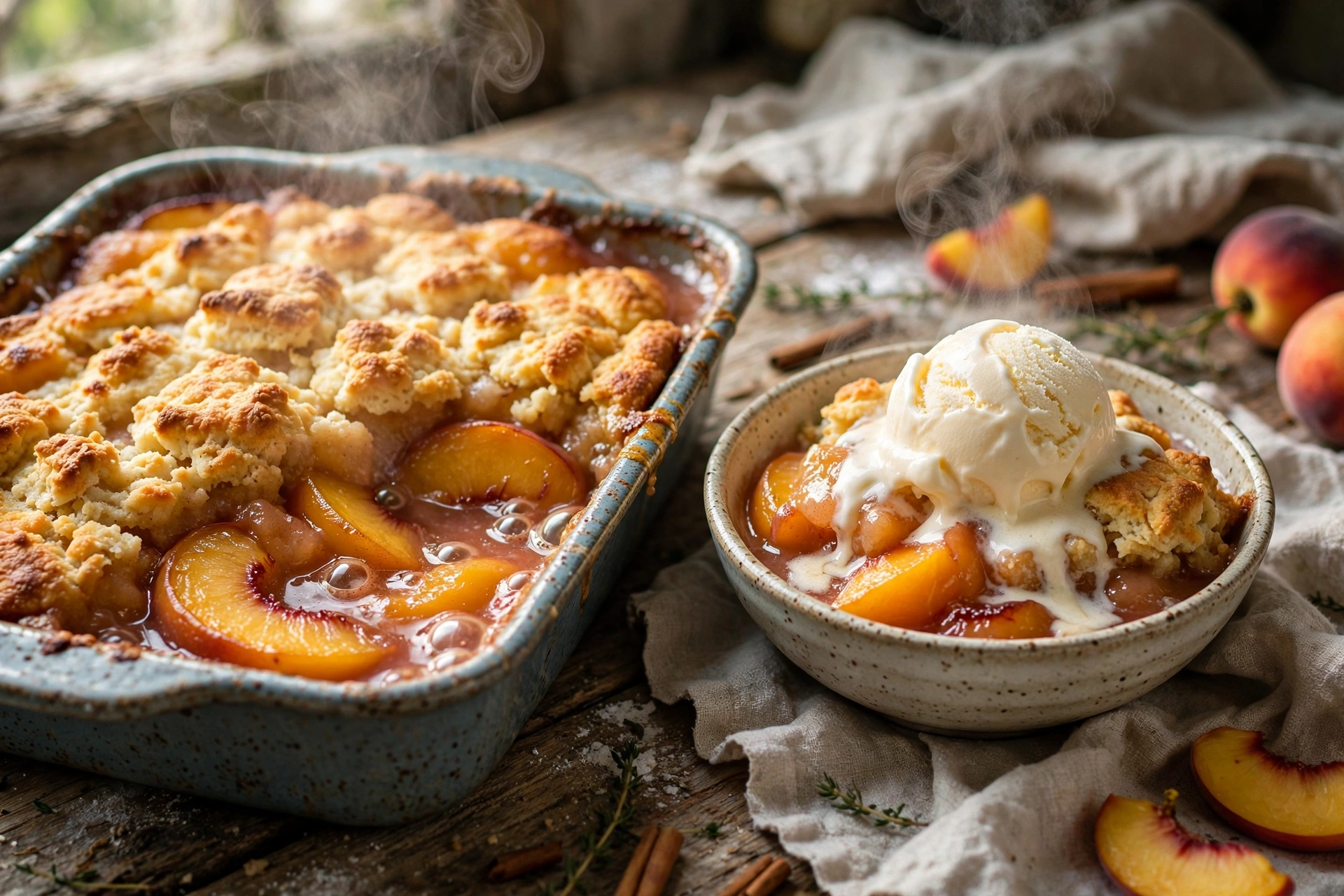
The result tastes like the best part of summer concentrated into a baking dish — caramelized peaches gone jammy at the edges, crisp-topped and soft-centered biscuit, all of it begging for a scoop of vanilla ice cream melting into the crevices. It’s the dessert I make when peaches are perfect in August, and the dessert I make with frozen peaches in February when I’m pretending it’s summer. Both versions are fantastic, and I’m going to show you exactly how to nail each one.

Why You’ll Love This Easy Peach Cobbler Recipe
First, it’s genuinely, honestly easy — not “easy for a pastry chef” but easy for a real person on a Tuesday. The topping is a simple drop biscuit: stir the dry ingredients, cut in the butter, add hot water, scoop. No rolling pin, no pie crust anxiety, no lattice weaving. If you can stir pancake batter, you can make this cobbler. The whole thing comes together in 15 minutes of actual work.
Second, the texture contrast is perfect and it’s the entire reason cobbler exists. Crisp, golden, buttery, slightly crackly topping over soft, jammy, bubbling peaches. Every spoonful has crunch and silk, hot and (with ice cream) cold, sweet and just tart enough. This recipe nails that contrast because the topping is designed to crisp rather than steam, and the filling is thickened to jammy rather than soupy.
Third, it works beautifully with fresh OR frozen peaches. Fresh in summer is transcendent — there’s nothing like it. But frozen peaches (properly thawed and drained) make this a legitimate year-round dessert, not a sad compromise. No excuses, no waiting for August — cobbler season is whenever you decide it is.
Finally, it’s a crowd-pleaser with zero pretension. Serve it warm in bowls with vanilla ice cream and watch the table go quiet — that happy, focused quiet that means the dessert is really, truly good. It’s the dessert equivalent of a firm handshake: straightforward, reliable, and deeply satisfying.
Cobbler, Crisp, Crumble, Buckle, Pandowdy: What’s the Difference?
American fruit desserts have a confusing number of names, so let’s sort it out — because it actually affects what you’re making. A cobbler (this recipe) has a biscuit, batter, or dumpling-like topping dropped or spread over fruit. The name comes from the topping’s resemblance to cobblestones. A crisp has a streusel topping that includes oats (it “crisps” in the oven). A crumble is like a crisp but without oats. A buckle has fruit folded into a cake batter that “buckles” as it bakes. A pandowdy has a pastry crust that’s broken and pushed down into the fruit halfway through baking (“dowdying”).
Why does this matter? Because the topping defines the eating experience. Biscuit topping (cobbler) gives you that wonderful bread-meets-dessert quality — crisp outside, tender and slightly doughy where it meets the fruit. It’s heartier and more satisfying than a streusel, and it soaks up the peach juices in the most delicious way. When someone says “peach cobbler,” this biscuit-topped version is what most Americans picture — it’s the classic Southern style.
Choosing Peaches: The Most Important Decision You’ll Make
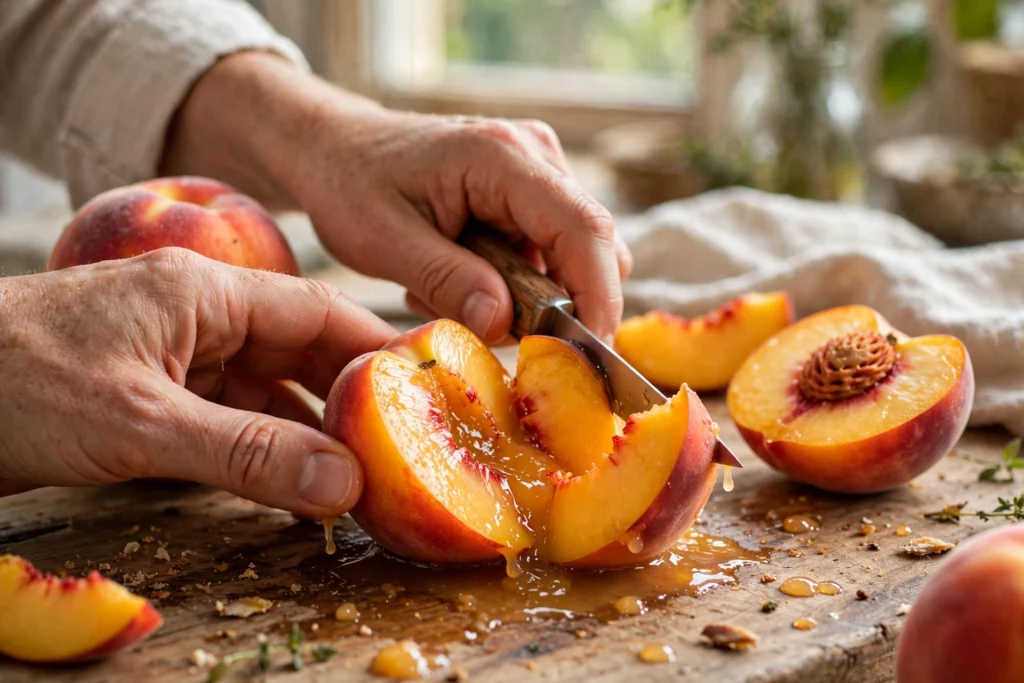
The peaches make or break this dessert, so let’s talk about choosing them properly. You’re looking for peaches that are ripe but not mushy — they should smell distinctly like peaches (bury your nose near the stem end and inhale), give slightly when gently pressed, and feel heavy for their size. Heavy means juicy. No smell means no flavor, no matter how pretty they look.
Freestone versus clingstone: freestone peaches (the pit pulls away cleanly) are easier to slice and are what you want. Most peaches sold in summer are freestone. Clingstone peaches (the flesh clings to the pit) are fine for eating but frustrating for baking — if that’s all you can find, just cut the flesh away from the pit as best you can.
Yellow versus white peaches: yellow peaches are the classic choice — more acidic, more “peachy” flavor, and they hold up better to baking. White peaches are sweeter, more floral, and more delicate; they work but can turn mushy faster. For cobbler, yellow is the safer bet.
What about underripe peaches? If your peaches are hard as rocks, put them in a paper bag at room temperature for 1-3 days — the trapped ethylene gas speeds ripening. Don’t refrigerate unripe peaches; cold stops the ripening process permanently. Once ripe, you can refrigerate them for 3-5 days.
And frozen peaches: buy them unsweetened (not in syrup), thaw completely in a colander in the sink or fridge, and drain off all the excess liquid. Frozen peaches release more water than fresh, so you may want an extra teaspoon of cornstarch. The flavor is surprisingly good — modern flash-freezing preserves peaches at peak ripeness.
Also Read : Perfect Pan-Seared Scallops Recipe (Golden Crust Every Time)
Ingredients for Easy Peach Cobbler (And the Role Each Plays)
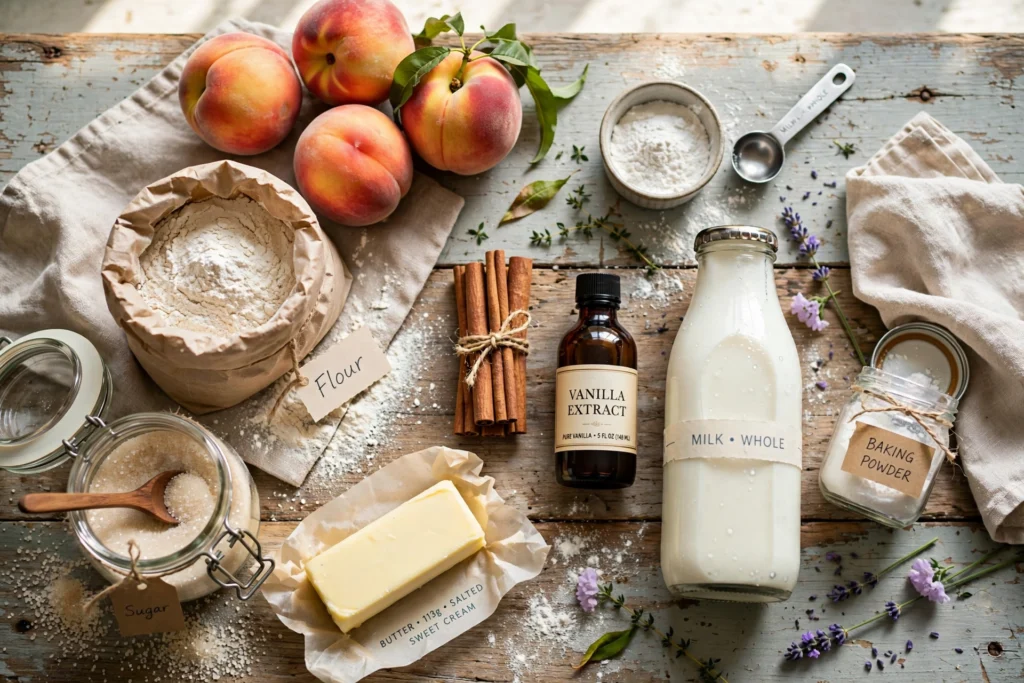
For the peach filling:
Peaches (8 cups sliced, about 10-12 medium fresh peaches) — The star of the show. Ripe but still firm enough to hold their shape — they should smell like peaches and give slightly when pressed. Overripe, mushy peaches dissolve into baby food during baking. In the off-season, use 3 pounds of frozen peach slices, thawed completely and well drained.
Granulated sugar (¾ cup for the filling) — Does three jobs: sweetens, draws juice out of the peaches through osmosis (creating the syrupy filling), and caramelizes at the edges for those irresistible browned bits. Taste your peaches first — candy-sweet peaches need less (down to ½ cup); tart or underripe ones might need a bit more. The recipe is a starting point; your peaches are the truth.
Cornstarch (2 tablespoons) — The thickener that turns peach juices into a glossy, jammy filling instead of a watery puddle. It needs to reach a full boil to activate properly, which is why the filling must bubble thickly in the oven. Don’t skip it, and don’t substitute flour (which makes the filling cloudy and pasty).
Cinnamon (1 teaspoon) + nutmeg (¼ teaspoon) — Warm spices that make peaches taste more intensely like themselves. Cinnamon is the classic partner; nutmeg adds depth in the background. A tiny pinch of ground ginger is a nice addition if you’re feeling adventurous.
Lemon juice (1 tablespoon, fresh) — Brightens the peaches, balances the sweetness, and prevents browning. Fresh lemon juice has a liveliness that bottled can’t match. It won’t make the filling taste lemony — just more vibrant.
Vanilla extract (1 teaspoon) — In the filling, not just the topping. It adds warmth and aromatic depth that rounds out the fruit flavor. Use real vanilla extract.
For the biscuit topping:
All-purpose flour (1½ cups) — The structure of the topping. Spooned and leveled for accuracy.
Granulated sugar (¼ cup) + coarse sugar for sprinkling — The ¼ cup sweetens the biscuit dough. The coarse sugar (turbinado or demerara) sprinkled on top before baking creates a crackly, sparkly, professional-looking crust. Don’t skip this — it’s the difference between homemade-looking and bakery-looking.
Baking powder (2 teaspoons) — The leavening that makes the topping puff up light and tender. Check that yours is fresh — baking powder loses potency after about 6 months open. (Test: drop ½ teaspoon in hot water; it should fizz vigorously.)
Salt (½ teaspoon) — Sharpens all the flavors and balances the sweetness. Biscuit dough without salt tastes flat.
Cold butter (½ cup / 1 stick, cut into small cubes) — Must be cold, straight from the fridge. Cold butter creates little pockets in the dough that turn to steam in the oven, producing flaky layers. If your kitchen is warm, cube the butter and put it back in the fridge for 10 minutes before using.
Boiling water (½ cup) — This is the magic ingredient and the most unusual one. The boiling water creates instant steam when it hits the hot oven, giving the biscuit topping extra lift and a crisp exterior. It’s an old-fashioned Southern technique that really works. The dough will look shaggy and wet — that’s correct.
Equipment You’ll Need
A 9×13-inch baking dish is the standard — it gives the right ratio of filling to topping. A 12-inch oven-safe skillet (cast iron is perfect) is a gorgeous alternative that goes straight from oven to table and makes for stunning presentation. You’ll also need two mixing bowls (one for filling, one for topping), a pastry cutter or two forks for cutting in the butter, and a large spoon for dropping the topping. An ice cream scoop for serving is highly recommended — it makes perfect round scoops of cobbler plus ice cream.
If you don’t have a pastry cutter, two butter knives used in a scissoring motion work, or you can rub the butter into the flour with your fingertips (work quickly so the butter doesn’t melt). A food processor can cut in the butter in seconds, but it’s easy to overdo — pulse, don’t run continuously.
How to Make Easy Peach Cobbler (Step by Step)
Step 1 — Prep the peaches. Heat the oven to 375°F (190°C) with a rack in the center. If using fresh peaches, peel them first: bring a large pot of water to a boil, score a small X on the bottom of each peach, blanch for 30 seconds, then immediately transfer to a bowl of ice water. The skins will slip right off with your fingers. (This blanch-and-shock method is much faster than peeling with a knife and doesn’t waste any flesh.) Slice the peeled peaches about ½-inch thick — not paper-thin (they’ll dissolve) and not too thick (they won’t cook through).
Step 2 — Macerate the filling. In a large bowl, toss the sliced peaches with ¾ cup granulated sugar, cornstarch, cinnamon, nutmeg, lemon juice, and vanilla. Let the mixture sit for 10 minutes at room temperature. During this rest, the sugar draws juice out of the peaches through osmosis, the cornstarch hydrates, and the spices distribute. You’ll see a pool of gorgeous syrupy liquid forming — that’s exactly what you want. Give it a stir before proceeding.
Step 3 — Fill the baking dish. Pour the peaches and ALL of their juices into your baking dish, spreading into an even layer. Don’t leave any of that liquid behind — those juices bubble up around the topping during baking, caramelize at the edges, and become the luscious sauce. Scrape the bowl clean.

Step 4 — Make the biscuit topping. In a separate bowl, whisk together the flour, ¼ cup sugar, baking powder, and salt. Add the cold cubed butter and cut it in with a pastry cutter, two forks, or your fingertips until the mixture resembles coarse crumbs with some pea-sized pieces of butter still visible. Those visible butter pieces are important — they create the flaky pockets. Pour in the boiling water all at once and stir just until a shaggy, wet dough forms. It will look messy and too wet — that’s correct. Do not overmix; stop as soon as the flour is moistened.
Step 5 — Drop the topping. Using a large spoon, drop mounds of dough over the peaches, spacing them out and deliberately leaving gaps between the mounds. The gaps are functional, not just aesthetic: they let steam escape (keeping the topping crisp instead of soggy) and allow the peach juices to bubble up around the biscuits, creating those caramelized edges. Sprinkle the entire surface generously with coarse turbinado or demerara sugar — this creates the crackly, golden, professional-looking crust.

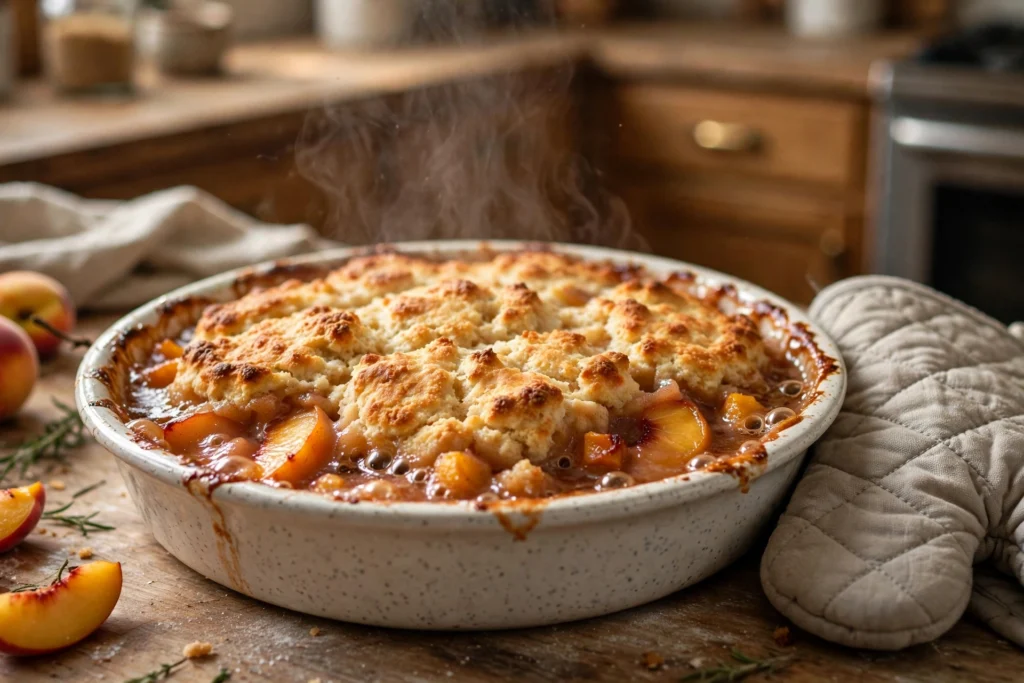
Step 6 — Bake to golden perfection. Bake for 40–45 minutes, until the topping is a deep golden brown and the peach filling is bubbling thickly — not just simmering, but actively bubbling — around the edges and through the gaps. The bubbling is how you know the cornstarch has activated and the filling is properly thickened. If the topping is getting too dark before the filling bubbles (around 30 minutes), tent loosely with aluminum foil and continue baking.
Step 7 — Rest (the hardest step). Remove from the oven and let it rest for 15–20 minutes on a wire rack. I know — the smell is torture and you want to dig in immediately. But the filling is molten right now and needs this time to set from bubbling liquid to jammy syrup. Cutting in early gives you peach soup (delicious soup, but soup). Use this time to scoop the ice cream and put the kettle on.
Step 8 — Serve warm. Scoop generous portions into bowls, making sure everyone gets both biscuit and peaches. Top with vanilla ice cream — the hot-cold contrast of melting ice cream pooling into warm peach juices is one of food’s great pleasures and, in my opinion, non-negotiable. Serve immediately.
My Best Tips for the Best Peach Cobbler
Taste your peaches first, then adjust sugar. This is the most important tip. Great, candy-sweet peaches need less sugar (down to ½ cup); bland or tart ones need the full ¾ cup or even a bit more. Taste a slice before you start, then adjust. The recipe is a framework; your specific peaches are the reality.
Don’t skip the rest — seriously. I know I already said this, but it bears repeating because it’s the most commonly skipped step. The filling needs 15–20 minutes to transform from bubbling liquid to jammy syrup. Set a timer if you don’t trust yourself. The difference between rested and unr rested cobbler is dramatic.
Cold butter plus boiling water isn’t a contradiction. It sounds wrong, but it’s the core technique: cold butter creates flaky pockets through steam expansion, while boiling water creates immediate additional steam for lift and crispness. Both contribute to the topping’s texture in different ways. Trust the process.
Leave real gaps in the topping. A solid blanket of dough traps steam and goes soggy underneath. Generous gaps mean crispy biscuit edges, visible bubbling fruit, and those caramelized bits where juice meets hot topping. Think cobblestones with space between them, not a paved road.
Frozen peaches are genuinely great. Thaw completely in a colander, drain off all excess liquid, and proceed as written. You may want an extra teaspoon of cornstarch since frozen fruit releases more water. Don’t apologize for using frozen peaches in February — it’s smart, not cheating.
Manage browning and doneness separately. The topping’s color and the filling’s doneness run on different schedules. If the top is perfectly golden at 30 minutes but the filling isn’t bubbling yet, tent loosely with foil and keep baking. Foil stops the browning while letting the heat continue working on the filling.
Use a light-colored baking dish if you have one. Dark dishes absorb more heat and can over-brown the bottom before the top is done. If all you have is dark, reduce the oven temperature by 25°F and check 5 minutes early.
Read Must : Simple Banana Bread Recipe (Moist, Tender & One Bowl)
Troubleshooting: When Things Don’t Go as Planned
Watery, soupy filling: The most common issue. Causes: underbaking (the filling must bubble thickly, not just simmer, to activate the cornstarch), cutting too soon (it sets as it cools), or exceptionally juicy peaches (add an extra teaspoon of cornstarch next time). For a rescue: return it to the oven for 10 more minutes, then rest properly.
Topping is pale and soft: Not baked long enough, or the oven temperature was too low. The topping should be deep golden brown, not just lightly tanned. An oven thermometer can reveal if your oven runs cool. Also make sure you left gaps — a solid topping steams instead of crisps.
Topping is burnt but filling isn’t done: Your oven has hot spots or runs hot on top. Tent with foil as soon as the topping reaches the right color, then continue baking until the filling bubbles. Next time, try a lower oven rack position.
Biscuit topping is tough: Overmixed dough develops too much gluten. Stir just until the flour is moistened — lumps and shagginess are fine, even desirable. Also check that your baking powder is fresh; old leavening gives dense results.
Peaches are still crunchy: Slices were cut too thick, or the peaches were very underripe. Cut thinner next time (¼-inch), and make sure underripe peaches get the paper-bag treatment before baking day.
Delicious Variations to Try
Blackberry-peach: Replace 2 cups of the peaches with fresh blackberries. The tart, dark berries against sweet peaches is visually stunning and the flavor contrast is incredible. The blackberries break down more, creating beautiful purple-streaked filling.
Bourbon-peach: Add 2 tablespoons of good bourbon to the filling along with the vanilla. The oak and vanilla notes are incredible with peaches, adding warmth and complexity. The alcohol bakes off, leaving just the flavor. This is the dinner-party version.
Ginger-peach: Add 1 tablespoon of freshly grated ginger to the filling. Warm, zingy, and sophisticated — it makes the peaches taste brighter and more interesting. A pinch of ground ginger works too, but fresh is better.
Streusel topping (peach crisp): Replace the biscuit topping with a crumble: 1 cup flour, ½ cup brown sugar, ½ cup cold butter, and ½ cup rolled oats, rubbed together into clumps. Different texture — crunchy and buttery rather than bready — equally delicious. (Technically this makes it a crisp, not a cobbler, but who’s checking?)
Savory-sweet with herbs: Add a pinch of freshly ground black pepper and 1 teaspoon of fresh thyme leaves to the peaches. It sounds strange; it tastes like something from a fancy restaurant. The pepper amplifies the peach flavor and the thyme adds an herbal note that’s surprisingly perfect.
Individual cobblers: Divide the filling among 8 buttered ramekins, top each with dough, and reduce the bake time to 25–30 minutes. Adorable for dinner parties, and everyone gets their own perfect ratio of topping to fruit. Plus, no fighting over the crispy edge pieces.
Blueberry-peach: Swap 2 cups of peaches for fresh blueberries. The blueberries burst and create a gorgeous purple-red filling marbled through the peaches. A classic Southern combination.
Storing, Freezing & Reheating (Complete Guide)
Room temperature: Covered loosely, 1 day. The topping stays crispest the day it’s baked — this is a dessert that’s genuinely best fresh. Cover with a clean kitchen towel rather than plastic wrap (which traps moisture and softens the topping).
Refrigerator: 4 days, covered. The topping will soften as it absorbs moisture from the filling — that’s the inevitable price of leftovers, and it’s still delicious, just different. The flavors actually deepen overnight.
Freezer (baked): Baked cobbler freezes well for up to 3 months. Cool completely, wrap tightly in plastic wrap followed by foil, and freeze. Thaw overnight in the refrigerator. The topping won’t be as crisp as fresh, but the flavor is excellent.
Freezer (unbaked): Assemble the filling in the baking dish, wrap tightly, and freeze. Make the topping fresh on baking day (it takes 5 minutes). Thaw the filling overnight in the fridge, then top and bake as directed, adding 5-10 minutes to the bake time. This gives you nearly-fresh results with advance prep.
Reheating: The oven is far superior — 350°F for 15–20 minutes restores much of the topping’s crispness. The microwave works in a pinch but makes the topping soggy (emergency use only). For individual portions, a toaster oven is perfect.
What to Serve with Peach Cobbler
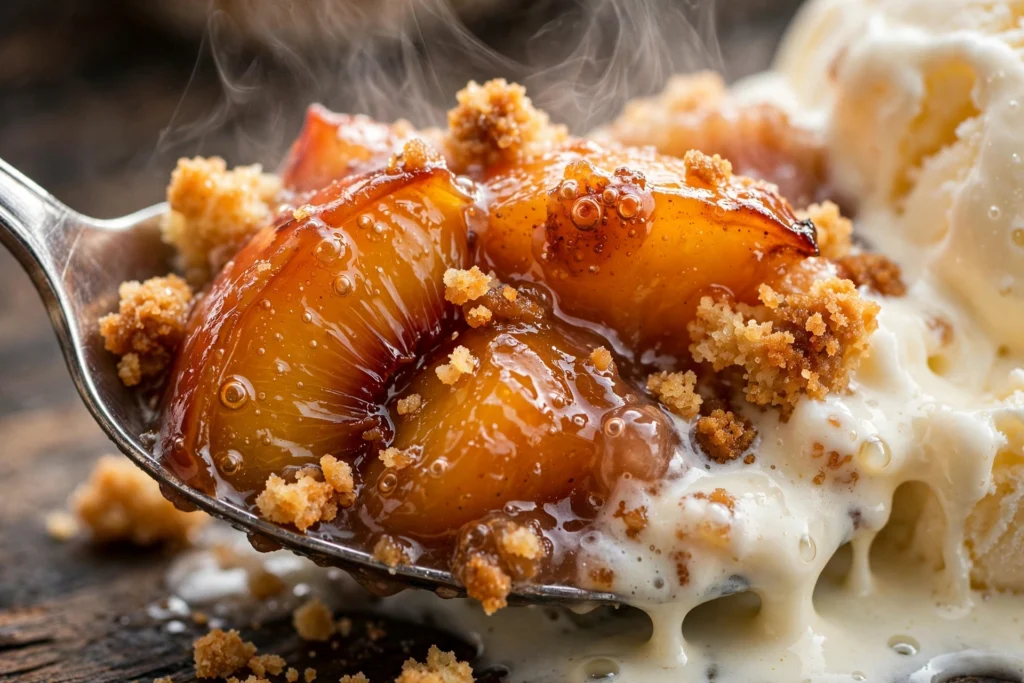
Vanilla ice cream. Full stop. The combination of hot cobbler, cold melting ice cream, and the cream pooling into the warm peach juices is one of the great dessert experiences — the temperature contrast, the creaminess against the fruit, the way the ice cream melts into all the crevices. It’s not just a suggestion; it’s the intended experience.
That said, alternatives exist for different occasions. Freshly whipped cream (lightly sweetened, with a drop of vanilla) is elegant and lets the peach flavor shine more. A pour of cold heavy cream over the warm cobbler — very traditional Southern — is simple and wonderful. For breakfast (and yes, cobbler for breakfast is absolutely a thing — the fruit-to-biscuit ratio is basically a scone with compote), serve with Greek yogurt instead of ice cream. I won’t tell anyone.
For drinks: sweet tea is the Southern classic. Coffee cuts the sweetness nicely. For an adult gathering, try my Classic Paloma Cocktail
Troubleshooting: Fixing Common Peach Cobbler Problems
Peach cobbler is forgiving, but a few things can go wrong. Here’s how to diagnose and fix them — and how to prevent them next time.
Problem: The topping is soggy or gummy instead of crisp and golden. This is the most common cobbler complaint, and it almost always comes down to excess liquid. Peaches release a lot of juice as they bake, and if there’s too much, the topping steams instead of crisping. The fix starts with your peaches: if they’re very ripe and juicy, toss them with the sugar and let them sit 15 minutes, then drain off 2-3 tablespoons of the accumulated juice before assembling. You can also increase the thickener — an extra teaspoon of cornstarch in the filling absorbs the extra liquid without making it gluey. And make sure your oven is fully preheated; putting cobbler into a not-quite-hot oven means the topping sits in liquid too long before it starts setting. If it’s already baked and soggy, there’s no perfect rescue, but serving it warm with a scoop of vanilla ice cream makes even a soggy cobbler delicious — the contrast of cold ice cream and warm fruit covers a multitude of sins.
Problem: The filling is runny — more like soup than jammy fruit. Under-thickened filling. Peaches vary enormously in juiciness depending on variety, ripeness, and season, so the thickener amount in any recipe is an educated guess. For very juicy peaches, increase cornstarch to 3 tablespoons. For firm, less-juicy peaches, 2 tablespoons is plenty. Also critical: let the cobbler rest at least 20-30 minutes after baking. The filling continues to thicken as it cools — cutting into it straight from the oven will always look runnier than it actually is. Patience is a thickener.
Problem: The topping browned too fast and the center is still raw. Your oven runs hot, or the rack was too high. Tent the cobbler loosely with aluminum foil once the topping reaches a deep golden brown, then continue baking until the filling bubbles thickly in the center. For future batches, bake on the middle rack (not the top), and if your oven is known to run hot, reduce the temperature by 25 degrees and add 5-10 minutes to the bake time.
Problem: The peaches are mushy with no texture. Overripe peaches or overbaking. Use peaches that are ripe but still firm — they should give slightly when pressed but not feel soft or bruised. If your peaches are very ripe, reduce the bake time by 5-10 minutes and check early. Frozen peaches (thawed and drained) actually hold their shape better than overripe fresh ones, so don’t hesitate to use them out of season.
Problem: It’s too sweet or not sweet enough. Peach sweetness varies wildly. Taste your peach filling before assembling — it should taste slightly too sweet, because the unsweetened biscuit or batter topping balances it. If your peaches are tart, increase sugar by 2-3 tablespoons. If they’re candy-sweet, reduce by the same. There’s no shame in adjusting; it’s what good cooks do.
Read Also : Creamy Cheeseburger Soup Recipe (All the Flavor, One Pot)
Fresh vs. Frozen vs. Canned Peaches: An Honest Guide
Let’s settle this, because peach season is short and cobbler cravings are year-round.
Fresh peaches (in season, June-September): The gold standard when they’re good — which means ripe, fragrant, and from a source you trust. Farmers’ market peaches in August are transcendent. Grocery store peaches in June can be mealy and disappointing. The test: smell them. A good peach smells like a peach from a foot away. No fragrance, no flavor. Freestone varieties (where the pit separates easily) are much easier to work with than clingstone; most grocery store peaches are freestone, but farmers’ market varieties vary, so ask.
To peel or not to peel: For cobbler, I recommend peeling — the skins can turn tough and chewy during baking, and they add a slightly bitter note. The fastest method: score an X on the bottom of each peach, blanch in boiling water for 30-60 seconds, then transfer to ice water. The skins slip right off. If your peaches are very ripe, you can often peel them with a paring knife without blanching.
Frozen peaches: The best off-season option, and honestly excellent year-round. They’re picked ripe and frozen immediately, so the flavor is often better than out-of-season fresh peaches. Thaw them completely, then drain well — frozen peaches release more liquid than fresh, so don’t skip the draining step, and consider adding an extra teaspoon of cornstarch. Use them in the same quantity as fresh. No need to peel (they’re already peeled).
Canned peaches: The emergency option. They work, but the texture is softer and the flavor is less bright. If using canned, choose peaches packed in juice (not heavy syrup), drain them thoroughly, and reduce the added sugar by 2-3 tablespoons since they’re already sweetened. This is the version for February when you need peach cobbler and there’s no other choice — and it’s still better than no cobbler at all.
Make-Ahead, Storage & Reheating
Make-ahead: You can assemble the entire cobbler (fruit filling + topping) up to 24 hours ahead, cover tightly, and refrigerate unbaked. Bake straight from the fridge, adding 5-10 extra minutes to the bake time. The topping may be slightly less crisp than a freshly assembled version, but the convenience is worth it for entertaining. Alternatively, prepare the peach filling up to 2 days ahead and refrigerate; make the topping fresh and assemble just before baking for the best texture.
Room temperature: Baked cobbler keeps at room temperature for up to 2 days, loosely covered. The topping stays crispest this way. After 2 days, refrigerate.
Refrigerator: Up to 5 days, covered. The topping will soften in the fridge — this is normal and unavoidable. Reheat individual portions to restore some crispness.
Freezer: Baked cobbler freezes well for up to 3 months. Cool completely, wrap tightly in plastic wrap then foil, or use a freezer-safe container. Thaw overnight in the fridge. For best results, freeze the unbaked assembled cobbler instead — wrap tightly, freeze, then bake from frozen, adding 15-20 minutes to the bake time. The topping comes out remarkably crisp with this method.
Reheating: The oven is best — 350°F for 15-20 minutes (from fridge) restores the topping’s crispness far better than the microwave. For a single serving, 5-8 minutes in a toaster oven works wonderfully. The microwave will warm it through but leaves the topping soft; if that’s all you have, it’s still delicious, just different.
Serving Ideas: Beyond the Scoop of Ice Cream
Vanilla ice cream is the classic for a reason — the cold cream against warm jammy peaches is perfect. But there’s a whole world beyond.
Whipped cream variations: Lightly sweetened whipped cream is lighter than ice cream and lets the peach flavor shine. For something special, whip the cream with a tablespoon of bourbon, a teaspoon of vanilla bean paste, or a pinch of cinnamon. Mascarpone whipped with a little sugar and lemon zest is luxurious and less sweet than ice cream.
Savory-sweet twists: A drizzle of salted caramel sauce, a sprinkle of flaky sea salt on top of the ice cream, or a handful of candied pecans for crunch. A sharp cheddar cheese slice alongside warm cobbler is an old Southern tradition that sounds strange and tastes incredible — the salty cheese against sweet peaches is a revelation.
For a crowd: Bake in individual ramekins or mason jars for portion control and a charming presentation. Or set up a cobbler bar: warm cobbler in a baking dish, with bowls of vanilla ice cream, whipped cream, caramel sauce, toasted pecans, and fresh mint. Guests build their own — it turns dessert into an event. For a full summer menu, start with my Authentic Greek Salad — its crisp, briny freshness makes the sweet cobbler that follows taste even better.
Final Thoughts
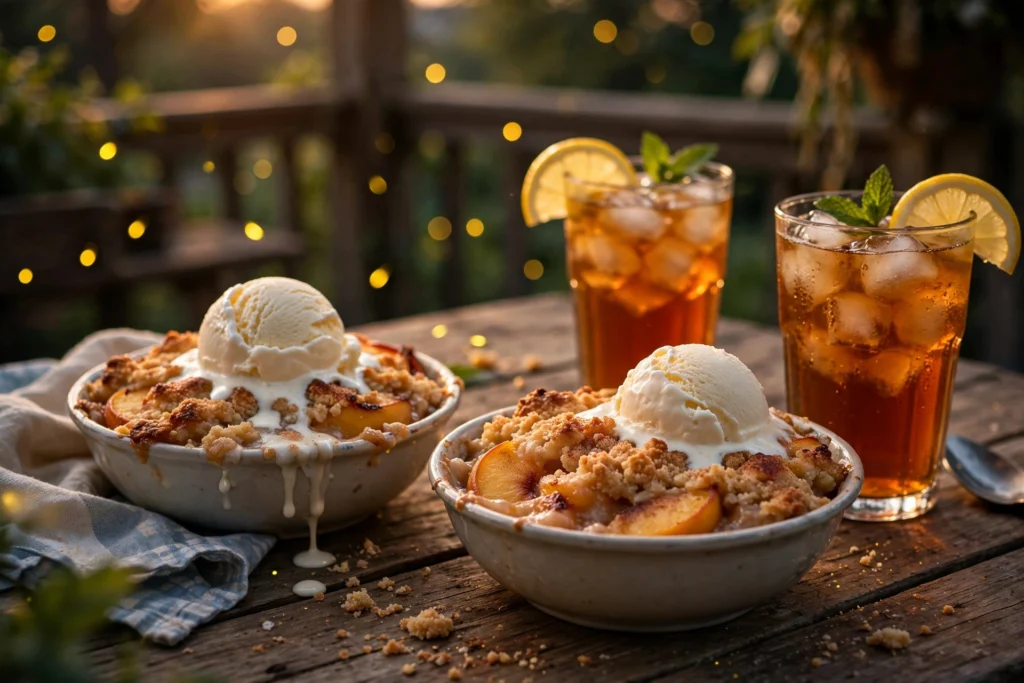
There’s a reason peach cobbler shows up at every Southern summer gathering, every church potluck, every family reunion, every Fourth of July table. It’s not fancy. It doesn’t need to be. It’s ripe fruit, butter, sugar, flour, and heat — the simplest good things in the world, combined with care and served warm.
What I love most about the easy version is that it removes every possible excuse. No pastry skills? Doesn’t matter — you’re dropping dough with a spoon. Only 15 minutes of hands-on time? That’s plenty. Peaches aren’t in season? Frozen works beautifully. Intimidated by baking? This easy peach cobbler recipe is the one that converts non-bakers, because it’s genuinely hard to mess up and the result tastes like you worked all day.
So the next time peaches smell like summer — or the next time you’re standing in the grocery store in February, holding a bag of frozen peaches and wishing it were summer — make this. Your kitchen will smell incredible, your people will be happy, and you’ll wonder why you don’t make cobbler every single week. (There’s no good reason. Make it every week.) If you love bakes this simple, my Simple Banana Bread is another reader favourite.
Easy Peach Cobbler
Ingredients
Equipment
Method
- Heat the oven to 375°F (190°C) with a rack in the centre. If using fresh peaches, peel them first: blanch for 30–60 seconds in boiling water, shock in iced water, then slip off the skins. Slice the peaches about ¼-inch thick.
- In a large bowl, toss the sliced peaches with ¾ cup granulated sugar, the cornstarch, cinnamon, nutmeg, lemon juice and vanilla. Rest for 10–15 minutes so the peaches release their juices (macerating).
- Pour the peaches and ALL of their juices into a 9×13-inch baking dish, spreading into an even layer.
- In a separate bowl, whisk together the flour, ¼ cup sugar, baking powder and salt. Cut in the cold cubed butter until pea-sized crumbs form, then stir in the boiling water just until a shaggy dough comes together — do not overmix.
- Drop mounds of dough over the peaches, leaving generous gaps so steam can escape. Sprinkle with coarse sugar. Bake for 40–45 minutes, until the topping is deep golden brown and the filling is bubbling thickly through the gaps.
- Rest for 15–20 minutes on a wire rack so the filling sets, then serve warm with vanilla ice cream.
Frequently Asked Questions
Can I use frozen peaches in this easy peach cobbler recipe?
Yes. Thaw them fully in a colander, drain off all the liquid and pat dry, then proceed exactly as written. If your peaches are very juicy, add an extra teaspoon of cornstarch so the filling still bakes up thick and jammy rather than watery.
Do I have to peel the peaches?
Peeling is recommended. Peach skins can turn tough and chewy during baking and add a slightly bitter edge. For the silkiest filling, peel fresh peaches; frozen peach slices are already peeled, which is one reason they are so convenient.
Why does the topping use boiling water?
The boiling water creates instant steam when it hits the hot oven, which makes the biscuit topping puff up light, crisp and tender. It sounds odd alongside cold butter, but the cold butter still creates flaky pockets — the two techniques work together.
How do I stop my peach cobbler going watery?
Bake until the filling bubbles thickly through the gaps in the topping — gentle simmering is not enough to activate the cornstarch. Then rest the cobbler for 15 to 20 minutes before serving so the filling sets. Cutting too soon is the most common cause of a runny slice.
Can I make peach cobbler ahead of time?
Yes. Assemble the whole cobbler up to 24 hours ahead, cover tightly and refrigerate unbaked, then bake straight from the fridge, adding 5 to 10 minutes to the bake time. Baked cobbler keeps for 2 days at room temperature or 5 days in the fridge.
Can I use tinned peaches?
Yes in a pinch — drain them very well first. Tinned peaches are softer and packed in syrup, so reduce the sugar in the filling by a couple of tablespoons and expect a less bright peach flavour.
What is the difference between a cobbler, a crisp and a crumble?
A cobbler has a biscuit, batter or dumpling-like topping dropped over fruit. A crisp has a streusel topping that includes oats, which crisp in the oven. A crumble is like a crisp but made without oats.
Can I make this easy peach cobbler recipe gluten-free?
Yes. Swap the plain flour in the biscuit topping for a 1:1 gluten-free flour blend — the peach filling itself is naturally gluten-free. The topping may brown a little faster, so check it 5 minutes early.
How do I know when the cobbler is done?
Look for two signs together: a deep golden-brown topping and thick, jammy bubbling visible through the gaps. If the top browns before the filling bubbles, tent loosely with foil and keep baking until the centre bubbles.
What should I serve with peach cobbler?
Vanilla ice cream is the classic — hot cobbler against cold, melting ice cream is unbeatable. Lightly sweetened whipped cream is a lighter alternative, and a drizzle of salted caramel sauce takes it firmly into celebration territory.
Can I use white peaches?
You can, but yellow peaches are the better choice here. White peaches are more delicate and can turn mushy in the oven, while yellow peaches hold their shape and have the brighter, tangier flavour that makes this easy peach cobbler recipe sing.
Sources & Further Reading
For the history and regional variations of this classic dessert, see Cobbler (food) on Wikipedia — handy background reading while this easy peach cobbler recipe bakes.

Hi, I’m Angela. I cook the way busy people actually cook — simple, tasty food with ingredients you already have. On CookBookBite I share easy recipes, honest kitchen tips, and dishes my family asks for again and again.
Pingback: Homemade Chex Mix Recipe – Bold & Buttery Snack
Pingback: Light Jello Dessert Recipe – Low-Calorie Berry Treat (60 Cal!)