
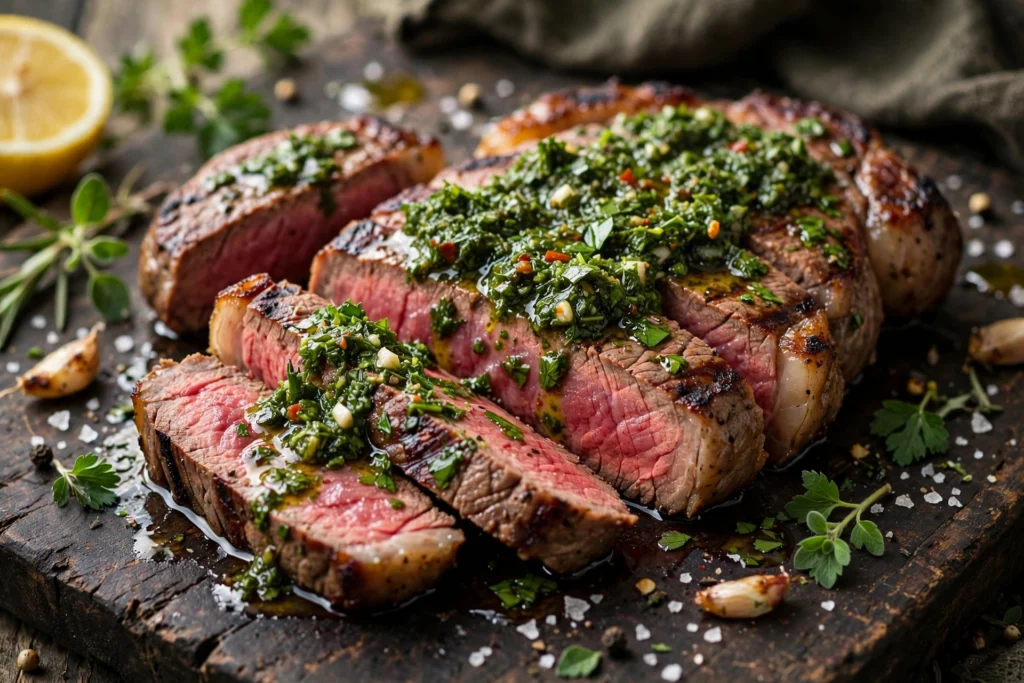
In Argentina, chimichurri isn’t a condiment – it’s a way of life. This chimichurri sauce recipe is my homage to the classic.
It sits on every asado table next to the grilled meats, bright green and glistening in its bowl, and it does something magical: it takes rich, red meat and makes it sing. The first time I had real chimichurri spooned generously over a perfectly grilled steak, I understood completely – the sauce doesn’t just complement the meat, it completes it. Without chimichurri, the steak is just steak. With it, it’s an experience.
Here’s the beautiful part: this chimichurri sauce recipe takes 10 minutes and zero cooking. Fresh parsley, oregano, garlic, red wine vinegar, olive oil, red pepper flakes — chopped by hand, stirred together, done. No blender needed (in fact, hand-chopping is traditional and gives you a far superior texture). It’s the highest-flavor-per-minute sauce I know of — nothing else delivers this much impact this fast.
Also Read : Chicken Tinga Recipe (Smoky, Saucy & Weeknight-Fast)
Once chimichurri enters your life, you’ll put it on everything: steak (obviously, the classic), chicken, shrimp, roasted vegetables, fried eggs, sandwiches, grilled fish, even pizza. It’s the green sauce that makes everything taste like a celebration — bright, bold, alive.
What makes chimichurri different from every other herb sauce? It’s the vinegar. Most herb sauces (pesto, salsa verde, gremolata) are oil-based or balanced toward richness. Chimichurri leads with acidity — sharp red wine vinegar that cuts through fat and richness like a knife. That’s why it’s the perfect partner for grilled meats: the char and fat need acid for balance, and chimichurri delivers it in the most flavorful package imaginable. It’s not just a sauce; it’s a lesson in how acid transforms food.
Why You’ll Love This Chimichurri
First, it’s instant flavor gratification. Ten minutes, no cooking, no special equipment, and you have a sauce that transforms plain grilled anything into something restaurant-worthy. The effort-to-impact ratio is honestly absurd — I can’t think of another recipe that delivers this much with so little.
Second, it’s fresh and vibrant in a way cooked sauces can’t be. Raw herbs, sharp vinegar, pungent fresh garlic — chimichurri is alive. It has a brightness and punch that cooked sauces lose. When you taste it, you taste the garden, not the pot.
Third, it’s endlessly versatile. Steak is the iconic pairing, but this sauce elevates grilled chicken, fish, roasted vegetables, eggs, sandwiches, tacos, and grain bowls equally. One batch on Sunday means a week of better meals — drizzle it on everything and watch ordinary food become exciting.
Fourth, it’s naturally healthy without trying. Fresh herbs, olive oil, vinegar, garlic — it’s essentially a salad in sauce form. No cream, no butter, no sugar. Drizzle it generously and feel genuinely good about it. It’s proof that the most flavorful food is often the simplest.
Fifth, it keeps beautifully. Unlike delicate fresh sauces that fade in hours, chimichurri actually improves as it sits — the flavors meld and deepen. Make it in the morning for evening grilling, or make a big batch on the weekend for the week ahead. It waits patiently in the fridge for up to two weeks.
Sixth, it’s impressive with zero stress. Bring a jar to a barbecue and watch people ask about it. Drizzle it over a simple grilled steak for guests and they’ll think you’re a culinary genius. It’s the highest social-return-on-investment of any recipe I know.
Finally, it’s a gateway to Argentine food culture. Chimichurri opens the door to asado (the Argentine barbecue tradition), empanadas, provoleta (grilled cheese), and a whole world of grilled deliciousness. Start with the sauce; the rest follows naturally.
Ingredients for This Chimichurri Sauce Recipe — And Why Each One Matters
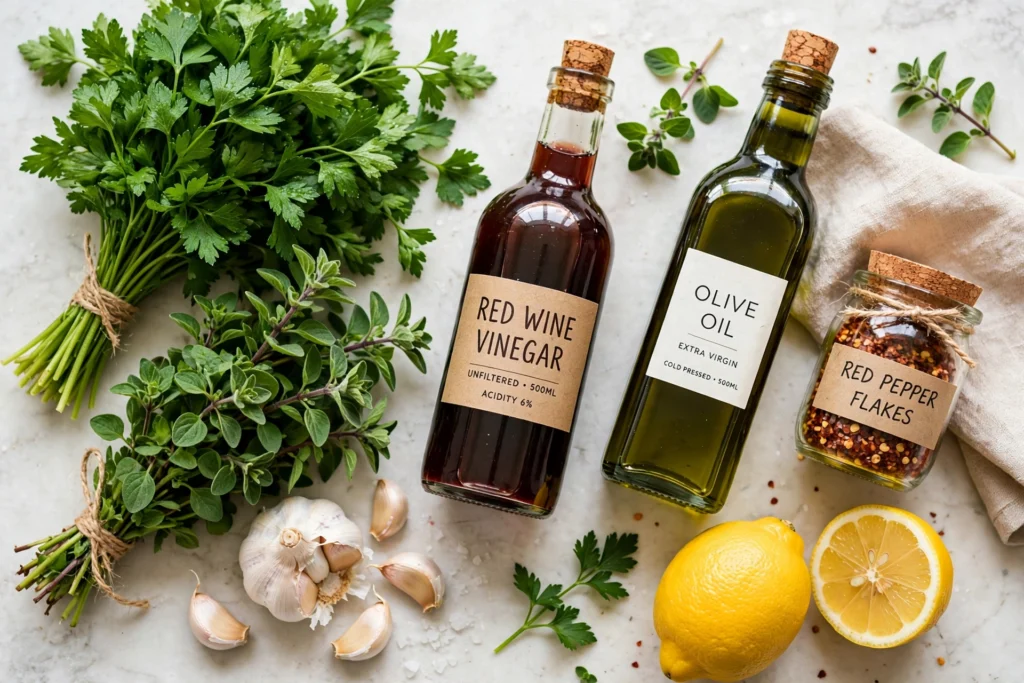
Fresh flat-leaf parsley (1½ cups, packed, finely chopped) — The foundation and the soul of the sauce. Flat-leaf (Italian) parsley — NOT curly, which is tougher, less flavorful, and has an unpleasant texture when raw. This is a parsley-forward sauce; don’t skimp on quantity. The parsley should be vibrant green, perky, and fresh-smelling — not yellowing, wilted, or slimy. One large bunch typically yields about 1½ cups chopped. Wash it well and dry it thoroughly (a salad spinner is ideal) — wet herbs make watery sauce.
Fresh oregano (¼ cup, finely chopped) — Or 1 tablespoon of dried oregano, which is actually traditional in Argentina (fresh oregano is less common there). Fresh oregano is brighter and more aromatic; dried is earthier and more authentically Argentine. Both work beautifully — use what you have. If using fresh, strip the tiny leaves from the woody stems (the stems are too tough to eat). If using dried, crumble it between your fingers as you add it to release the oils.
Garlic (4–5 cloves, minced very fine) — Chimichurri is boldly, unapologetically garlicky. Four cloves minimum — this isn’t the place for subtlety or restraint. The garlic mellows significantly during the resting period, so don’t be alarmed by the raw punch when you first mix it. Mince it very fine or grate it on a microplane — you want it to distribute evenly throughout the sauce, not lurk in unpleasant chunks. Fresh garlic only — the jarred stuff has an off flavor that has no place here.
Red wine vinegar (⅓ cup) — The acidic backbone and arguably the most important ingredient after the parsley. It brightens the herbs, cuts through rich grilled meats, and gives chimichurri its characteristic tang. Don’t substitute white vinegar (too harsh and one-dimensional) or apple cider vinegar (wrong flavor profile). Red wine vinegar is traditional and irreplaceable here. Good red wine vinegar (not the cheapest bottle) makes a noticeable difference.
Extra-virgin olive oil (¾ cup) — Use good olive oil — you’ll taste it prominently. It rounds out the sharp vinegar, carries the herb flavors, and gives the sauce its luscious mouthfeel. Fruity, peppery olive oil is ideal. You don’t need your most expensive bottle, but don’t use the flavorless “light” olive oil either. The oil should taste good on its own — dip some bread in it. If it’s delicious, your chimichurri will be delicious.
Red pepper flakes (1 teaspoon) — Gentle, warming heat — not a burn. Traditional chimichurri has a mild kick that builds slowly. One teaspoon gives you that warmth without overwhelming the herbs. Adjust to your preference: ½ teaspoon for mild, 2 teaspoons for genuinely spicy. Aleppo pepper (milder, fruitier) is a wonderful substitute if you have it.
Salt (1 teaspoon, plus more to taste) — Essential and often underused. Under-salted chimichurri tastes flat, grassy, and dull; properly salted, it sings — the herbs pop, the vinegar brightens, everything comes alive. Start with a teaspoon, then taste and add more in pinches until it “pops.” You’ll know when you hit it. Use fine sea salt or kosher salt for even distribution.
Black pepper (½ teaspoon, freshly ground) — Background warmth and complexity. Freshly ground has a floral pungency that pre-ground lacks. It’s a supporting player, but the sauce is flatter without it.
Lemon juice (1 tablespoon, optional — my addition) — Not traditional, but I love what it does. A squeeze of fresh lemon adds a brightness that complements (rather than competes with) the vinegar. It lifts the whole sauce. Optional but lovely — try it once and see if you agree.
Must Read : Creamy Potato Soup Recipe (The Best You’ll Ever Make)
Equipment You’ll Need
A sharp chef’s knife and a cutting board — for the traditional hand-chopped texture that defines authentic chimichurri. Your knife should be genuinely sharp; a dull knife bruises herbs instead of cutting them cleanly, releasing bitter compounds. A medium mixing bowl for combining everything. A jar with a tight-fitting lid for storage. That’s genuinely it. (A food processor will work in a pinch, but pulse very carefully — you want distinct chopped pieces, not a uniform purée. Over-processed chimichurri has the texture of pesto and has lost its soul. Hand-chopping takes 5 extra minutes and the result is dramatically better.)
How to Make Chimichurri (Step by Step)
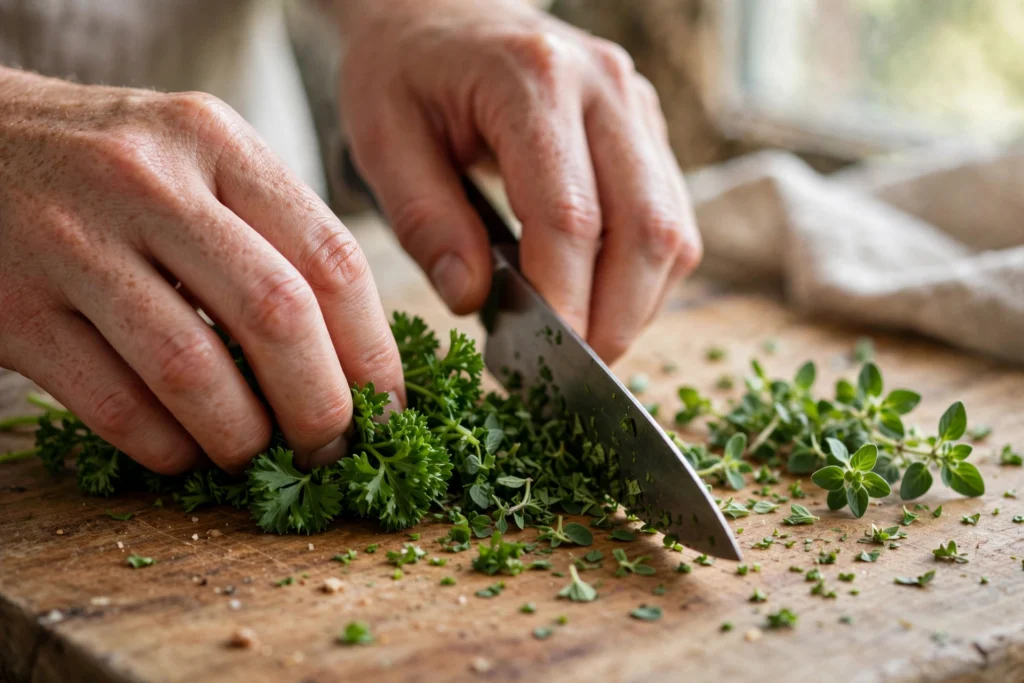
Step 1 — Chop the herbs by hand. This is the most important technique step. Finely chop the parsley and oregano with a sharp knife — you want small, even pieces, roughly ⅛ inch. Not minced to a paste (that releases too much chlorophyll and turns bitter), not big leaves (that won’t distribute). Take your time; the texture defines the sauce. Gather the herbs into a tight pile, rock your knife through them, gather again, repeat. It should take about 5 minutes. Put on music. Enjoy the smell — fresh-cut parsley and oregano is one of the great kitchen aromas.
Step 2 — Mince the garlic very fine. Mince the garlic cloves very fine — almost to a paste — or grate them on a microplane. You want the garlic to distribute invisibly throughout the sauce, not appear as chunks. (If you’re sensitive to raw garlic’s bite, you can blanch the cloves in boiling water for 30 seconds first — it tames the harshness while keeping the flavor.)
Step 3 — Combine the dry ingredients. In your mixing bowl, combine the chopped herbs, minced garlic, red pepper flakes, salt, and black pepper. Toss them together with a fork so everything is evenly distributed before the liquids go in. This ensures no pocket of pure salt or lone garlic chunk.
Step 4 — Add the acids. Pour in the red wine vinegar and lemon juice (if using). Stir well to combine. At this stage, it’ll look a bit dry and the smell will be aggressively sharp — that’s normal. The oil comes next, and the resting period transforms everything.
Step 5 — Add the olive oil. Pour in the extra-virgin olive oil and stir thoroughly. The sauce should be loose and spoonable — more like a vinaigrette than a paste or pesto. It should flow off a spoon, not clump. If it seems thick or dry, add another tablespoon or two of olive oil. The ratio of oil to herbs affects both texture and flavor — you want enough oil to carry the flavors without drowning them.
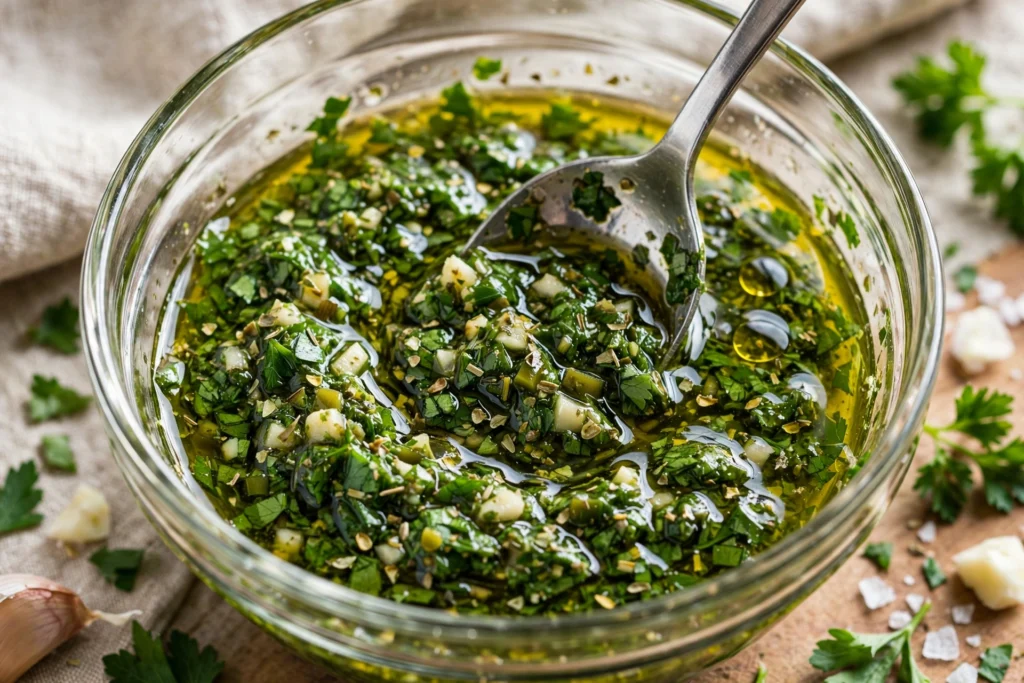
Step 6 — Rest (don’t skip this). Let the chimichurri sit at room temperature for at least 15 minutes — 1 hour is significantly better. This rest is not optional; it’s transformative. During resting, the raw garlic mellows from harsh to warm, the salt dissolves fully, the herbs infuse the oil with their flavor, and all the sharp edges round into harmony. Freshly mixed chimichurri is aggressive and disjointed; rested chimichurri is balanced and complex. Taste it before and after resting — the difference will convert you.
Step 7 — Taste and adjust boldly. Taste on a piece of bread, a slice of steak, or just a spoon. Now adjust: More salt? (Probably — most first batches are under-salted.) More vinegar for brightness? More pepper flakes for heat? A bit more oil if it seems dry? Chimichurri should be punchy and assertive — if it tastes timid, it needs more salt and acid. Adjust confidently; this sauce rewards boldness.
My Best Tips for Perfect Chimichurri
Chop by hand — always. I know the food processor is tempting. Resist. The processor bruises herbs (releasing bitter compounds), creates a uniform paste (losing the delightful texture variation), and over-processes in seconds. Hand-chopping gives you distinct pieces — little bits of parsley, flecks of garlic, visible pepper flakes — that’s the authentic look, texture, and flavor. Five extra minutes, dramatically better result.
Don’t skimp on the vinegar. Chimichurri should be tangy — that acidity is the entire point. It’s what cuts through rich grilled meats and makes the sauce refreshing instead of heavy. If your chimichurri tastes flat or “green,” it almost certainly needs more vinegar (or more salt) before it needs anything else. Be brave with the acid.
Rest it — seriously. Fifteen minutes minimum, one hour ideally, overnight in the fridge is fine too. The transformation during resting is one of the most dramatic in all of cooking — raw, harsh, and disjointed becomes mellow, balanced, and harmonious. If you’ve ever thought “I don’t like chimichurri,” you may have only had it unrested.
Serve at room temperature. Cold mutes flavors dramatically and firms up the olive oil into an unpleasant waxy texture. Take it out of the refrigerator 20–30 minutes before serving. Room-temperature chimichurri is vibrant and flowing; cold chimichurri is muted and stiff.
Salt boldly — then taste. Herbs need assertive seasoning to shine. If your chimichurri tastes “grassy” or like lawn clippings, it’s under-salted — almost guaranteed. Add salt in small pinches, tasting after each, until the flavors suddenly “pop” into focus. You’ll feel the moment it happens.
Make extra — you’ll use it. This keeps well and you’ll find uses for it all week. A double batch is never a mistake. Drizzle it on eggs, spread it on sandwiches, toss it with roasted vegetables, spoon it over grain bowls. It elevates everything it touches.
Dry your herbs thoroughly. Wet herbs = watery, diluted sauce. After washing, spin in a salad spinner or pat very dry with clean towels. Any surface water dilutes the vinegar and oil, weakening the flavor.
Taste your olive oil first. Since it’s such a prominent ingredient, rancid or low-quality oil will ruin the sauce. Taste it straight — it should be fruity and pleasant, maybe with a peppery tickle. If it tastes flat, musty, or like crayons, it’s rancid — don’t use it.
Adjust the heat to your audience. The standard 1 teaspoon of pepper flakes gives gentle warmth. For heat-lovers, go to 2 teaspoons or add a minced fresh chili. For kids or the spice-averse, halve it. The sauce is flexible — make it yours.
Don’t make it too far ahead. While it keeps 2 weeks, the vibrant green color fades after 3–4 days (the acid darkens the herbs) and the fresh punch mellows. For maximum impact — bright color, bold flavor — use within the first few days. It’ll still taste good at 2 weeks, just less spectacular.
Revive leftovers. If your chimichurri has been sitting and looks a bit tired, stir in a fresh squeeze of lemon juice and a drizzle of new olive oil. It won’t be quite as vibrant as day one, but it’ll perk up considerably.
Freeze in portions. Ice cube trays are perfect — each cube is about 2 tablespoons, ideal for single servings. Freeze solid, pop out, bag them. Thaw individual cubes as needed. The texture softens slightly but the flavor holds beautifully for 3 months.
Troubleshooting: When Chimichurri Goes Wrong
Tastes grassy or like lawn clippings: Under-salted — almost certainly. Add salt in pinches until the flavor “pops.” Also check: did you rest it? Unrested chimichurri tastes raw and green.
Too harsh or aggressive: Needs more resting time. The garlic and vinegar mellow dramatically with rest. If it’s still too sharp after an hour, add a bit more olive oil to round it out.
Bitter aftertaste: Herbs were over-processed (food processor too long), olive oil is rancid, or parsley was old/yellowing. Use fresh herbs, hand-chop, taste your oil.
Too oily or greasy: Too much oil for the amount of herbs. Add more chopped parsley to balance, or more vinegar for brightness. The sauce should be herb-forward, not an oil slick.
Color turned brown: Normal oxidation from the vinegar and air exposure — especially after a few days. The flavor is still fine. For serving, stir well and drizzle fresh oil on top. To minimize: press plastic wrap directly on the surface for storage, and maintain that thin oil layer on top.
Too thick / paste-like: Needs more oil, or the herbs were chopped too fine (releasing too much liquid and creating paste). Add oil a tablespoon at a time until it’s spoonable and loose.
Also Read: Bechamel Sauce Recipe (Silky, Lump-Free & Foolproof)
Delicious Variations to Try
Cilantro chimichurri: Replace half the parsley with fresh cilantro. Brighter, more citrusy, with a completely different personality — amazing on tacos, grilled fish, and anything Mexican-inspired. If you’re a cilantro lover, this might become your default.
Mint chimichurri: Add ¼ cup of fresh mint leaves to the standard recipe. The cool mint against the sharp vinegar is incredible with lamb — it’s a natural pairing that tastes like it was always meant to be. Also wonderful with grilled peas and spring vegetables.
Smoky chipotle: Add 1 minced chipotle pepper in adobo sauce (plus a teaspoon of the adobo sauce). Smoky, spicy, complex — this version loves grilled chicken, pork, and roasted sweet potatoes. It strays from tradition but earns its place.
Basil chimichurri: Swap the parsley entirely for fresh basil. It’s pesto-adjacent but the vinegar tang makes it completely different — brighter, sharper, less rich. Spectacular on summer tomatoes, fresh mozzarella, and grilled bread.
Green onion boost: Add 3 thinly sliced green onions (white and green parts) to the standard recipe. Extra allium depth and a bit of crunch. Particularly wonderful drizzled over grilled corn on the cob.
Red chimichurri: Add 2 tablespoons of smoked paprika and 1 finely minced roasted red pepper (jarred is fine, drained well). Deeper, smokier, with a gorgeous brick-red color. A completely different visual and flavor experience — try it on grilled sausages.
Carrot top: If you buy carrots with tops, don’t throw them away — substitute carrot tops for half the parsley. Slightly sweeter, more delicate, and a brilliant way to reduce waste. It tastes like spring.
Arugula: Replace half the parsley with baby arugula for a peppery bite. The arugula’s natural spice complements the vinegar and garlic beautifully. Great on beef — the peppery notes echo the meat’s richness.
Sun-dried tomato: Add ¼ cup of finely minced oil-packed sun-dried tomatoes. They add umami depth and chewy texture bits. This version is almost a meal in itself — incredible on grilled bread as bruschetta.
Avocado chimichurri: Stir in 1 diced ripe avocado just before serving (don’t make it ahead — the avocado browns). Creamy, rich, luxurious — almost like a chimichurri-guacamole hybrid. Amazing on fish tacos.
Storing, Freezing & Make-Ahead
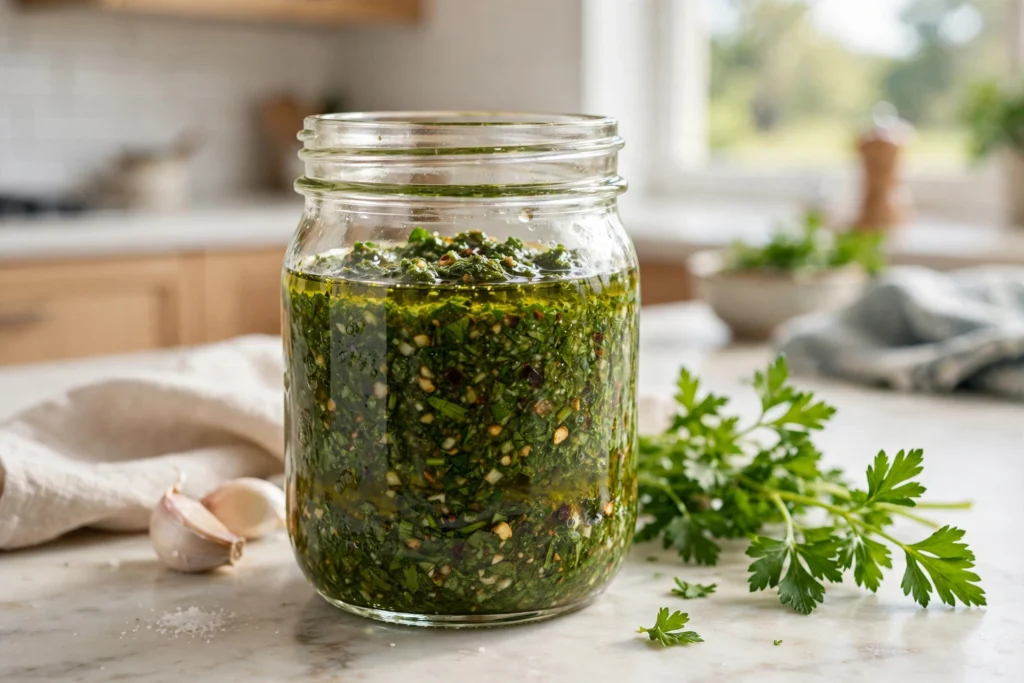
Refrigerator: Up to 2 weeks in a sealed jar. Pour a thin layer of olive oil on top before sealing — it creates a barrier against air that prevents browning. The vibrant green color will gradually darken (especially after day 3–4) due to acid exposure, but the flavor holds well for the full two weeks. Always use a clean spoon — introducing food particles or double-dipping shortens the life.
Freezer: 3 months, and the method matters. Freeze in ice cube trays — each cube is roughly 2 tablespoons, perfect for single servings. Once frozen solid, pop the cubes out and store in a freezer bag with the air pressed out. Thaw individual cubes at room temperature (20 minutes) or overnight in the fridge. The texture will be slightly softer than fresh (ice crystals break some cell walls), but the flavor is remarkably intact. This is the best way to preserve a summer herb glut.
Make-ahead strategy: Chimichurri is one of those rare preparations that’s genuinely BETTER made ahead. The flavors need time to meld — make it in the morning for evening grilling, or the night before for next-day asado. Minimum 1 hour rest; 4–8 hours is the sweet spot; 24 hours is excellent. Beyond 2 days, the color starts fading even though flavor holds.
Color preservation tip: The parsley darkens over time — it’s enzymatic browning accelerated by the vinegar’s acid. To minimize: blanch the parsley for 10 seconds in boiling water, shock in ice water, dry thoroughly, then chop. This sets the chlorophyll and keeps the green vibrant for days longer. It’s an extra step, but if presentation matters (dinner party, photos), it’s worth it.
Reviving older chimichurri: If your week-old chimichurri looks tired, don’t throw it out. Stir it well, add a fresh squeeze of lemon juice and a drizzle of new olive oil, and taste. Often that’s enough to bring it back to 80% of its former glory. Use revived chimichurri in cooked applications (stirred into hot pasta, over roasted vegetables) where absolute freshness matters less.

What to Serve with Chimichurri
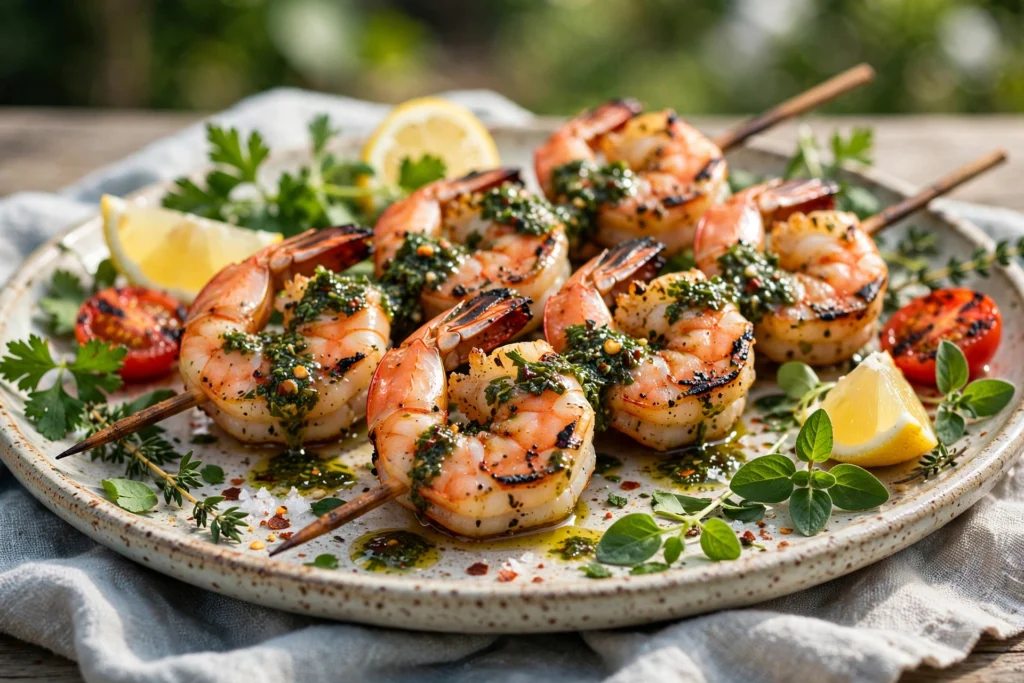
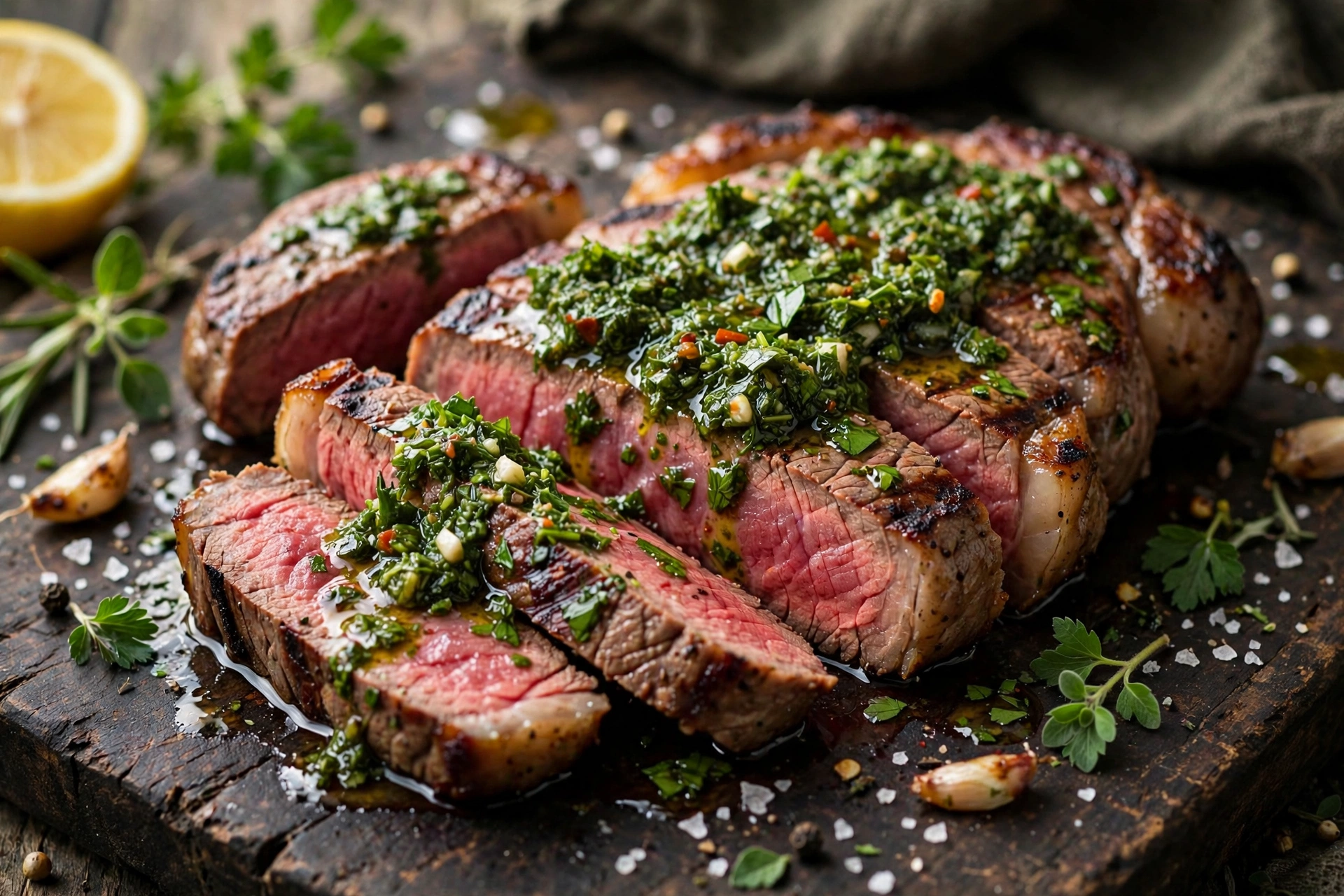
The classics, in order of iconic status: grilled steak — specifically Argentine cuts like vacío (flank), entraña (skirt), or asado de tira (short ribs) — this is THE pairing, the reason chimichurri exists. Churrasco (Brazilian-style grilled meats). Grilled chicken — especially thighs, which stay juicy. Shrimp skewers — the charred sweetness against the tangy herbs is perfect. Roasted vegetables — particularly potatoes, cauliflower, and carrots, which absorb the sauce beautifully. Grilled fish — firm white fish like halibut or swordfish. Empanadas — as a dipping sauce alongside (or instead of) the traditional filling. Sandwiches and burgers — spread it like you would mayo or mustard; it transforms a basic sandwich. Fried or scrambled eggs — breakfast will never be boring again. Pizza — drizzled over the top after baking, especially on margherita or vegetable pizzas. Grain bowls — spoon over farro, quinoa, or rice bowls with roasted vegetables. My sleeper favorite, the one I tell everyone to try: spooned generously over creamy polenta with roasted mushrooms. The rich polenta, earthy mushrooms, and bright chimichurri create a combination that’s greater than the sum of its parts. Planning a cookout? Spoon it over chicken tinga, pile it onto tacos al pastor, or serve it as the bright counterpoint to a classic paloma.
Chimichurri Science: Why Hand-Chopping Matters
It sounds like food-snob preciousness, but the “chop by hand, don’t use a food processor” rule is grounded in real science — and it makes a measurable difference you can taste.
Cell damage and oxidation: A food processor’s high-speed blade doesn’t just cut herbs — it pulverizes them, rupturing far more cell walls than hand-chopping. This massive cell damage releases enzymes (particularly polyphenol oxidase) that cause rapid browning and develop bitter, off flavors. It also exposes more surface area to air, accelerating oxidation. The result: processor-made chimichurri tastes duller, slightly bitter, and turns brown within hours. Hand-chopped herbs have cleaner cuts, less cell damage, and stay vibrant green for days. The difference is visible within 30 minutes and unmistakable by the next day.
Texture and mouthfeel: Hand-chopping gives you distinct, varied pieces — some fine, some slightly larger — that create textural interest. Each bite has little bursts of herb, garlic, and pepper flake. A processor creates a homogeneous paste where everything blends into sameness. Chimichurri should be a sauce with texture, not a smooth purée. That textural variety is part of what makes it so satisfying — your mouth encounters different elements with each bite.
Oil infusion: When herbs are chopped by hand and then mixed with oil, the oil coats the pieces rather than being emulsified into them. This means the flavors release gradually as you eat, rather than all at once. It’s the difference between a sauce that unfolds and one that hits you flat. If you must use a processor (we’ve all been short on time), pulse in very short bursts and stop while it’s still visibly chunky — never let it run continuously.
The garlic question: Minced vs. pressed vs. grated garlic behave differently in chimichurri. Pressed garlic (through a garlic press) releases more allicin — the compound responsible for garlic’s pungency — and distributes more evenly, but can taste harsh if the chimichurri is served immediately. Hand-minced garlic gives you small distinct pieces with slightly mellower flavor that blooms during the resting period. For the smoothest integration, try grating garlic on a microplane — it essentially dissolves into the sauce. My preference: hand-minced for texture, but microplaned if serving to garlic-sensitive guests.

Argentine Asado Culture: Understanding the Context
Chimichurri doesn’t exist in a vacuum — it’s the essential companion to asado, the Argentine tradition of grilling that borders on sacred ritual. Understanding this context helps you use chimichurri more authentically.
What is asado: More than just “barbecue,” asado is a social institution. It involves specific cuts (vacío/flank, entraña/skirt steak, matambre/rolled flank, chorizo, morcilla/blood sausage, provoleta/grilled provolone), cooked slowly over wood embers (not gas, not charcoal briquettes – real wood), and eaten over several leisurely hours. The asador (grill master) is a position of honor. Chimichurri sits on the table throughout – not as a marinade (a common misconception), but as a table sauce for each diner to apply to their liking.
Chimichurri vs. salsa criolla: Argentina has two essential grilled-meat sauces. Chimichurri is the herb-oil-vinegar one. Salsa criolla is its fresh counterpart — diced tomatoes, onions, and peppers in oil and vinegar, more like a pico de gallo. They’re often served side by side. If you’re doing a full Argentine spread, make both — they complement each other beautifully, the chimichurri bringing herbal depth and the salsa criolla bringing fresh brightness.
The name’s origin: Nobody knows for certain, but the leading theories are charming. One says it’s a corruption of “Jimmy’s curry” — from an English meat importer named Jimmy McCurry (or similar) whose sauce was so popular that Argentines bastardized his name. Another traces it to Basque settlers and their “tximitxurri” (a loose Basque term for “hodgepodge”). A third credits Irish immigrant Jimmy Curry. The uncertainty is part of the fun — every Argentine has a favorite theory, and they’ll defend it passionately.
Read Also: Creamy Cheeseburger Soup Recipe (All the Flavor, One Pot)
Regional variations: Even within Argentina, chimichurri varies. In Buenos Aires, it’s typically the classic parsley-oregano version. In the northwest, you might find versions with more heat (extra ají molido — crushed red pepper). Some families add a splash of white wine. Others insist on red wine vinegar specifically (not white, not apple cider). These aren’t right-or-wrong differences — they’re family traditions, and they’re all “authentic” to someone.
Chimichurri Beyond Steak: Creative Uses
As a marinade: While traditionalists use it only as a table sauce, chimichurri makes an excellent marinade — the acid tenderizes, the oil carries flavor, the herbs perfume. Marinate chicken thighs, pork tenderloin, or firm fish for 2–4 hours (not longer — the acid will start “cooking” the proteins). Reserve some fresh chimichurri for serving; don’t serve the used marinade.
Chimichurri butter: Soften a stick of butter, mix in 3–4 tablespoons of chimichurri, roll into a log in plastic wrap, and refrigerate. Slice coins over hot grilled steak, corn on the cob, baked potatoes, or crusty bread. It keeps 2 weeks refrigerated, 3 months frozen. This is the kind of compound butter that makes people ask “what IS that?” in the best way.
Chimichurri vinaigrette: Whisk 3 tablespoons of chimichurri with 1 additional tablespoon of red wine vinegar and 2 tablespoons of olive oil. Instant salad dressing with way more character than anything bottled. Especially good on hearty salads with grilled vegetables, white beans, or quinoa.
Chimichurri mayo: Stir 2 tablespoons into ½ cup of mayonnaise. Spread on sandwiches, dollop on burgers, use as a dip for fries. The creamy-tangy-herbal combination is addictive — you’ll want to put it on everything.
Pasta sauce: Toss hot pasta (especially short shapes like orecchiette or fusilli that catch sauce) with chimichurri, a handful of cherry tomatoes, and grated parmesan. The residual heat blooms the flavors. It’s an unconventional but brilliant weeknight dinner — ready in the time it takes to boil pasta.
Final Thoughts
Chimichurri is a reminder that the best sauces are often the simplest. No cooking, no reduction, no emulsification technique, no special equipment just great ingredients, chopped fresh by hand, combined with confidence, and given time to become themselves. Ten minutes of work for a sauce that’ll make you feel like a grill master and taste like you spent all day.
What I love most about chimichurri is its generosity. A spoonful makes everything on the plate better — the steak, the vegetables, the bread you use to mop up the bowl and it asks for almost nothing in return except fresh herbs and a few minutes of your time. It’s the kind of recipe that starts as a novelty, becomes a habit, and ends as a tradition. You’ll find yourself making it without thinking, the way you brew coffee in the morning.
It also teaches a fundamental cooking lesson: acid is transformative. So many home cooks underuse vinegar and citrus, reaching for salt or fat when brightness is what’s missing. Chimichurri is essentially a masterclass in acid it shows you, in the most delicious way possible, what happens when you lead with tang instead of richness.
So chop those herbs by hand, pour that good olive oil, add the vinegar boldly, and let it rest. Your next grilled dinner is about to get a serious upgrade Argentine style. And once you’ve tasted real, rested, hand-chopped chimichurri, the bottled stuff will taste like a sad rumor of the real thing. Bookmark this chimichurri sauce recipe and welcome to the club.
Classic Chimichurri Sauce
Ingredients
Equipment
Method
- Hand-chop the parsley and oregano finely with a sharp knife. Do not use a food processor — you want distinct chopped pieces, not a paste.
- Mince the garlic very fine, almost to a paste, or grate it on a microplane.
- Combine the chopped herbs, minced garlic, red pepper flakes, salt and black pepper in a mixing bowl. Stir in the red wine vinegar and lemon juice.
- Pour in the extra-virgin olive oil and stir thoroughly. The sauce should be loose and spoonable — not a thick paste.
- Rest at room temperature for at least 15 minutes (1 hour is better) so the flavours meld and the garlic mellows.
- Taste and adjust: more salt, vinegar or heat as needed. Serve at room temperature.
Frequently Asked Questions
What does chimichurri taste like?
This chimichurri sauce recipe is bright, herby, tangy, and boldly garlicky with a mild warming kick — fresh parsley and oregano sharpened by red wine vinegar and rounded by good olive oil.
Can I make chimichurri in a food processor?
You can, but hand-chopping gives a far better result. A food processor’s blades bruise the herbs, which can turn the sauce bitter and pasty — if you must use one, pulse in very short bursts. A sharp knife and a few extra minutes are worth it.
How long does chimichurri last in the fridge?
Up to 2 weeks in a sealed jar. Pour a thin layer of olive oil over the surface before sealing to protect the herbs, and bring it back to room temperature before serving — cold mutes the flavours.
Can I use dried herbs instead of fresh?
For the oregano, yes — 1 tablespoon of dried oregano is actually traditional in Argentina. But the parsley must be fresh; dried parsley can’t replicate the vibrant flavour and texture that define chimichurri.
Is chimichurri supposed to be spicy?
Mildly — the standard 1 teaspoon of red pepper flakes gives gentle warmth, not real heat. Increase to 2 teaspoons for genuinely spicy, add a fresh chili for serious heat, or halve it for kid-friendly. It’s flexible.
What’s the difference between chimichurri and pesto?
They’re completely different sauces. Chimichurri is vinegar-based with no cheese or nuts — tangy, loose, herb-forward. Pesto is oil-and-cheese-based with pine nuts and basil — rich, thick, nutty. Different ingredients, different texture, different purpose.
Can I freeze chimichurri?
Yes — and it’s the best way to preserve a herb glut. Freeze in ice cube trays (each cube ≈ 2 tablespoons), then bag the frozen cubes. Thaw individual portions as needed. Keeps 3 months; flavor holds beautifully, texture softens slightly.
Why is my chimichurri bitter?
Three usual causes: herbs over-processed in a food processor (bruising releases bitter compounds), rancid olive oil (taste your oil straight — it should be fruity, not musty), or old/yellowing parsley. Use fresh herbs, hand-chop, and verify your oil.
What meat goes best with chimichurri?
Grilled steak is the iconic pairing for this chimichurri sauce recipe — especially skirt, flank, or ribeye. But it’s equally magnificent on grilled chicken, pork, lamb, and shrimp. Honestly, any grilled protein benefits. The acid cuts through richness beautifully.
Can I use chimichurri as a marinade?
Yes — it’s an excellent marinade for chicken, steak, pork, or shrimp (30 minutes to 4 hours; the acid tenderizes). Important: reserve some fresh, uncontaminated sauce separately for serving — don’t serve the marinade that’s been touching raw meat.
Why did my chimichurri turn brown?
Normal oxidation — the vinegar’s acid and air exposure darken the herbs over time, especially after 3–4 days. The flavor is still fine. Minimize it by pressing plastic wrap directly on the surface and maintaining an oil layer on top. A fresh stir + new oil drizzle revives the appearance.
Can I make chimichurri without cilantro?
This chimichurri sauce recipe doesn’t contain cilantro at all — it’s parsley-based, which is traditional Argentine chimichurri. (If you’re asking because of the cilantro soap-gene, you’re safe.) For a cilantro version, see the variations section.

Hi, I’m Angela. I cook the way busy people actually cook — simple, tasty food with ingredients you already have. On CookBookBite I share easy recipes, honest kitchen tips, and dishes my family asks for again and again.
Pingback: Ultimate Trail Mix Recipe (Road Trip & Flight Ready)
Pingback: Perfect Vinaigrette Recipe – The 3:1 Ratio That Never Fails
Pingback: Classic Mexican Side Dishes: 8 Easy Recipes