
Here’s a hill I’ll die on: nobody needs to buy salad dressing. Ever. A perfect vinaigrette recipe takes five minutes, costs a fraction of the bottled stuff, tastes infinitely better, and has exactly zero ingredients you can’t pronounce. Once you learn the ratio, you’ll never go back — I haven’t bought dressing in years, and my salads have never been better.
The secret isn’t a secret at all: it’s the classic 3:1 ratio of oil to vinegar, plus an emulsifier (mustard), seasoning, and whatever flavor direction you want to take it. That’s the whole formula. Master this one vinaigrette recipe and you can spin off a dozen variations without ever measuring again — you’ll just know.
Also Read : Chimichurri Sauce Recipe (Bright, Bold & 10 Minutes)
And here’s what the bottle can’t give you: freshness. Homemade vinaigrette is bright, alive, punchy in a way that shelf-stable dressing never is. Your greens deserve better than the bottle. Let’s fix that in five minutes.

Why You’ll Love This Vinaigrette Recipe
First, it’s foolproof. The 3:1 ratio works every single time, with any oil and any vinegar. Memorize it once, make dressing forever. No recipe needed after today.
Second, it tastes dramatically better than bottled. Fresh lemon, good olive oil, real mustard — the flavors are brighter, cleaner, more alive. Side-by-side, there’s no contest.
Third, you control everything. Less salt? No problem. No sugar? Done. Allergic to something? It’s not in there. Homemade means no preservatives, no weird gums, no high-fructose anything.
Finally, it’s insanely versatile. This isn’t just salad dressing — it’s a marinade, a grain-bowl sauce, a roasted-vegetable drizzle, a sandwich spread. One jar in the fridge upgrades a week of meals.
The Science of Vinaigrette: Why the Ratio Works
Understanding why vinaigrette works makes you a better cook, not just a recipe follower. So here’s the quick version: oil and vinegar don’t naturally mix. Oil is non-polar, vinegar (mostly water) is polar, and they repel each other like opposing magnets. Left alone, they separate within minutes.
That’s where the emulsifier comes in. Dijon mustard contains compounds that have both water-loving and oil-loving ends — they position themselves at the boundary between oil droplets and vinegar, holding the two together in a stable suspension. This is called an emulsion, and it’s the same principle behind mayonnaise, hollandaise, and every creamy dressing you’ve ever had.
The 3:1 ratio specifically balances richness against brightness. Three parts oil gives the dressing body and mouthfeel — that luxurious coating quality. One part vinegar provides the acidic punch that makes salad taste alive. Too much vinegar and it’s harsh and mouth-puckering; too much oil and it’s greasy and flat. The ratio isn’t arbitrary — it’s the sweet spot that generations of cooks arrived at through tasting.

Mechanical action matters too. Whisking or shaking breaks the oil into tiny droplets, dramatically increasing the surface area the emulsifier has to work with. Smaller droplets = more stable emulsion. That’s why a vigorous 30-second shake produces a creamier result than a lazy stir — you’re literally creating more surface for the mustard to stabilize.
In scientific terms, a vinaigrette is a temporary emulsion — the oil droplets disperse through the vinegar but regroup within minutes unless an emulsifier stabilises them.
Ingredients for Perfect Vinaigrette
Extra-virgin olive oil (¾ cup) — The foundation. Use a good one you enjoy the taste of — you’ll taste it prominently. Fruity and peppery is ideal. Here’s what to look for: harvest date (fresher is better; olive oil degrades over time), dark bottle (light damages oil), and a peppery tickle in the throat (that’s the polyphenols — a sign of quality). For a neutral version, use half olive oil and half avocado or grapeseed oil. Don’t use your most expensive finishing oil for everyday vinaigrette — a solid mid-range extra-virgin is perfect.
Red wine vinegar (¼ cup) — The classic acid. Bright, balanced, endlessly versatile. This is your starting point; the variations below swap it freely. Quality matters here too — a decent red wine vinegar has complexity that cheap distilled white vinegar lacks. That said, don’t overthink it: any red wine vinegar from the grocery store works fine.
Dijon mustard (1 tablespoon) — The emulsifier AND a flavor star. Mustard’s magic is that it binds oil and vinegar into a creamy, stable dressing. Don’t skip it — without an emulsifier, your vinaigrette separates in minutes. Dijon is classic because it’s smooth and well-balanced; whole-grain mustard adds pleasant texture and visual interest. In a pinch, even yellow mustard works as an emulsifier, though the flavor is less refined.
Honey (1 teaspoon) — Just enough to round the sharp edges. It doesn’t make the dressing sweet — it makes it balanced. That tiny bit of sweetness counteracts the vinegar’s harshness the way a pinch of sugar improves tomato sauce. Maple syrup works too and adds a subtle complexity. For a sugar-free version, you can skip it, but the dressing will taste noticeably sharper.
Garlic (1 small clove, minced or grated) — Fresh garlic gives a pungent backbone that bottled dressings can’t replicate. Grate it on a microplane for the smoothest distribution — minced pieces can be jarring in a smooth dressing. One clove is plenty — raw garlic is assertive and its flavor intensifies as the dressing sits. If you’re sensitive, use half a clove or substitute a pinch of garlic powder.
Shallot (1 tablespoon, finely minced — optional) — Adds a gentle oniony sweetness that’s more refined than raw onion. Shallots have a delicate, almost sweet flavor that melts into the background. Optional but lovely — it adds a layer of complexity that makes people ask “what’s in this?” Mince it as finely as possible so it distributes evenly.
Salt (¾ teaspoon) + black pepper (½ teaspoon, freshly ground) — Season boldly. Under-salted vinaigrette tastes flat no matter how good the oil is. Use kosher salt or fine sea salt (not iodized table salt, which can taste metallic). Freshly ground pepper has dramatically more flavor than pre-ground — this is one place where it really matters.

Equipment You’ll Need
A small bowl and whisk, OR a mason jar with a lid (my preferred method shake and store in the same vessel, zero extra dishes). A microplane for the garlic is nice but not essential. If you’re making large batches regularly, a small blender or immersion blender creates the most stable emulsion but for everyday use, the jar method is faster and easier to clean.
Must Read : Creamy Herb Salad Dressing Recipe (Better Than Ranch)
How to Make Vinaigrette (Step by Step)
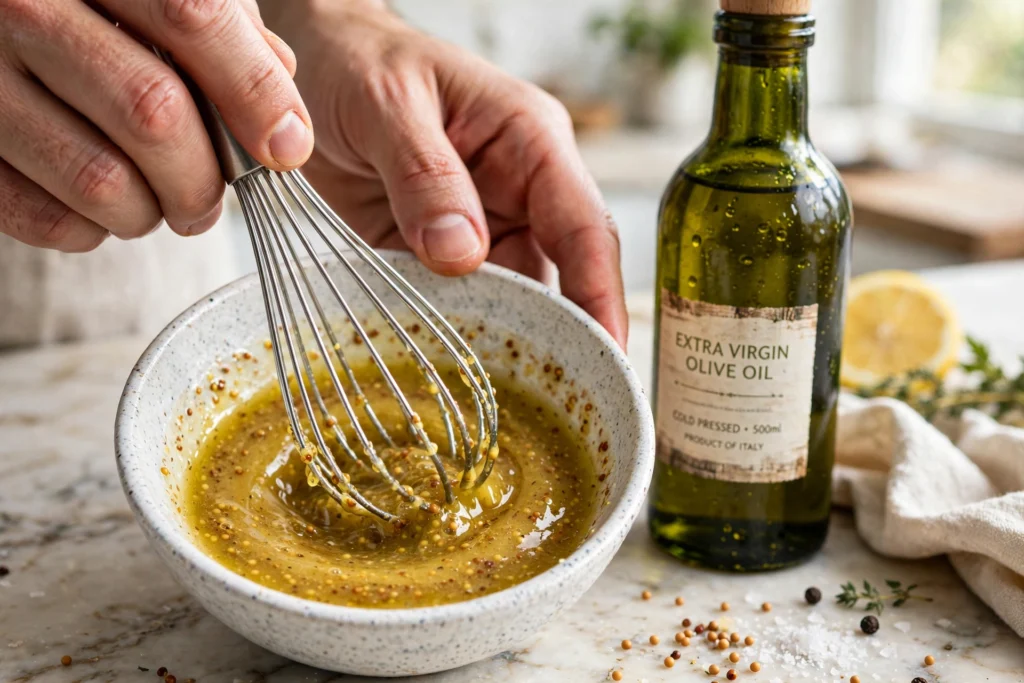
Step 1 — Combine everything except the oil. In your bowl or jar, add the vinegar, Dijon, honey, garlic, shallot (if using), salt, and pepper. Whisk or shake to combine. There’s a reason for this order: salt dissolves in acid (vinegar), not in oil. Dissolving the salt in the vinegar first means it distributes evenly throughout the dressing instead of sitting in gritty crystals. Same logic for the honey — it dissolves more easily in the vinegar base.
Step 2 — Add the oil slowly. If whisking: drizzle the olive oil in a slow, steady stream while whisking constantly. The slow addition is what creates a proper emulsion — dumping all the oil at once overwhelms the emulsifier and you get a separated, greasy mess. If using a jar: add all the oil, seal tightly, and shake vigorously for 30 seconds. The violent shaking breaks the oil into tiny enough droplets that the mustard can stabilize them even without slow drizzling. Both methods work; the jar is faster and the cleanup is nonexistent.
Step 3 — Taste and adjust. This is the step most people skip, and it’s the most important. Dip a lettuce leaf (not your finger, not a spoon — the leaf is the real test because dressing tastes different on greens than on your tongue) and taste critically. Too sharp? Add a drizzle more oil or another drop of honey. Flat? More salt or a splash more vinegar. Too thick? A teaspoon of water thins it without diluting flavor. Too garlicky? A bit more oil mellows it. This is where you develop your palate — trust it.
Step 4 — Rest 10 minutes, then serve. Letting it sit lets the garlic mellow (raw garlic’s harsh edge softens), the salt fully dissolve, and the flavors marry into something cohesive. Give it one final shake or whisk before dressing your salad — even a good emulsion settles slightly.
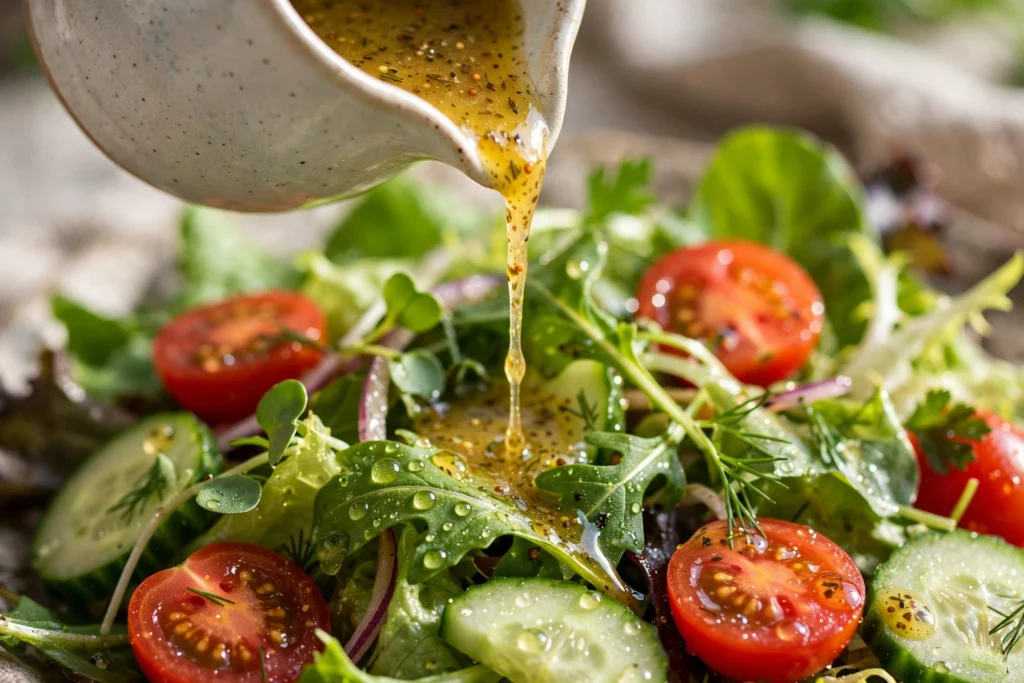
Step 5 — Dress properly. Use less than you think — start with half the amount you’d guess, toss thoroughly, then add more if needed. Every leaf should glisten; none should swim in a puddle at the bottom of the bowl. Overdressed salad is the #1 home-cook salad sin, and it’s irreversible. You can always add more dressing; you can never take it away.
Troubleshooting: Fixing Common Vinaigrette Problems
It separated immediately. You either skipped the mustard, added the oil too fast (when whisking), or didn’t shake hard enough. Fix: add another teaspoon of Dijon, then re-whisk or re-shake vigorously. The extra emulsifier plus mechanical action should bring it back together.
It tastes too acidic/harsh. Add oil a tablespoon at a time until it balances, or add another ½ teaspoon of honey. A pinch more salt also helps — salt suppresses sourness perception. If it’s still too sharp, you may have mismeasured the vinegar; next time, start with slightly less and add to taste.
It tastes flat or bland. Almost certainly needs more salt. Add ¼ teaspoon, shake, taste on a leaf. Repeat until it pops. If salt doesn’t fix it, it needs more acid — a teaspoon of vinegar or lemon juice.
The garlic is overpowering. Raw garlic intensifies over time, especially by day 2–3. For your current batch, dilute with more oil and vinegar (maintaining the 3:1 ratio). Next time, use half a clove, or grate it instead of mincing (grated distributes more evenly, so no single bite is a garlic bomb).
It’s too thick. Whisk in water a teaspoon at a time until it reaches the consistency you want. This is especially common with the creamy variations (yogurt, tahini) or if you were generous with the mustard.
The olive oil solidified in the fridge. Completely normal — olive oil firms up below about 50°F. It’s not spoiled. Let the jar sit at room temperature 15–20 minutes, then shake. It returns to liquid with no quality loss.
My Best Tips for Perfect Vinaigrette
The 3:1 ratio is your anchor. Three parts oil to one part acid. Too much vinegar = harsh and mouth-puckering; too much oil = greasy and flat. When in doubt, measure the first few times until your eye learns it. After a dozen batches, you’ll be able to eyeball it perfectly.
Mustard is non-negotiable. It’s doing structural work (emulsification), not just flavor work. A vinaigrette without mustard separates within minutes; with mustard, it holds for hours. Dijon is classic; whole-grain adds texture and visual appeal.
Taste on a leaf, not a spoon. Dressing tastes fundamentally different on greens than on your bare tongue. The leaf test tells you the truth about balance. Keep a piece of lettuce handy when you’re adjusting.
Room-temperature ingredients emulsify better. Cold oil is sluggish and doesn’t break into fine droplets as easily. If your olive oil lives in a cold pantry, let it warm up a few minutes first. Same for the mustard — cold mustard straight from the fridge is less effective.
Salt goes in the vinegar. Salt dissolves in acid, not oil. Adding it with the vinegar (before the oil) means no gritty salt crystals in your finished dressing. This small ordering detail makes a real textural difference.
Shake before every use. Even a well-emulsified vinaigrette settles over time — that’s just physics. A 10-second shake re-forms the emulsion instantly. Totally normal, not a sign of failure.
Make it yours. Once you understand the formula, start improvising. The ratio is the skeleton; the specific oil, acid, sweetener, and seasonings are the personality. Your perfect vinaigrette might use walnut oil and sherry vinegar with a touch of maple. There’s no wrong answer once the fundamentals are solid.
Delicious Variations to Try

Balsamic vinaigrette: Swap red wine vinegar for balsamic; keep everything else the same. Add a pinch of dried Italian herbs. The crowd-pleaser — slightly sweeter, deeply familiar. Use a decent balsamic; the cheap stuff is just colored vinegar.
Lemon vinaigrette: Swap vinegar for fresh lemon juice (¼ cup); add 1 teaspoon of lemon zest. Bright, fresh, perfect for spring salads and delicate greens. The zest adds aromatic oils that juice alone can’t provide.
Honey-mustard: Double the Dijon and honey. Sweet, tangy, amazing on chicken salads, grain bowls, and as a dipping sauce. Kids tend to love this one.
Asian-inspired: Swap olive oil for a blend (half toasted sesame oil, half neutral oil), vinegar for rice vinegar, honey for a touch of soy sauce, and add grated fresh ginger. Completely different flavor profile from the same technique.
Herb vinaigrette: Add ¼ cup of chopped fresh herbs (parsley, basil, chives, tarragon — whatever’s growing). Summer in a jar. Add the herbs after emulsifying so they stay bright green. Best used within a week.
Raspberry vinaigrette: Swap vinegar for raspberry vinegar (or mash ¼ cup fresh raspberries into red wine vinegar and strain through a fine mesh). Gorgeous pink color, fruity tang. Beautiful on spinach salads with goat cheese.
Creamy vinaigrette: Whisk in 2 tablespoons of Greek yogurt or sour cream after emulsifying. Richer, clings to greens beautifully. Adds protein and a pleasant tang.
Shallot-sherry: Use sherry vinegar instead of red wine, double the shallot. Sophisticated, nutty, wonderful on bitter greens like frisée or radicchio.
Spicy vinaigrette: Add ¼ teaspoon of red pepper flakes or a minced Calabrian chile to the base. The heat builds slowly and pairs beautifully with rich ingredients like avocado or bacon.
Also Read : Crispy Potato Skins Recipe (Better Than the Restaurant)
Choosing Your Oil: A Practical Guide
The oil is three-quarters of your vinaigrette, so it deserves some thought. But “thought” doesn’t mean “anxiety” — here’s a straightforward breakdown of what works and why.
Extra-virgin olive oil is the default for good reason: it has flavor (fruity, peppery, complex), it’s widely available, and it’s the traditional choice. Within EVOO there’s a spectrum — mild, buttery oils (often Spanish) make gentle dressings; bold, peppery oils (often Tuscan or Greek) make assertive ones. For everyday vinaigrette, a solid mid-range bottle is perfect. Save the $30 bottle for finishing, not emulsifying.
Avocado oil is the best neutral option — buttery, mild, high in monounsaturated fats. Use it when you want the other ingredients (herbs, mustard, a fancy vinegar) to be the star. It’s also great for people who find olive oil too assertive.
Walnut oil is a secret weapon for fall and winter salads. Rich, nutty, almost creamy — it’s transformative on salads with pears, blue cheese, or roasted squash. It’s delicate and goes rancid faster than other oils, so buy small bottles and use within a couple months of opening.
Grapeseed oil is light, clean, and truly neutral. Good when you want the vinegar or add-ins to dominate. It’s also inexpensive, making it practical for large batches.
Toasted sesame oil is intensely flavored — a little goes a long way. Use it as an accent (a tablespoon in an otherwise neutral base) rather than the main oil, unless you’re specifically making an Asian-style dressing.
The practical rule: match the oil’s intensity to the salad’s intensity. Delicate butter lettuce wants a mild oil; hearty kale or radicchio can handle (and needs) a bold one.
Choosing Your Acid: Beyond Red Wine Vinegar
If oil is the body of vinaigrette, acid is the personality. Red wine vinegar is the reliable default, but the acid you choose dramatically changes the dressing’s character.
Red wine vinegar: Balanced, versatile, the classic. Works with everything. Your starting point.
White wine vinegar: Lighter and more delicate than red wine vinegar. Better for pale dressings where you don’t want color, and for delicate greens.
Sherry vinegar: Nutty, complex, slightly sweet. My personal favorite for sophisticated salads — it has a depth that regular wine vinegars lack. Particularly good with bitter greens, nuts, and aged cheeses.
Balsamic vinegar: Sweet, syrupy, familiar. The crowd-pleaser. Traditional balsamic is aged and expensive; the everyday stuff is fine for vinaigrette. Note that it darkens the dressing significantly.
Apple cider vinegar: Fruity, slightly sweet, with a farmhouse character. Great for fall salads, coleslaw-style dressings, and anything with apples or pork.
Rice vinegar: Mild, slightly sweet, clean. The go-to for Asian-inspired dressings. Unseasoned rice vinegar is what you want (seasoned has added sugar and salt).
Fresh citrus juice: Lemon, lime, orange, grapefruit — each brings its own character. Citrus-based vinaigrettes taste brighter and fresher than vinegar-based ones but don’t keep quite as long (about a week). Always use fresh-squeezed; bottled citrus juice tastes flat and slightly metallic.
You can also combine acids — a splash of lemon juice plus red wine vinegar, for instance. Once you understand the 3:1 framework, the acid becomes your creative playground.
Storing, Meal Prep & Make-Ahead

Refrigerator: 2 weeks in a sealed jar. The vinegar and salt are natural preservatives. Olive oil may solidify when cold — totally normal, not spoilage. Let it sit at room temperature 15 minutes and shake vigorously.
Freezer: Don’t bother — it takes 5 minutes fresh, and freezing damages the emulsion irreparably. There’s no good reason to freeze vinaigrette.
Make-ahead strategy: This IS a make-ahead recipe. Make a jar on Sunday; it covers salads all week. The garlic mellows beautifully by day 2–3, and the flavors actually improve as they marry. Keep a “house vinaigrette” in the fridge at all times and weeknight salads become effortless.
Batch scaling: The recipe doubles and triples perfectly — just maintain the 3:1 ratio. For large batches, a blender creates the most stable emulsion. A quart jar of vinaigrette covers roughly 8–10 large salads.
What to watch for: If it smells off, looks cloudy in a new way, or the garlic turns blue-green (a harmless chemical reaction, but unappetizing), make a fresh batch. When in doubt, throw it out — it takes 5 minutes to remake.
What to Serve with Vinaigrette (Beyond Salad)
Beyond the obvious green salads: drizzle over grain bowls (farro, quinoa, rice bowls all love vinaigrette), roasted vegetables (especially roasted beets, carrots, and Brussels sprouts – the acid cuts through caramelized sweetness), grilled chicken or fish, caprese salad, bean salads, lentil salads, or even as a bread dip with crusty bread.
As a marinade: use it for chicken (30 minutes to 2 hours), pork tenderloin, or vegetables before grilling. The acid tenderizes and the oil carries flavor. Don’t marinate fish longer than 20 minutes — the acid will start to “cook” it (like ceviche).
As a finishing sauce: spoon over grilled steaks, roasted potatoes, or steamed artichokes. A bright vinaigrette can rescue a rich, heavy dish by cutting through the fat.
Creative uses: toss with warm pasta for an instant pasta salad, drizzle over avocado toast, use as a base for coleslaw instead of mayo, or whisk into pan sauces for brightness.
Troubleshooting: Fixing Broken or Boring Vinaigrette
Vinaigrette is simple, but simple doesn’t mean foolproof. Here’s how to fix the most common problems.
Problem: The vinaigrette separated — oil floating on top, vinegar on the bottom. This is normal; vinaigrettes are temporary emulsions, not permanent ones. The fix is mechanical: whisk vigorously right before serving, or shake in a sealed jar for 10 seconds. For a more stable emulsion that holds for hours, add 1 teaspoon of Dijon mustard — the mucilage in mustard seeds is a powerful emulsifier that keeps oil and vinegar suspended together far longer. A teaspoon of honey or maple syrup helps too (sugar increases viscosity, which slows separation). For a nearly permanent emulsion, use an immersion blender for 30 seconds — the tiny droplet size it creates stays suspended much longer than hand-whisked. But honestly? A quick shake before serving is the traditional method, and it works fine. Don’t overthink it.
Problem: It tastes too sharp or acidic. Too much vinegar, or vinegar that’s too aggressive. Fix it by whisking in more oil, a tablespoon at a time, until the balance feels right. Or add 1-2 teaspoons of honey, maple syrup, or sugar — sweetness rounds out acidity without diluting flavor the way extra oil does. A pinch of salt also suppresses sourness perception (salt and sour are antagonistic tastes). For future batches, remember the classic ratio is 3 parts oil to 1 part vinegar, but that’s a starting point, not a law — delicate vinegars (champagne, rice wine) can go 2:1, while aggressive ones (distilled white) might need 4:1.
Problem: It tastes flat or bland. Almost certainly under-salted or under-acidified. Salt is the most common missing ingredient in homemade vinaigrette — commercial dressings are saltier than you think. Add salt in small pinches, whisking and tasting, until the flavors pop. If it’s salty enough but still boring, it needs more acid (a squeeze of lemon, a splash of vinegar) or an aromatic boost (minced shallot, garlic, fresh herbs, a pinch of red pepper flakes). Bland vinaigrette is almost never an oil problem; it’s a seasoning problem.
Problem: The garlic tastes harsh and raw. Raw garlic in an uncooked dressing can be aggressive, especially if it sits. Fix it by mincing the garlic finer (smaller pieces distribute more evenly and taste less harsh in any single bite), or tame it in advance: let the minced garlic sit in the vinegar for 10 minutes before whisking in the oil. The acid mellows the raw bite significantly. For the mildest garlic flavor, use a microplane to grate it into a paste — it distributes so evenly you get garlic flavor without garlic chunks.
Problem: It solidified in the fridge. Olive oil firms up when cold — this is normal and not a problem. Let the jar sit at room temperature for 10-15 minutes, then shake vigorously. It will return to liquid. If you’re in a hurry, run the sealed jar under warm (not hot) water for a minute. Don’t microwave it you’ll overheat spots and damage the fresh flavors.
Also Read: Bechamel Sauce Recipe (Silky, Lump-Free & Foolproof)
Oil & Vinegar Selection: A Practical Buying Guide
The quality of your vinaigrette is the quality of your oil and vinegar. You don’t need the most expensive bottles, but you do need to understand what you’re buying.
Olive oil: Extra-virgin is the right choice for vinaigrette — its fruity, peppery flavor is the backbone of the dressing. But not all extra-virgin is equal. For everyday vinaigrette, a decent mid-range bottle ($10-15) is perfect. Save the $30 estate-bottled oil for finishing dishes where you’ll taste it undiluted. Avoid “light” olive oil (it’s refined, neutral, and pointless in a dressing) and avoid anything labeled just “olive oil” without “extra virgin” (it’s a blend of refined and virgin oils). Store olive oil away from heat and light — the cabinet next to the stove is the worst spot in your kitchen. A cool, dark pantry keeps it fresh for months; a hot, bright countertop kills it in weeks.
Vinegar selection: This is where you customize. Red wine vinegar is the all-purpose workhorse — bold enough for hearty salads, not so aggressive it overwhelms. White wine vinegar is milder and lighter in color (won’t tint your greens). Champagne vinegar is the most delicate and elegant — my choice for butter lettuce and fine herbs. Sherry vinegar has a nutty, complex depth that’s incredible with roasted vegetables and grain salads. Apple cider vinegar brings fruity tang and works beautifully in autumn salads. Balsamic is the outlier — sweet, syrupy, and assertive; use it when you want the vinegar to be a co-star, not a background player. Rice vinegar is the mildest of all, ideal for Asian-inspired salads. Keep 2-3 types on hand and you’ll always have the right one.
What about lemon juice? Fresh lemon juice can replace some or all of the vinegar for a brighter, fresher vinaigrette. It’s less stable (the flavor fades faster), so lemon vinaigrettes are best made fresh and used within a day. The general rule: 3 tablespoons of lemon juice replaces 2 tablespoons of vinegar (lemon is less acidic, so you need more).
Batch Prep & Storage: Vinaigrette for the Whole Week
The weekly jar: Make a double or triple batch on Sunday — it takes 5 minutes — and keep it in a mason jar in the fridge. A basic vinaigrette (oil, vinegar, mustard, salt, pepper, garlic) keeps beautifully for 2 weeks. The flavor actually improves over the first 24 hours as the garlic and seasonings meld. Shake well before each use.
What keeps and what doesn’t: The base emulsion (oil + vinegar + mustard + salt + dried seasonings) is nearly indestructible — 2-3 weeks refrigerated. Fresh herbs are the limiting factor: basil, cilantro, and parsley start to darken and lose vibrancy after 3-4 days. If you want herby vinaigrette all week, make the base in bulk and stir in fresh herbs in small daily portions. Fresh garlic is fine for a week but gets stronger over time — if making a big batch, use slightly less garlic than you think you need.
Portioning for lunches: Keep dressing separate from greens until serving — this is the golden rule of packed salads. Use small leakproof containers (2-oz condiment cups are perfect) for individual portions. A salad dressed at noon tastes infinitely better than one dressed at 7 AM and left to wilt.
Freezing: Don’t freeze vinaigrette. The emulsion breaks completely, fresh herbs turn to mush, and the texture never fully recovers. It’s a 5-minute recipe — just make it fresh. If you must prep far ahead, freeze only the vinegar-mustard-seasoning base (no oil, no fresh herbs), then whisk in oil after thawing.
Beyond Salad: 10 Unexpected Uses for Vinaigrette
A good vinaigrette is too useful to limit to lettuce. Here are the ways I use it that have nothing to do with salad.
- Grain bowls: Drizzle over farro, quinoa, or rice bowls — it ties the whole bowl together the way it does a salad.
- Roasted vegetables: Toss hot roasted vegetables with vinaigrette straight from the oven; they absorb it like a sponge.
- Marinade: The acid tenderizes — marinate chicken, pork, or firm tofu for 30 minutes to 4 hours.
- Bean salads: White beans, chickpeas, or lentils dressed while warm absorb maximum flavour.
- Grilled meats: Spoon over sliced steak or grilled chicken as a bright finishing sauce.
- Sandwich spread: A thick vinaigrette (extra mustard) on crusty bread instead of mayo.
- Coleslaw: Lighter and brighter than mayo-based slaw.
- Pasta salad: Dress warm pasta so it absorbs the flavour.
- Dipping sauce: For crusty bread, artichokes, or grilled shrimp.
- Sautéed greens: A splash at the end of cooking kale or spinach brightens the whole pan.
Also Read : Perfect Pan-Seared Scallops Recipe (Golden Crust Every Time)
Final Thoughts
Learning to make vinaigrette is one of those small kitchen skills that quietly changes everything. Salads stop being sad diet food and start being something you actually crave. Weeknight vegetables get interesting. Grain bowls come together in minutes.
And there’s something deeply satisfying about the self-sufficiency of it — opening the fridge, grabbing YOUR jar of dressing, knowing exactly what’s in it because you put it there. No label-reading, no $6 bottles, no compromises. Just oil, vinegar, mustard, and confidence.
So memorize the ratio: 3 parts oil, 1 part vinegar, a spoonful of mustard, salt, and something sweet. That’s it. That’s the whole thing. Your salads will thank you forever.
One last thought: the best vinaigrette is the one you actually make. Don’t wait for the perfect olive oil or the ideal vinegar. Start with what you have, learn the ratio, and refine from there. A decent homemade vinaigrette beats the finest bottled dressing every single time — because it’s yours, it’s fresh, and it took you five minutes.

Perfect Everyday Vinaigrette (3:1 Ratio)
Ingredients
Equipment
Method
- Combine the vinegar, Dijon, honey, garlic, shallot, salt and pepper in a small bowl or mason jar.
- Drizzle in the olive oil while whisking, or seal the jar and shake for 30 seconds until emulsified.
- Taste on a lettuce leaf; adjust salt, honey or vinegar to your liking.
- Rest 10 minutes so the flavours meld, then shake or whisk before serving.
- Toss with salad using less than you think you need; add more as needed.
Notes
Frequently Asked Questions
What is the classic ratio for vinaigrette?
Three parts oil to one part vinegar, plus an emulsifier such as Dijon mustard, salt and a touch of sweetness. This 3:1 balance gives richness from the oil and brightness from the acid. Once you memorise it, you can make vinaigrette without measuring.
Why does my vinaigrette separate?
Separation is completely normal because oil and vinegar do not naturally mix; vinaigrette is a temporary emulsion. Whisking or shaking breaks the oil into tiny droplets that stay suspended for a while. Adding Dijon mustard and shaking before every use keeps it together much longer.
Can I make vinaigrette without mustard?
You can, but the dressing will separate far more quickly because mustard is the emulsifier holding oil and vinegar together. Honey, garlic and salt help a little, but nothing works as well as a spoonful of Dijon. If you must skip it, shake the jar hard right before serving.
How long does homemade vinaigrette keep?
It keeps for up to two weeks in a sealed jar in the fridge, thanks to the preserving power of vinegar and salt. The flavour is best in the first week, as fresh garlic mellows and then intensifies over time. Always give it a good shake before using.
Why has the olive oil solidified in the fridge?
Olive oil firms up below about 10°C, so solidifying in a cold fridge is completely normal and not a sign of spoilage. Simply leave the jar at room temperature for 10 to 15 minutes, then shake vigorously. It will return to liquid with no harm done.
Can I use a different oil instead of olive oil?
Absolutely. Avocado oil is the best neutral choice, walnut oil adds richness for autumn salads, and grapeseed oil lets the vinegar shine. Just match the oil’s intensity to your salad: delicate leaves suit mild oils, hearty greens can take bolder ones.
Is homemade vinaigrette healthier than bottled dressing?
Generally yes, because you control every ingredient: no preservatives, stabilisers, added sugars or refined oils. You choose a good olive oil and season to taste. The result is fresher and usually lower in additives than anything shelf-stable.
Can I make vinaigrette in a blender?
Yes, and a blender or immersion blender makes an exceptionally stable emulsion thanks to the tiny droplet size it creates. It is ideal for large batches. For a single jar, though, shaking is quicker and means less washing up.
What is the difference between vinaigrette and salad dressing?
Vinaigrette is a specific type of salad dressing made from oil and an acid such as vinegar or citrus juice, usually with mustard and seasoning. Salad dressing is the broader category, which also includes creamy styles like ranch or Caesar. All vinaigrettes are dressings, but not all dressings are vinaigrettes.
How much vinaigrette should I use per salad?
Use less than you think: start with about one tablespoon per generous handful of leaves, toss thoroughly, then add more if needed. It is easy to add dressing but impossible to remove it. Well-tossed leaves should glisten, not swim.
Can I use lemon juice instead of vinegar?
Yes. Fresh lemon juice can replace some or all of the vinegar for a brighter, fresher vinaigrette. Citrus-based versions taste especially good on delicate greens and fish. Use the same 3:1 ratio of oil to lemon juice.
Why does my vinaigrette taste bitter?
Bitterness usually comes from the olive oil itself, as some extra-virgin oils have a naturally peppery, bitter edge. It can also mean the dressing needs more salt or a touch more honey to balance. Taste on a lettuce leaf and adjust before adding more.

Hi, I’m Angela. I cook the way busy people actually cook — simple, tasty food with ingredients you already have. On CookBookBite I share easy recipes, honest kitchen tips, and dishes my family asks for again and again.
Pingback: Classic Borscht Recipe for 10 – Rich, Ruby-Red & Satisfying